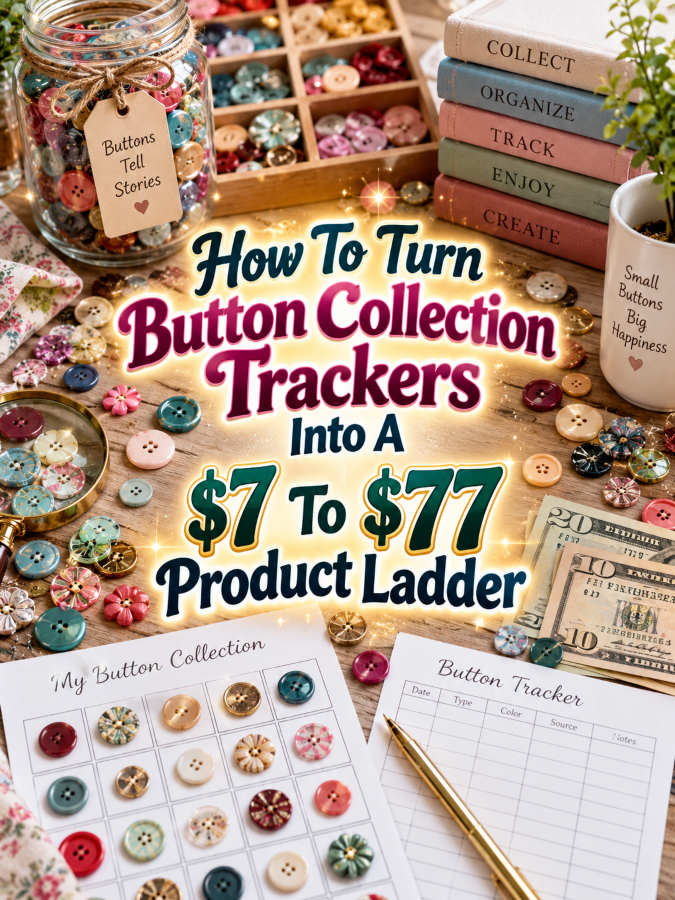
Button collectors know how innocent this hobby can look at the beginning. You find a few pretty vintage buttons, maybe tuck them into a little dish, and think, “Oh, these are cute.” Then you find another handful at a flea market. Then someone gives you a tin. Then you discover a box of old buttons at an estate sale and suddenly your “little collection” needs categories, storage, labels, notes, and possibly its own zip code.
That growing collection is exactly where a button collection tracker can become useful. Collectors want to know what they own, where they found it, what it looks like, how old it might be, whether they have duplicates, and which pieces still need research. A thoughtfully designed tracker can turn that information into a simple digital product that solves a real organizational problem.
And you don’t need to create a giant course or a 400-page button encyclopedia wearing a business hat. You can start with one useful tracker at $7, expand it into a better organizing kit, build a complete collection management bundle, and then create a premium editable package at $67 to $77. The important part is that every price jump adds usefulness, not fluff. That’s the whole game.
Quick Answer
A $7 to $77 button collection tracker ladder can begin with a simple printable inventory tracker and grow into a complete collection management system. The $7 version should solve one small problem quickly, while the $17 to $27 version adds more templates and guidance, the $37 to $47 version creates a complete working bundle, and the $67 to $77 version adds editable assets, customization options, promotional materials, or commercial-use features where appropriate.
The key is to make each level genuinely more useful. A collector who only wants to record a few buttons shouldn’t have to buy a giant system. At the same time, a serious collector may happily pay more for a polished system that helps organize hundreds of pieces without making them dig through three notebooks and a suspiciously overflowing cookie tin.
Why Button Collection Trackers Work As A Product Ladder
Button collecting creates a natural organizational problem. A collector may want to record the button’s material, color, size, shape, design, markings, approximate age, source, purchase date, price paid, and current location. Once a collection grows beyond a small handful, remembering all of that becomes difficult, especially when similar-looking buttons start multiplying.
That gives you several different buyer needs to work with. A beginner may only want a simple inventory sheet. A more serious collector may want separate pages for research notes, duplicates, purchases, storage locations, and wish-list items. Someone building a collection around vintage clothing, sewing history, military buttons, novelty buttons, or other specialized categories may want a tracker designed specifically around that type of collection.
The ladder works because different buyers value different levels of organization. Some people want a quick printable. Others want a system that helps them actually manage the hobby. And some buyers will pay more for editable templates because they want to customize the system, brand it for their own audience, or adapt it into another related product.
A good button collection tracker can help answer questions such as:
- What buttons do I already own?
- Where did I find or purchase this button?
- How much did I pay for it?
- What size, material, color, or style is it?
- Does it have markings or identifying information?
- Where is the button stored?
- Do I have duplicates?
- Which buttons still need research?
- What pieces am I looking for next?
- Which parts of my collection are especially meaningful?
That is a much stronger product foundation than simply making a pretty page with the words “My Button Collection” at the top.
The Reasonable Pricing Rule For Button Collection Products
The simplest way to build this ladder is to match the price to the amount of help the buyer receives. The template’s core pricing guidance is straightforward: $7 is for a quick win, $17 to $27 is for a stronger kit, $37 to $47 is for a working bundle, and $67 to $77 is for a premium offer with substantially more value.
At $7, you’re not trying to create the ultimate button collecting command center. You’re giving the buyer one useful solution they can open, print, and use right away. At $17 to $27, you’re adding more examples, more templates, and better instructions. At $37 to $47, you’re giving them a system that helps them manage more of the hobby without starting from scratch.
The $67 to $77 version needs a stronger reason to exist. That could mean editable Canva templates, editable documents, finished PDFs, customization guidance, promotional assets, commercial-use features, or carefully defined resale or PLR rights when they genuinely make sense. The important point is that the premium product isn’t expensive because you added another 100 pages. It’s expensive because you’ve saved the buyer time and made the next step easier.
And here’s a rule worth keeping taped to your monitor: if the product doesn’t honestly support $77, don’t force it to. A strong $47 product is better than a $77 product that feels like somebody put a bow on a thin PDF and called it premium.
The $7 Starter Product: Button Collection Inventory Tracker
The easiest place to begin is a focused Button Collection Inventory Tracker. This product should help collectors record the basic details of individual buttons without overwhelming them with a giant database. Think of it as the “finally, I know what I own” product.
The tracker could include printable inventory pages with fields for button name or description, collection category, color, material, size, markings, estimated age, source, date acquired, price paid, storage location, and notes. You could also include a simple duplicate checkbox and a small space for a photo or sketch. That gives the buyer a practical way to document the collection without requiring a master’s degree in Buttonology.
$7 feels reasonable because the buyer gets a quick win. They can download the tracker, print it, and immediately start cataloging. Don’t add research guides, resale materials, elaborate storage systems, or dozens of specialized templates yet. Save those additions for the next rung of the ladder.
- Button inventory sheets
- Basic collection categories
- Button description fields
- Acquisition information
- Storage location field
- Duplicate tracking
- Notes section
- Simple collection summary page
The goal is simple: make the $7 product easy to understand and easy to use. A buyer should be able to look at the product preview and immediately know what problem it solves.
The $17 To $27 Expanded Kit: Button Collection Organization Toolkit
Once you have the starter tracker, the next step is to help collectors manage more than basic inventory. This is where you can turn the original tracker into a Button Collection Organization Toolkit priced around $17 to $27.
Now you’re helping the buyer organize the collection more completely. Add pages for acquisition logs, duplicate buttons, buttons needing research, favorite pieces, collection themes, storage locations, wish-list items, and collection goals. You can also include different tracker layouts so buyers can choose the format that works best for their collection.
The kit becomes more valuable because it helps the collector actually use the information. Add short instructions explaining how to photograph buttons, how to create consistent descriptions, how to organize categories, and how to keep the tracker updated. A before-and-after example can also show what a messy collection record looks like before organization and how much easier it becomes after using the system.
- Everything from the $7 tracker
- Multiple inventory layouts
- Acquisition log
- Duplicate tracker
- Research-needed tracker
- Collection wish list
- Storage location pages
- Favorite or featured button pages
- Collection goals worksheet
- Button photography checklist
- Organization instructions
- Sample completed pages
This is where the buyer should think, “Oh, this actually helps me manage the hobby.” That’s the value difference you’re looking for.
The $37 To $47 Working Bundle: Complete Button Collection Planner
The $37 to $47 level should feel like a complete working system rather than a larger stack of worksheets. A strong name could be The Complete Button Collection Planner and Cataloging Bundle. This version can bring inventory, organization, research, storage, collecting goals, and collection planning together in one place.
At this level, you’re helping serious collectors save time. Instead of figuring out how to create their own system, they receive a ready-made structure they can start using immediately. The bundle can include a main guide, workbook pages, trackers, collection planning sheets, research worksheets, storage maps, wish lists, purchase logs, and troubleshooting tips for keeping the system manageable as the collection grows.
You can also add practical bonus materials such as button identification prompts, collection review checklists, printable category labels, and a QuickStart plan. The template specifically recommends implementation-focused additions such as guides, workbooks, prompts, templates, launch checklists, use cases, and troubleshooting sections at this level.
- Complete collection catalog
- Collection planning workbook
- Purchase and acquisition log
- Duplicate tracker
- Research worksheet
- Storage planning pages
- Wish-list tracker
- Collection goals
- Button identification notes
- Printable category labels
- QuickStart setup guide
- Collection review checklist
This isn’t supposed to be a refrigerator-sized business university. It’s a practical bundle that helps a button collector get organized faster.
The $67 To $77 Premium Editable Button Collection Kit
The premium version can move beyond “something to print” and become an Editable Button Collection Management Kit. This is especially useful if your customer is a collector who wants to customize the system or a digital product seller who wants a flexible starting point for creating a niche-specific collection product.
The premium package could include editable Canva versions of the tracker pages, editable Google Docs or Word files, finished PDF versions, customization instructions, mockup ideas, product description copy, short promotional posts, and a setup checklist. If you offer commercial use, resale, or PLR rights, the license needs to clearly explain what buyers can and cannot do with the files.
This version earns its higher price by reducing work. Instead of making every page from scratch, the buyer gets a flexible system they can personalize. The template makes the same point clearly: the $77 version should cost more because it provides editable assets, saves time, supports customization or selling when appropriate, and makes implementation easier, not simply because it contains more pages.
- Everything from the lower tiers
- Editable Canva templates
- Editable Word or Google Docs files
- Finished printable PDFs
- Customization guide
- Product packaging guide
- Sales page copy starter
- Short promotional email ideas
- Social media promo copy
- Mockup ideas
- Setup checklist
- Commercial-use option where appropriate
- Clearly written license terms
- Resale or PLR option only when appropriate
If resale rights don’t make sense for the particular product, simply position this as a premium editable implementation kit. That’s still valuable.
Example $7 To $77 Button Collection Product Ladder
Now let’s put the whole thing together. The ladder should feel like a natural progression, where each buyer can choose the amount of help they actually need. Someone who only wants to catalog buttons can stop at $7, while a serious collector or product creator can move into the higher tiers.
- $7 Starter: Button Collection Inventory Tracker with basic cataloging and notes pages.
- $17 to $27 Kit: Button Collection Organization Toolkit with inventory, purchases, duplicates, research, storage, wish lists, and examples.
- $37 to $47 Bundle: Complete Button Collection Planner with a full cataloging and collection-management system.
- $67 to $77 Premium: Editable Button Collection Management Kit with Canva files, editable documents, finished PDFs, customization help, promotional assets, and appropriate licensing options.
The pricing makes sense because the buyer isn’t paying for four versions of the same tracker. They’re paying for increasingly complete solutions. The $7 version solves one problem. The middle tiers solve a wider organizational problem. The premium version saves the buyer even more time by giving them editable assets and a clearer path to customization or commercial use.
That distinction matters. More pages aren’t automatically more valuable. A 25-page product that helps someone finish a task can be far more useful than a 100-page product that mostly says the same thing 100 different ways.
Tools You Can Use To Create The Button Collection Ladder
You don’t need a complicated technology stack to create this product ladder. In fact, keeping the creation process simple can make the whole idea much more manageable. Your goal is to create attractive, functional files first, then build the selling and promotional pieces around them.
Canva is especially useful for creating printable tracker pages, editable templates, covers, labels, worksheets, and product mockups. Google Docs can work well for editable instruction guides, while Google Sheets can give collectors a digital inventory option.
For selling, Payhip or Gumroad can provide a simple place to deliver the files. ChatGPT can also help brainstorm categories, product variations, worksheet questions, instructions, descriptions, and promotional copy. Don’t use every tool just because it’s available. Pick the ones that make the actual product easier to create and use.
- Canva – printable designs and editable templates
- Google Docs – editable guides and worksheets
- Google Sheets – digital inventory trackers
- ChatGPT – brainstorming, prompts, instructions, and copy support
- Payhip – digital product delivery
- Gumroad – simple digital product sales
How To Know If Your Button Tracker Price Is Fair
Before publishing any version, step back and look at it from the buyer’s side. Would the product save them time? Would it help them organize something they have been putting off? Can they understand how to use it without sending you six messages asking where to start?
Higher pricing becomes easier to justify when the product helps the buyer finish faster, avoid mistakes, customize the files, or use the finished result in a meaningful way. That’s why an editable premium kit can reasonably cost much more than a simple printable tracker.
Ask yourself these questions before setting the price:
- Does this product solve a clear problem?
- Does it save the buyer time?
- Does it help them organize or finish something?
- Are the instructions clear?
- Are examples included where they’re useful?
- Does the product become more useful at the next price level?
- Are editable files included when the premium price depends on them?
- Would I feel good buying this product at this price?
If the answer to several of those questions is “not really,” don’t raise the price. Improve the product first.
5-Step Action Plan For Building Your Button Collection Ladder
You don’t have to create all four levels at once. That’s one of the easiest ways to turn a fun product idea into a giant unfinished project sitting quietly on your hard drive judging you.
Build the smallest useful version first. Then let the buyer’s needs tell you what deserves to be added next.
Step 1: Pick One Buyer Problem
Start by choosing one clear problem that button collectors actually have. “Helping people enjoy buttons” is too broad. “Helping collectors keep track of which buttons they own and where they’re stored” is much stronger.
Write down the exact result your first product will provide. If the buyer can look at the product and immediately understand what it will help them do, you’ve got a much better starting point.
Step 2: Create The $7 Quick Win
Create the simplest useful button inventory tracker you can. Include only the fields that help the buyer record and manage their collection.
Test it yourself before selling it. Print it. Fill it out. Try recording several different buttons. If something feels awkward during your own test, fix it before asking customers to wrestle with it.
Step 3: Expand It Into A Kit
Take the questions that aren’t answered by the $7 tracker and turn those needs into additional worksheets. Add duplicate tracking, research pages, storage planning, wish lists, purchase logs, and collection goals.
This gives you the natural foundation for the $17 to $27 tier. You’re not inventing a completely new product. You’re solving more of the same buyer’s problem.
Step 4: Build The Premium Version
For the $37 to $47 level, organize everything into a complete working system. Then decide what would genuinely save a premium buyer even more time.
That could be editable Canva templates, editable documents, finished PDFs, promotional copy, customization instructions, or appropriate commercial-use features. Add only what supports the buyer’s next step.
Step 5: Test The Ladder
Look at all four levels side by side. Can you immediately explain why someone would choose $7 instead of $27? Can you explain why the $77 version is worth paying more for?
If the answers sound almost identical, your ladder needs work. Each level should have a clear job, a clear buyer benefit, and a clear reason for the next price increase.
Common Pricing Mistakes To Avoid
The biggest mistake is charging $77 for something that still feels like a $7 printable. Buyers can tell when a product has been stretched instead of improved. Adding another 40 pages of nearly identical inventory sheets isn’t the same thing as adding value.
Another common mistake is making every tier so similar that the buyer can’t see why they should upgrade. The template specifically warns against adding pages instead of usefulness, making every version too similar, forgetting editable files at the premium level, and using unclear resale terms.
Keep the ladder simple. A buyer shouldn’t need a flowchart, calculator, and magnifying glass to understand what they’re purchasing.
- Charging $77 for a thin PDF: Add meaningful implementation value before raising the price.
- Adding pages instead of usefulness: Ask what new problem each addition solves.
- Making every tier too similar: Give each level a distinct purpose.
- Offering unclear resale rights: Use clear license terms and only offer rights you actually intend to grant.
- Forgetting editable files: Include editable assets if the premium price depends on customization.
- Using income promises: Focus on the product’s usefulness instead of promising buyers they will make money.
- Making the ladder confusing: Keep the differences between tiers obvious.
Where To Find Buyers For Button Collection Trackers
Your first buyers are likely to come from people who already understand the problem. That means collectors, sewing enthusiasts, vintage lovers, craft communities, textile-history enthusiasts, and people interested in organizing collections can all be potential audiences.
Etsy can be useful for testing demand for printable and digital organization products. Pinterest can help you reach people searching for collection organization ideas, while niche communities can provide useful clues about the problems collectors repeatedly discuss.
Don’t walk into every group shouting, “BUY MY BUTTON TRACKER!” That’s not a marketing strategy. That’s how you become the thundering herd nobody wants to invite back. Instead, pay attention to the questions people ask, create useful content around those problems, and make your product the natural next step.
- Etsy search and marketplace listings
- Pinterest search and idea pins
- Collector communities
- Sewing and textile-history communities
- Vintage collecting groups
- Craft blogs and niche websites
- Your own email list
- Short-form social content about collection organization
Affiliate Opportunities Around Button Collecting
A button collection tracker can also connect naturally to affiliate content because collectors need physical supplies to organize and preserve their collections. Storage boxes, small containers, labels, magnifying tools, photography equipment, display supplies, and craft organization products can all become related content topics.
The important part is relevance. Don’t recommend random products just because an affiliate program exists. Build useful content around the actual collection process and recommend tools that solve a problem the reader has already identified.
You can create supporting articles such as “How To Organize A Vintage Button Collection,” “Button Storage Ideas For Small Collections,” or “What To Record When Cataloging Vintage Buttons.” Those articles can naturally introduce related supplies while also leading readers toward your tracker.
- Button storage and organization supplies
- Small compartment containers
- Labels and labeling tools
- Magnifying tools
- Photography accessories
- Display materials
- Craft organization supplies
- Archival storage products
Internal Links To Build Around This Product
One button tracker article shouldn’t have to do all the selling by itself. Build a small content cluster around the same audience and connect the articles together. This helps readers move from learning about collection organization to seeing why a tracker would make their lives easier.
For example, an article about button storage can point readers toward your button collection tracker. A post about photographing collectibles can lead to a cataloging guide. A post about organizing vintage craft supplies can introduce the broader collection-management idea.
The goal is to create a helpful little ecosystem instead of one lonely blog post standing in the corner waving at Google.
- How To Organize A Vintage Button Collection
- Button Storage Ideas For Collectors
- How To Photograph Small Collectibles
- How To Catalog Vintage Sewing Items
- Printable Collection Trackers For Hobbyists
- How To Create A Collection Inventory
Simple Pinterest Ideas For Button Collection Trackers
Pinterest is a natural fit for collection organization because the product is visual. Show the tracker in use, display a few attractive button examples, and make the organizational transformation obvious. The viewer should be able to understand the benefit before reading the entire pin.
Use different pin angles rather than creating 20 nearly identical graphics. One pin can focus on organizing a vintage button collection, another can focus on tracking purchases, and another can show how a collector can document individual buttons.
Keep the promise realistic and specific. “Organize Your Button Collection” is much stronger than something vague like “Change Your Hobby Forever.” We’re organizing buttons here, not opening a portal to another dimension.
- “How To Organize A Button Collection”
- “Printable Button Collection Tracker”
- “Vintage Button Inventory Sheet”
- “Button Storage And Cataloging Ideas”
- “How To Keep Track Of Your Button Collection”
- “Button Collector Organization System”
- “Printable Hobby Collection Planner”
- “Button Collection Wish List Template”
Frequently Asked Questions About Button Collection Trackers
Collectors can have very different needs, so your FAQ should remove uncertainty before they buy. The best questions are the ones that help a buyer understand what the tracker does, who it’s for, and which version they actually need.
Keep the answers practical. You’re not trying to make the product sound bigger than it is. You’re helping the right buyer recognize that the product fits their needs.
What should a button collection tracker include?
A useful tracker can include fields for the button’s description, color, material, size, markings, estimated age, acquisition source, date acquired, price paid, storage location, and notes. More advanced versions can add research pages, duplicate tracking, wish lists, collection goals, purchase logs, and storage planning.
Can I sell a button collection tracker for $7?
Yes. A simple tracker can work well as a $7 quick-win product when it solves one clear organizational problem. The important thing is that the buyer understands exactly what they’re getting and can use it immediately.
What should I add for a $27 button collection kit?
Add more ways to organize the collection rather than simply adding more inventory pages. Purchase logs, duplicate trackers, research worksheets, storage planning pages, wish lists, collection goals, examples, and clear instructions can make the kit substantially more useful.
What makes a button tracker worth $47?
A $47 version should feel like a complete working system. It can combine the main tracker with guides, workbooks, research tools, storage planning, collection goals, templates, examples, and a QuickStart process that saves the buyer time.
Can a button collection tracker really be a $77 product?
It can, but only if the premium version offers meaningful additional value. Editable files, customization guidance, promotional materials, commercial-use options, appropriate licensing, and a complete implementation system can justify a higher price when they are genuinely useful to the buyer. If the product is too narrow to support that value, stop at $47 or $67 instead. The template explicitly recommends not forcing a $77 price when the topic or product is too light.
Simple Promo Angles For Button Collection Trackers
Your promotional message should focus on the problem the product solves. Collectors don’t necessarily wake up thinking, “I desperately need a PDF.” They wake up thinking, “Where did I put that button?” or “Do I already own this one?” Your marketing should connect the product to those real frustrations.
Keep the messaging specific and useful. The template recommends realistic promotional angles such as getting the quick-start version, using templates instead of starting from scratch, customizing the product, and saving time with done-for-you structure.
- “Finally keep track of every button in one place.”
- “Start cataloging your collection without building your own system.”
- “Know what you own, what you need, and where it’s stored.”
- “Organize your vintage buttons one page at a time.”
- “Save time with ready-to-use collection templates.”
- “Build a button catalog that actually makes sense.”
Final Button Collection Product Ladder Summary
The beauty of this ladder is that you don’t have to build the biggest product first. Start with the $7 Button Collection Inventory Tracker. Make it genuinely useful, easy to understand, and easy to use. Then look at what a collector would naturally need next and build that into the $17 to $27 kit.
From there, the $37 to $47 bundle can become the complete collection-management system. The $67 to $77 premium offer can then add editable assets, customization, promotional materials, commercial-use options, or other premium features that save the buyer significant time.
That’s the progression you want: quick win, better help, complete system, premium flexibility. The $7 version gives the buyer a reason to start. The middle products give them reasons to continue. The premium version gives them a reason to pay more because you’ve removed more work from their plate.
Conclusion
Button collecting may look like a small niche, but small niches can have very specific problems, and specific problems are often exactly where useful digital products shine. A collector doesn’t need another generic planner. They need a practical way to remember what they own, organize what they’ve found, research what they don’t understand yet, and keep the collection from becoming one enormous mystery pile.
That’s why the $7 to $77 ladder works when you build it around usefulness. Start small with the inventory tracker. Expand it into an organization kit. Turn that into a complete collection planner. Then create a premium editable version only when you have enough additional value to make the higher price feel natural.
You don’t need to create everything today. Create the first useful tracker, test it, listen to what buyers need next, and build from there. One button at a time is perfectly respectable progress. After all, nobody accidentally organizes 2,000 buttons in one afternoon unless they have either superpowers or a very alarming amount of coffee.