Introduction
Homeschooling often begins with a wonderful plan.
The books are stacked neatly on the table. Fresh pencils are waiting in a cup. The lesson planner looks beautifully organized, and everyone feels ready for an amazing week. Then Tuesday arrives. Science supplies are hiding somewhere in the house, yesterday’s math worksheet has mysteriously disappeared, and someone suddenly remembers there’s a field trip on Thursday that nobody wrote down.
Homeschooling isn’t the challenge. Keeping everything organized is.
Parents juggle lesson plans, assignments, reading logs, attendance records, field trips, projects, meal breaks, extracurricular activities, and family life all at the same time. That’s enough to make even the most organized parent wonder where the day disappeared.
But!
That’s exactly why Homeschool Planning Systems continue attracting loyal buyers. They help families stay organized, reduce daily stress, and create smoother learning experiences while giving printable creators an evergreen digital product business.
One thoughtfully designed planner can help transform scattered school days into calm, confident routines that families genuinely enjoy.
Quick Answer
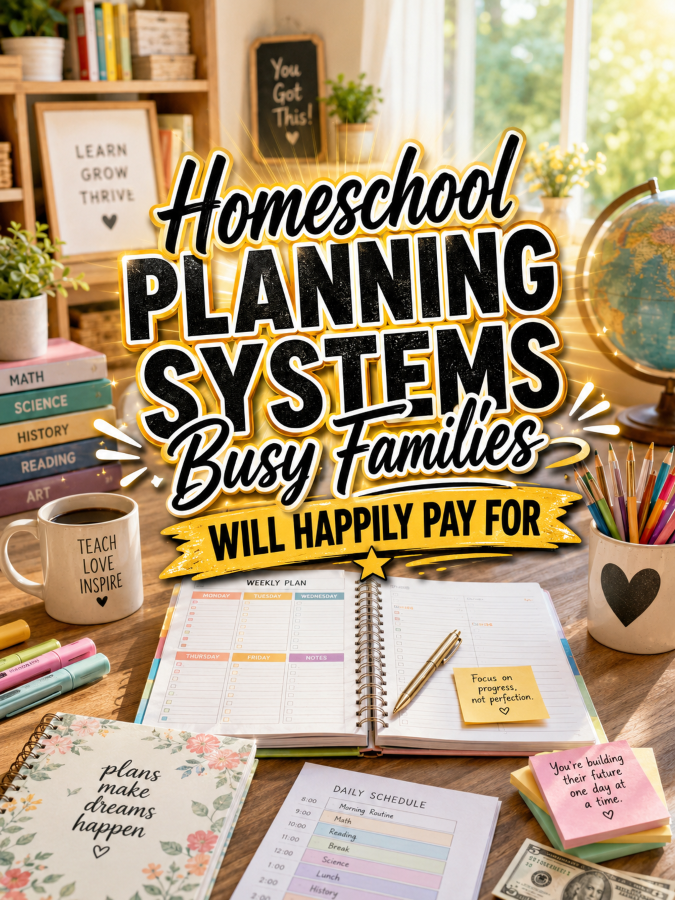
Homeschool Planning Systems are downloadable printable organizers that include lesson planners, attendance logs, reading trackers, assignment schedules, grade books, curriculum planners, field trip journals, weekly calendars, goal trackers, and family planning pages.
A starter planner can comfortably sell for around $7. Expand it into complete homeschool management systems, subject-specific planners, editable editions, and premium family education bundles, and you’ve built a natural product ladder reaching $27, $47, and even $77.
Homeschool families don’t need more paperwork. They need simple systems that help every school day run more smoothly. That someone creating that solution could absolutely be you!
Why This Niche Works
Homeschooling isn’t a one-time event. It’s an ongoing lifestyle. Families plan lessons, track progress, organize activities, and prepare for new school years every single year, creating consistent demand for practical planning tools.
Many planners focus only on lesson schedules. Meanwhile, homeschool families also need reading logs, attendance records, project planners, curriculum trackers, grading sheets, and extracurricular organizers. That’s like opening a library where every book is beautifully arranged except the one someone actually needs.
Once parents discover a planning system that genuinely saves time, they’ll happily return for seasonal planners, unit study organizers, student journals, high school planners, preschool activity binders, and countless related thingees.
Unlike curriculum trends that change over time, good organization never goes out of style.
Prior to pouncing upon this opportunity, you should first know all about the:
Tools You’ll Need
You don’t need to be a homeschool teacher to build this printable business. These dependable tools are more than enough to get started.
- Canva for designing attractive planner pages and educational printables.
- Google Docs for organizing lesson layouts, instructions, and planning guides.
- AWeber for building your email list with homeschool organization tips and printable updates.
- GetResponse for automated launches, newsletters, and customer follow-up.
- Gumroad for selling downloadable homeschool planners.
- Teachable if you’d eventually like to teach homeschool organization or printable design.
- Amazon Homeschool Planner Research for studying layouts, customer reviews, and popular planning features.
Don’t spend weeks collecting shiny software thingees. Spend that time building planners that help families focus more on learning and less on searching for missing paperwork.
Next, move to:
Your 5-Step Action Plan
Follow these five steps unless you’d rather spend 22 hours looking for last month’s reading log while yesterday’s science worksheet quietly joins it in the mystery pile.
Step 1. Study How Homeschool Families Organize
Spend about 92 minutes researching homeschool planners, family organizers, curriculum trackers, lesson journals, Facebook groups, blogs, and customer reviews. Listen carefully to the organizational challenges parents mention most often.
Create a master list containing 28 to 35 planner pages. Include weekly lesson plans, attendance records, reading logs, assignment trackers, grade books, curriculum maps, field trip journals, project planners, daily schedules, and family goal pages.
Your research becomes an X-ray machine that uncovers planning frustrations many families simply accept as part of homeschooling.
Step 2. Design Your Core Planning System
Create a printable collection containing 36 to 48 pages that naturally guides families through the entire school year.
Include lesson planners, assignment trackers, reading journals, attendance pages, subject planning sheets, grading logs, meal planners, extracurricular schedules, and weekly reflections. Keep everything simple because simplicity is always a Good Thing.
Step 3. Create Specialty Editions
Build separate planners for preschool, elementary, middle school, high school, unit studies, Charlotte Mason families, project-based learning, and multiple-child households.
Specific planners feel much more valuable than one enormous planner trying to organize every homeschooling style.
Your customers will appreciate having choices.
Step 4. Add High-Value Bonuses
This is where your planner begins standing out from the thundering herd.
Include printable reading challenges, educational field trip planners, report card templates, chore schedules, habit trackers, supply inventories, memory pages, and yearly achievement certificates.
Those bonus thingees don’t require much extra work, yet they dramatically increase the value of your bundle.
Families love thoughtful extras that make school days easier.
Step 5. Build Your Product Ladder
Launch your starter planner for $7. Expand into complete homeschool management systems around $27, then introduce premium family education libraries approaching $77.
Before long, your business won’t simply be selling planners. You’ll be helping families build smoother routines, reduce stress, and enjoy homeschooling with greater confidence.
Once you’ve figured out all of the above, the next step is implementing:
3 Ways to Stand Out From The Thundering Herd!
Let’s be honest. There are plenty of homeschool planners available already. That’s about as surprising as finding pencils in a classroom.
The Good Thing is that many of them only organize lessons. Your planner can organize an entire homeschool lifestyle, making busy parents feel like someone finally understands what their days actually look like.
Way 1. Build for Real Homeschool Styles
Every homeschool family teaches differently. Create separate planners for Charlotte Mason families, classical education, unit studies, unschooling, Montessori-inspired learning, project-based education, and large homeschooling households.
When parents immediately recognize their teaching style inside your planner, they stop comparing products and start imagining how much easier their mornings could become.
Way 2. Plan the Entire Day, Not Just School
Homeschool life doesn’t begin and end with math lessons.
Include meal planners, reading challenges, field trip organizers, chore schedules, extracurricular calendars, appointment trackers, habit logs, and family goals. Those extra thingees transform your printable into a complete family command center instead of another lesson planner sitting on the bookshelf.
Way 3. Leave Space for Milestones
Parents love watching their children grow.
Add memory pages, yearly achievements, favorite books, learning highlights, artwork trackers, educational goals, and end-of-year reflections. Those personal touches turn an ordinary planner into something families will treasure for years.
Next, here’s the thing. You’re probably NOT the only person offering this service. So you now require:
3 Nifty Ways to Find Customers
You don’t need paid ads because homeschool parents practically shine the Bat Signal every time they ask how everyone keeps lessons, activities, and paperwork organized.
Way 1. Homeschool Facebook Communities
Thousands of homeschool families gather in Facebook groups every day looking for lesson ideas, encouragement, and organizational resources.
Become the helpful person who shares practical planning tips before introducing your printable. Helpful advice builds lasting trust.
Way 2. Pinterest
Parents regularly search Pinterest for educational activities, lesson ideas, and homeschool organization.
Create attractive pins showing planner spreads, lesson pages, reading logs, field trip journals, and colorful planning layouts. Beautiful visuals naturally encourage clicks and saves.
Way 3. Homeschool Bloggers and YouTube Creators
Many homeschooling creators are always looking for quality planning resources they can recommend.
Partner through guest articles, reviews, or affiliate relationships that introduce your planner to highly engaged homeschooling families.
Speaking of completed projects, now let’s move to:
3 Takeaways You Won’t Find Elsewhere!
These aren’t feel-good reminders. They’re practical lessons that quietly transform one planner into a dependable digital product business.
Takeaway 1. You’re Selling Peace of Mind
Parents aren’t buying another planner because they enjoy filling out forms.
They’re buying calmer mornings, fewer forgotten assignments, smoother lesson planning, and the confidence that everything important is finally organized.
Takeaway 2. Organization Builds Better Learning Habits
When parents spend less time searching for worksheets, they spend more time teaching.
Your planner quietly removes unnecessary stress so families can focus on what matters most – learning together.
Takeaway 3. One Planner Can Become an Entire Education Library
Your Homeschool Planning System can naturally expand into reading journals, science notebooks, handwriting trackers, preschool activity planners, graduation planners, educational portfolios, and student assignment binders.
Those connected thingees create an entire library that families will continue building throughout the school year.
Now that you know the above, it’s time for:
3 Common Mistakes to Avoid
Many creators only focus on lesson plans.
That’s Not a Good Thing. Homeschool families also need attendance records, reading logs, project planners, extracurricular schedules, and family calendars to stay organized.
Some sellers overlook families with multiple children.
Planning for three students looks very different from planning for one. Including flexible layouts is always a Good Thing because it helps more families use your planner successfully.
Others create one planner and never expand.
The biggest opportunity comes from creating an entire collection that grows alongside every stage of a family’s homeschool experience.
What else should you know? How about:
Scaling Your Results
Expand beyond homeschool planning.
Create printable collections for preschool learning, reading programs, educational portfolios, nature study journals, field trip planners, student assignment books, graduation organizers, and family scheduling systems. One successful planner can inspire dozens of related products.
Create complete homeschool bundles.
Bundle lesson planners, attendance logs, report cards, reading journals, chore charts, field trip planners, subject trackers, and educational goal sheets into premium family education systems that simplify the entire school year.
Build an email list that homeschool families actually enjoy.
Share seasonal planning ideas, educational printables, organization tips, and new planner releases throughout the year. A collection containing 34 homeschool resources could realistically generate an additional $512 to $1,468 each month through repeat buyers, memberships, bundle sales, and seasonal promotions. Trust me, you’ll thank me later.
Let’s now wrap up everything via the:
Your Next Steps
Start by listing 35 printable pages that would genuinely make homeschool life easier for busy families. Don’t try to squeeze every educational idea into one giant planner because that’s usually a Not a Good Thing.
Design your first planner in Canva using clean layouts that make daily planning feel calm instead of overwhelming. If parents can open your planner and know exactly what to do next, you’ve created something truly valuable.
Then introduce your planner to five homeschool communities, parenting groups, educational bloggers, or Pinterest boards. Remember, 5 good messages beats 50 generic ones every single time.
One thoughtfully designed homeschool planner can quietly become the beginning of an entire education printable business.
Next, let’s finish with:
Final Thoughts
The best homeschool days aren’t the ones where every lesson goes perfectly. They’re the days when families learn together, adapt when plans change, celebrate small victories, and end the day knowing meaningful progress was made.
Your Homeschool Planning System helps make those days happen. It keeps important information organized, reduces unnecessary stress, and gives parents more time to focus on teaching instead of searching for paperwork. That’s exactly the kind of printable families continue using year after year.
Start with one planner that genuinely solves everyday homeschooling challenges. Keep listening to your customers, continue improving your pages, and expand your collection one helpful resource at a time. You don’t need bazillions of printables to build a thriving digital business. You simply need one planning system that helps families feel more confident every school day.
That’s it. That’s your beginning!
If you were creating your very first Homeschool Planning System today, what section would you build first – lesson planning, reading logs, attendance tracking, field trips, or something completely unique?
Enjoy!