
AI in accounts payable pays off when routine work disappears: invoice data gets captured reliably, coding becomes more consistent, and exceptions land with the right owner before approvals stall. The strongest AI-powered accounts payable automation software keeps AP workflow moving while protecting financial controls around payment approval and vendor payments.
Ranking criteria
The ranking prioritizes measurable automation in invoice processing and exception handling, then checks whether audit trails, segregation of duties, duplicate invoice detection, and ERP integration hold up in real operations.
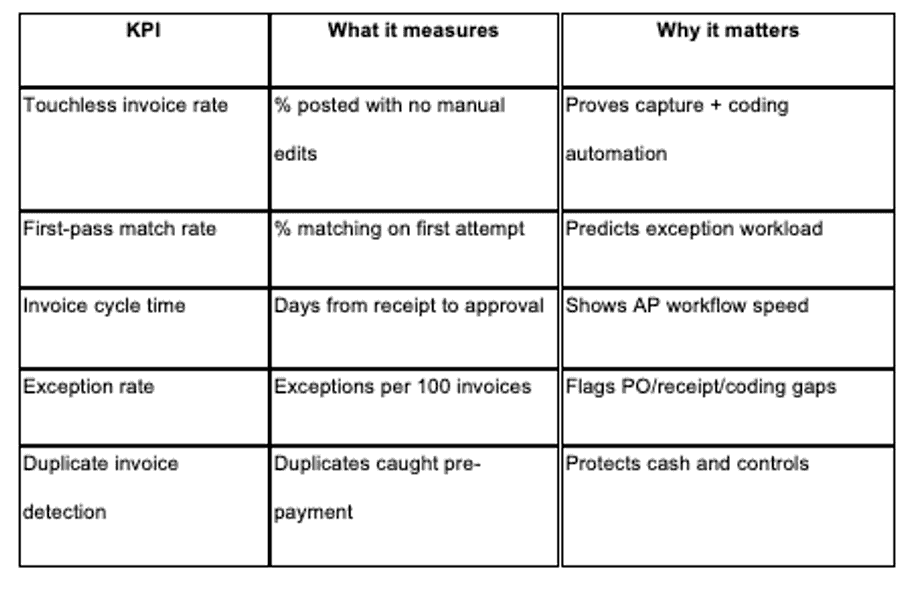
KPIs that show whether AI is improving the accounts payable process
Before committing to a platform, demos should pressure-test AI claims with real documents and real edge cases. The most revealing checks usually include mixed-format invoices (multi-page, credits, non-standard layouts), approval delegation for PTO, partial receipts for three-way matching, and a few “messy” vendors where master data has changed over time.
1) Precoro
Great for mid-sized teams standardizing approvals fast
For mid-market teams aiming to standardize approvals without turning AP into a ticketing system, comparing Precoro with larger suites often highlights which workflows can be tightened quickly. A strong fit appears when invoices, POs, and receipts need to stay connected, because shared documents reduce three-way matching exceptions and improve invoice processing visibility.
Caveats
ERP integration should be validated for GL coding, multi-entity requirements, and tax rules. Matching quality also depends on timely receiving and clean vendor master data, otherwise exceptions accumulate faster than automation clears them.
2) Coupa
Best for enterprise-grade spend governance with AP automation
Coupa is typically shortlisted by enterprises that want procurement governance plus accounts payable automation in one environment. AI value often shows up in policy-driven routing, stronger exception triage, and analytics that reveal approval bottlenecks—useful when non-PO invoices and inconsistent approvals stretch invoice cycle time.
Caveats
Results depend on configuration and change management. Ownership for tolerances, coding rules, and non-PO invoices needs to be explicit so approvers stay focused on approval decisions rather than data correction.
3) Basware
Strong choice for high-volume, touchless invoice processing goals
Basware is frequently evaluated for AP automation-first programs that push toward touchless processing at scale. AI-assisted capture plus anomaly signals can strengthen duplicate invoice detection and reduce payment risk in high-volume invoice processing environments.
Caveats
Weak PO discipline and late receipts inflate exceptions and can erode AP efficiency unless recurring root causes are tracked and resolved. Clear exception ownership matters as much as the model itself.
4) Stampli
Ideal for email-heavy invoices and faster exception collaboration
Stampli tends to stand out when invoices arrive via email and exceptions dominate the day, because collaboration needs to stay tied to the invoice record rather than scattered across chat threads. AI-assisted coding and invoice-level context can reduce cycle time by keeping clarifications in one place.
Caveats
Matching depth needs confirmation when three-way matching is mandatory, especially for partial deliveries and split coding. Integration planning also matters when multiple systems feed the accounts payable process.