
How agentic AI and real compliance automation separate the leaders in AI compliance software
Every vendor selling the best AI compliance tools in 2026 makes the same claim: the AI does the work. The claim covers a wide spread. Some platforms run agents that gather evidence and flag failing controls before anyone asks. Others bolt a chat window onto integration checks that have existed since 2019 and call the result agentic.
The gap shows up in hours. A program on a thin automation layer still needs someone to chase screenshots and re-map controls by hand every time a new framework lands. A program on deep automation hands that work to software and keeps people on the judgment calls. The order below follows that gap: how much compliance work the AI takes off your team, and how far one piece of evidence stretches across frameworks. Review data backs the distinction; across G2, praise concentrates on time saved, and complaints concentrate on the work automation handed back.
One definitional wrinkle first. “AI compliance tools” carries two meanings that vendors mash together. The first: platforms that use AI to run your compliance program, collecting evidence and monitoring controls for frameworks like SOC 2 and ISO 27001. The second: tools that keep your own AI systems inside the rules. Most of the six sit in the first camp. A couple stretch across both, and that stretch changes what your shortlist should cover.
How to judge what an AI compliance tool automates
Unprompted work versus on-request work
Start with what the AI does before anyone asks. An agent that scans controls overnight and queues fixes by morning changes your workload; a chat assistant that answers questions when queried changes your search habits. Both count as AI on a feature page, and only one of them shows up in the hours your team logs. Push vendors to spell out the distinction task by task. The gap between the two is the gap between an agentic platform and a dashboard with opinions.
Evidence coverage and monitoring cadence
Automation stops at the edge of its integration catalog, because software can’t collect evidence from systems it doesn’t reach. Count the connectors that match your stack rather than the headline number. Cadence matters just as much: a platform that checks controls once a quarter automates an audit snapshot, while one that re-checks around the clock automates the program itself. Within this group, monitoring frequency runs from continuous checks down to intervals a buyer should confirm rather than assume. The scraped-together alternative, exports and screenshots, is what these platforms exist to retire.
Cross-framework reuse and human oversight
A control you satisfy once should count everywhere it applies. Cross-framework mapping lets one evidence file serve a SOC 2 attestation and an ISO 27001 certification at once alike, which shrinks the marginal work of each new framework. The last test is human: auditors accept automated evidence when its provenance is clear, and platforms that pair agents with expert review produce fewer awkward audit-day surprises. AI output that nobody double-checks is a finding waiting to happen.
One deadline still belongs in any 2026 planning conversation: the EU AI Act starts enforcing its high-risk provisions in August 2026, with top-end fines of 7 percent of global turnover or EUR 35 million. If your product ships AI into Europe, framework support for the Act belongs on your shortlist. AI governance deserves a deeper comparison than one paragraph can give it; here it matters as coverage to confirm before enforcement, not after.
The 6 best AI compliance tools by automation depth
Each entry opens with what the platform automates and closes with the pricing facts that exist on the record. Ratings and complaint counts come from G2 review data captured in 2026.
Scytale
Best for teams that want agents doing the unprompted work and experts checking it.
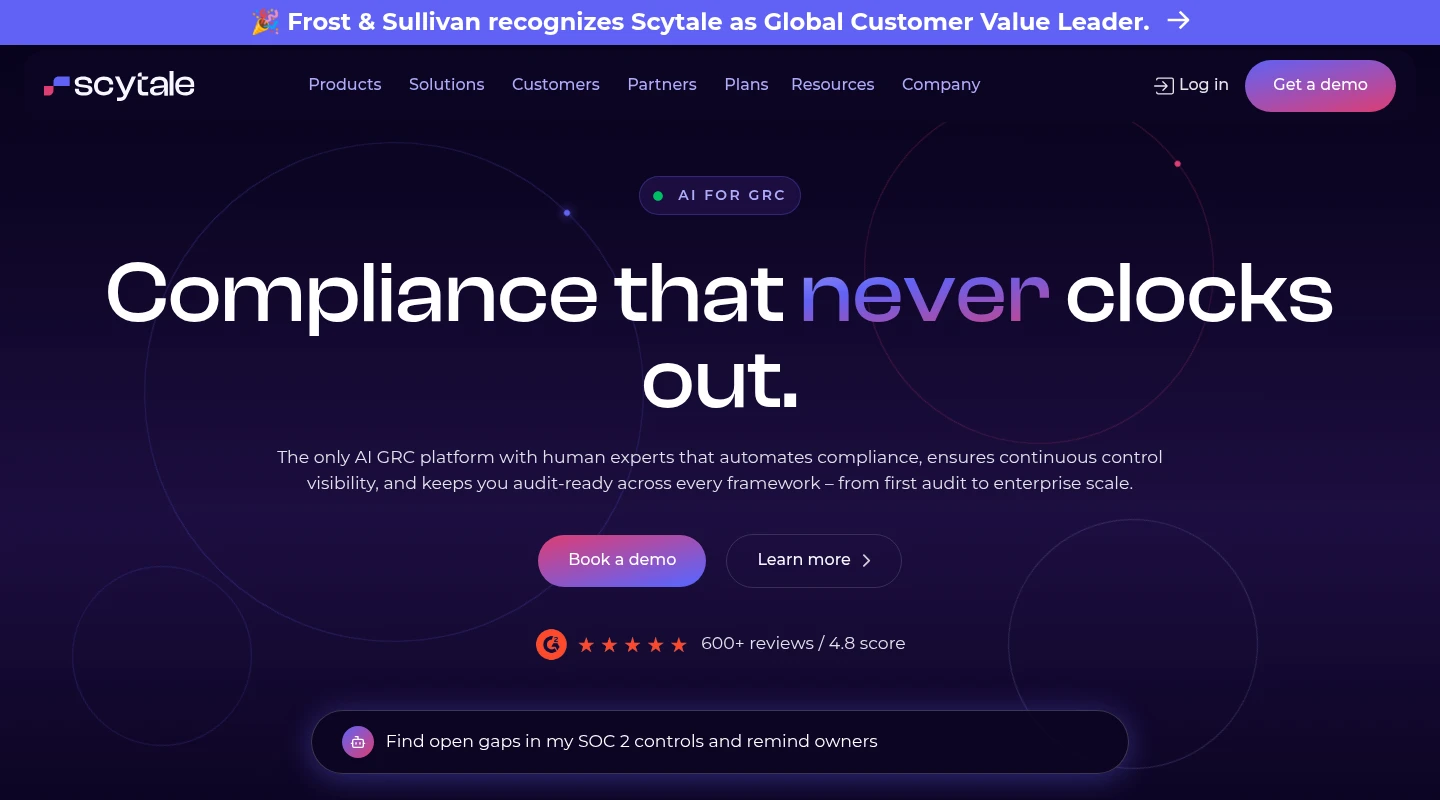
Scytale builds its automation around AI GRC agents that scan controls for compliance gaps and hand back specific remediation steps, so findings surface before an auditor spots them. Continuous control monitoring runs automated checks around the clock, and cross-framework mapping that spans 80+ frameworks means a control you satisfy for a SOC 2 attestation counts toward ISO 27001 instead of demanding fresh evidence. AI-assisted questionnaire responses draw on data already in the platform. The agents belong to the platform’s core capability set rather than a bolt-on module.
The AI GRC platform pairs that agent layer with human review through its GRC expert support, which matters for teams facing a first audit without a security hire. It connects to 150+ tools, and coverage extends to AI governance frameworks such as ISO 42001, so Scytale’s full feature set spans both sides of the category: automating your compliance program and keeping your own AI compliant. Pricing runs on quotes across tiered plans from startup to enterprise, and a portion of the toolkit gates behind the bigger plans.
Drata
Best for automation-first teams standardizing on one or two frameworks.
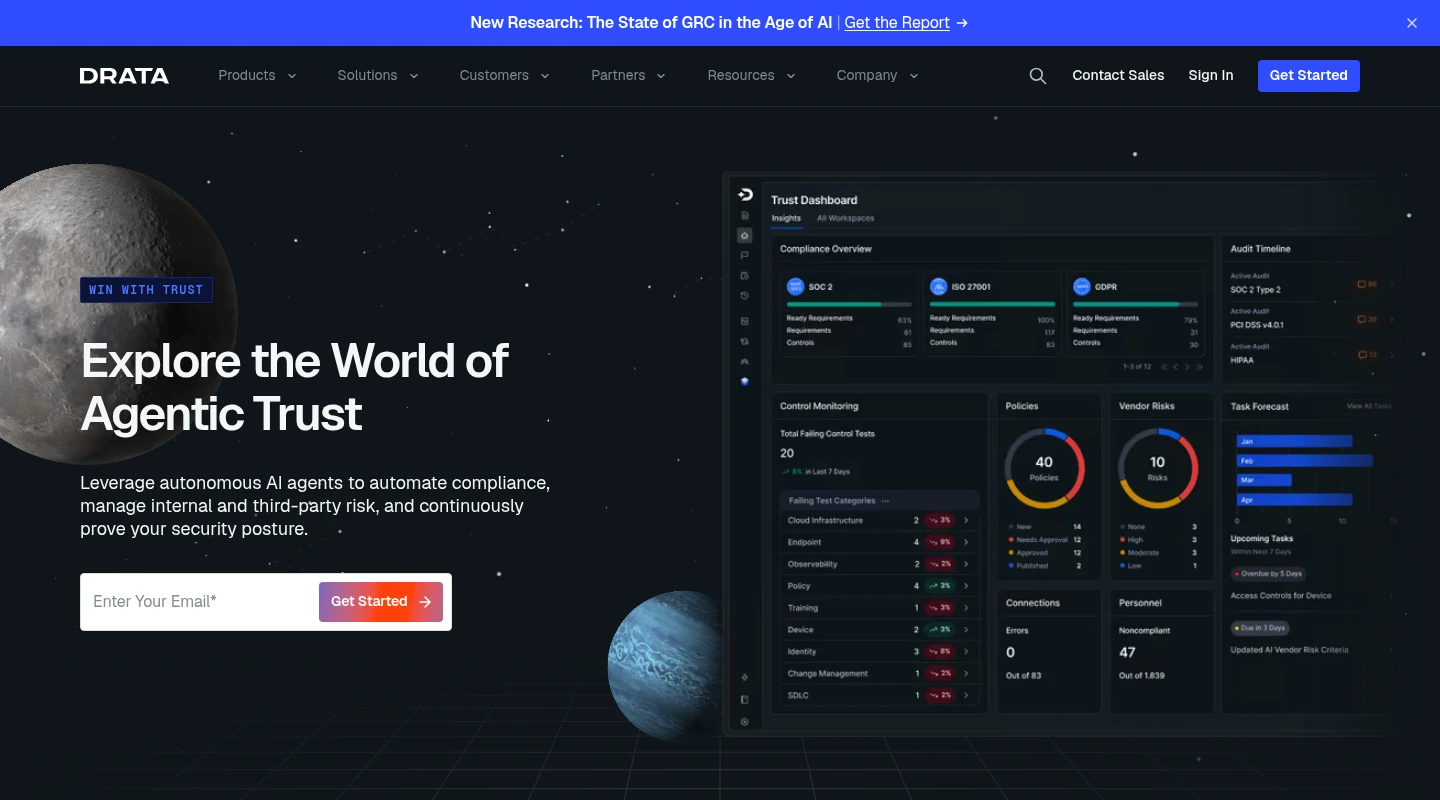
Drata’s autonomous AI agents handle compliance and risk workflows on top of continuous control monitoring, and the company says its questionnaire automation saves customers hundreds of hours a year on security reviews. Its trust center and pre-built framework content shorten setup for teams that fit the standard mold, so the automation starts paying back early, and continuous monitoring keeps posture visible between audits rather than at renewal time. Drata’s G2 profile averages 4.7 from 1,331 reviews, with customer support the most-praised theme.
The complaints cluster on the interface: reviewers describe a confusing UI that buries tasks, and some flag a thinner third-party integration catalog than the marketing suggests, which caps how much evidence the agents can pull on their own. On cost, Drata prices by quote, and buyer reports put each additional framework near $5,000, a figure the company doesn’t confirm.
Vanta
Best for teams whose stack maps onto the widest integration catalog in the category.
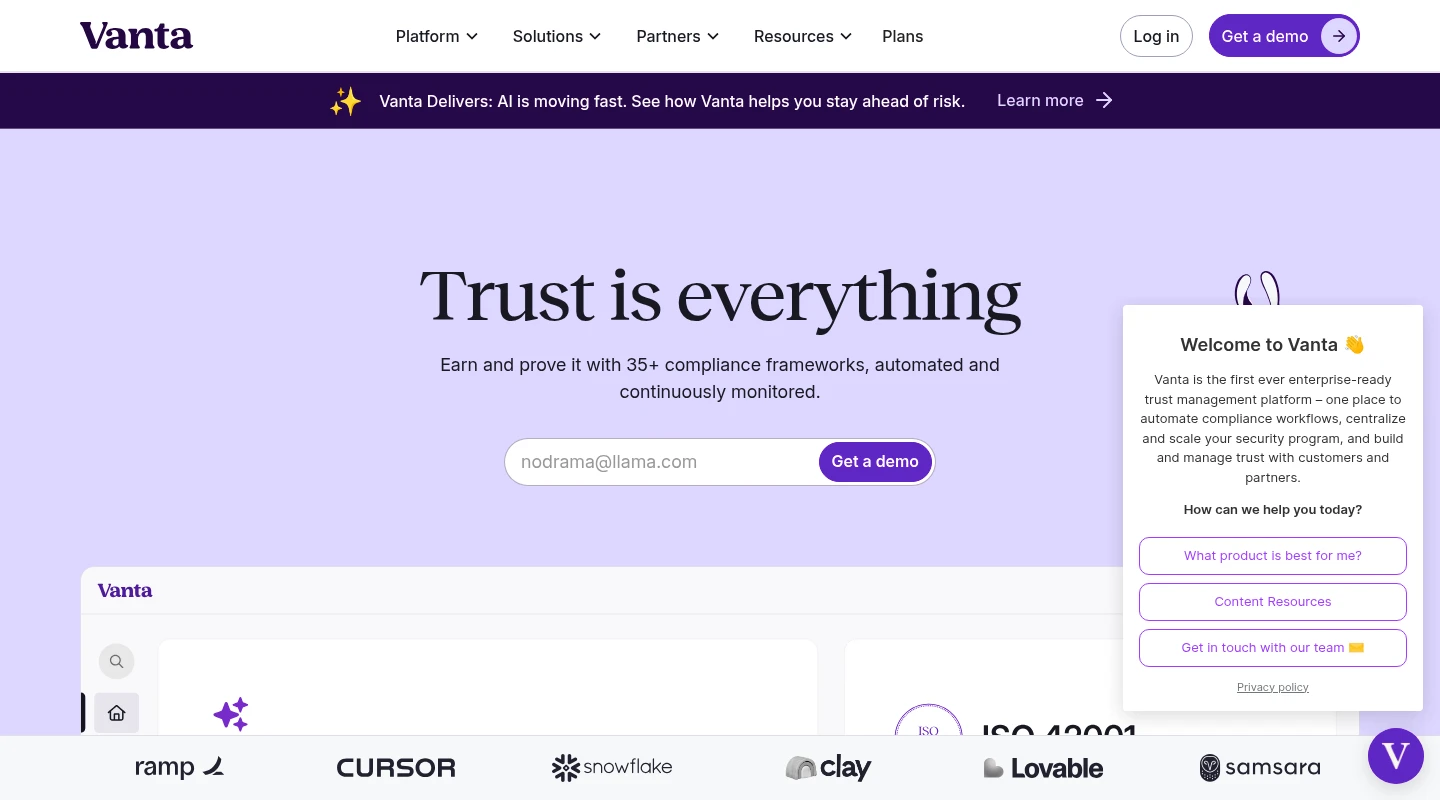
Vanta’s 375+ integrations give it the broadest native evidence coverage on this list, and coverage is the floor any automation claim stands on. Its AI agents pick up questionnaire automation and third-party risk work, while control monitoring re-runs on an interval measured in hours, not quarters. Reviewers rank the interface as its strongest trait with 675 mentions and credit the automation with real time savings across 405 more, and a customer base above 16,000 companies means the onboarding playbook is well worn.
Two friction points recur in the review data: 179 reviewers describe integration issues that push work back onto staff, and the self-serve model leaves program guidance to your own team, so the automation runs itself but the program doesn’t. Vanta prices by quote, and cost complaints lead its G2 profile, with 146 reviewers citing high pricing at small-company scale.
Centraleyes
Best for risk teams that want AI oversight folded into an enterprise risk register.
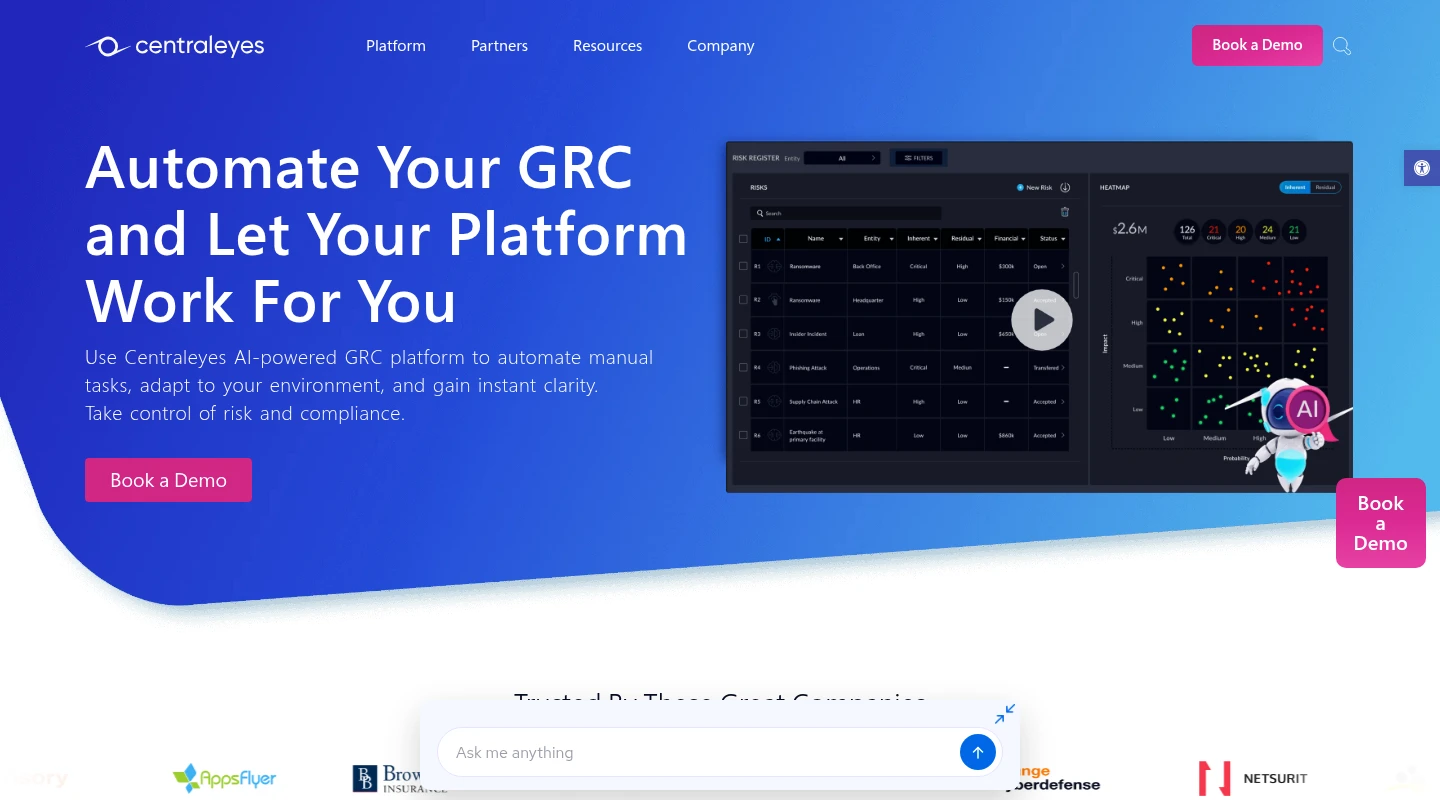
Centraleyes points its AI at the governance side of the house. The AI Governance Module inventories AI models and classifies their risk, folding oversight of your own systems into the same register as the rest of the program, while regulatory change tracking and control mapping round out a risk-first toolkit. Evidence reuse and audit-ready reporting sit in the same environment, so assessments feed one data set. For a security leader who already owns a risk register, that consolidation is the draw.
The evidence base runs thin, though: Centraleyes shows three G2 reviews, and those reviewers flag reporting and drill-down depth as underbuilt. Startups chasing a first attestation will find the platform tilted toward larger GRC teams that can drive it. Centraleyes doesn’t publish pricing; a free trial offers the first look.
Sprinto
Best for startups chasing maximum automation with minimum compliance headcount.
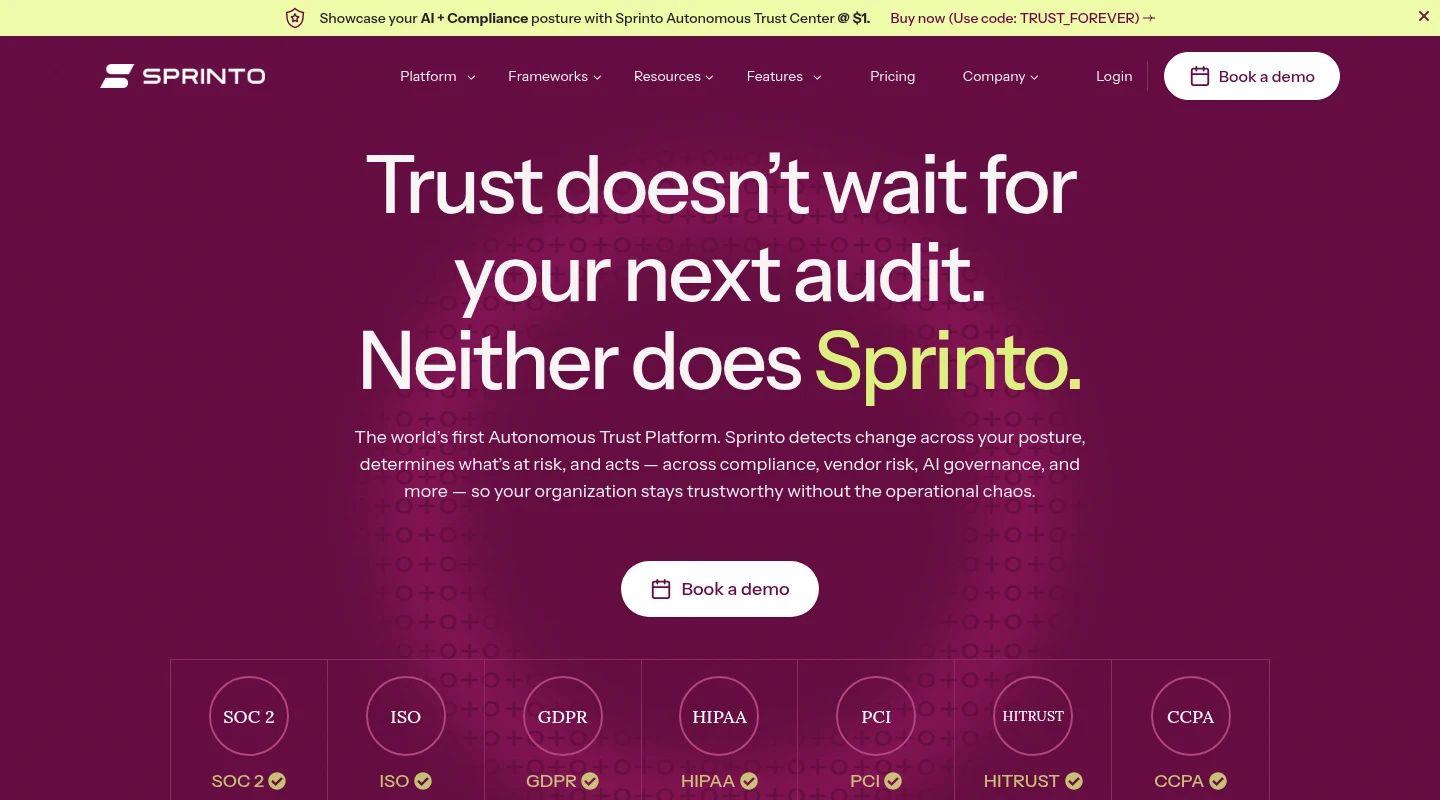
Sprinto’s pitch is automation density. It markets an automation rate in the 90-to-95-percent band covering its 200+ checks, with built-in device management and guided onboarding aimed at first-time compliance teams. It connects to 160+ tools out of the box, and reviewers describe implementation as fast, with onboarding built for teams that have no compliance hire. An AI-assisted risk register keeps scoring current without a quarterly spreadsheet exercise, and continuous monitoring keeps the checks running between audits rather than in a pre-audit sprint.
That integration figure trails Vanta’s 375+, which matters for unusual stacks, and reviewers note the platform suits growth-stage companies better than complex enterprise environments, where deeper customization runs out. Sprinto quotes on request and sells ISO 27001 and HIPAA coverage as add-on framework layers.
Secureframe
Best for teams that want an expert attached to the subscription rather than hired on the side.
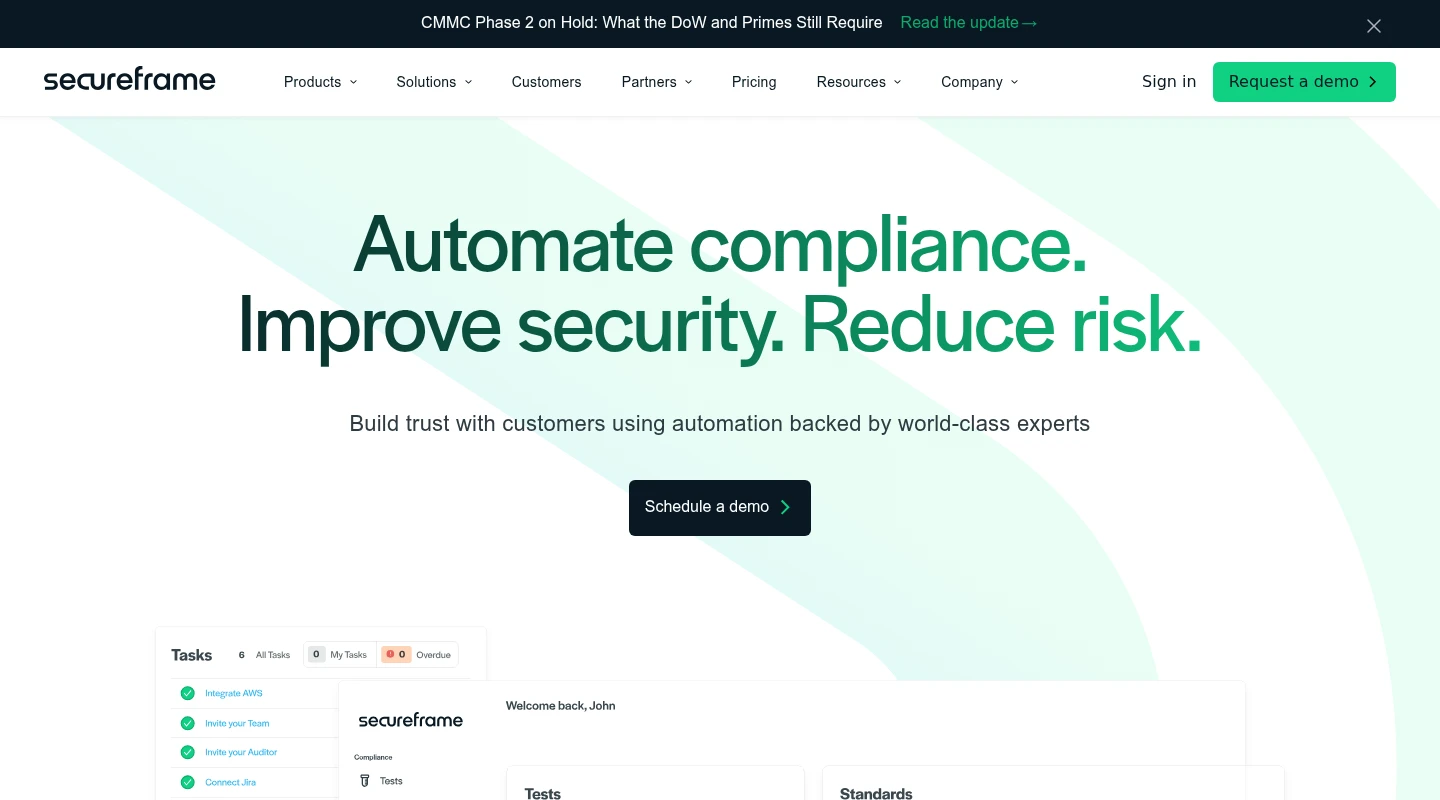
Secureframe’s Comply AI features draft remediation fixes and assess risk, and questionnaire automation pulls answers from evidence the platform already holds, while automated evidence collection feeds its readiness reports without a screenshot chase. Coverage spans 30+ frameworks, with readiness reports and a trust center rounding out the toolkit, its 300+ integrations keep evidence flowing from the common stacks, and assigned compliance experts stay involved as the automation runs. Ease of use tops its G2 praise at 650 mentions from a 4.7-rated base of 802 reviews.
The complaint file has two recurring entries: 184 reviewers flag missing connectors for niche tools, which leaves holes in automated evidence collection, and 109 say the audit functionality needs work. Secureframe prices on request, and reviewers count limited pricing transparency among their documented gripes.
How to choose an AI compliance tool in 5 steps
Step 1: Name the job the AI should own
Decide which meaning of AI compliance you’re buying. Automating a SOC 2 or ISO 27001 program points you at the automation-first platforms; governing your own AI models points you at ISO 42001 and EU AI Act coverage. Your answer sets the shortlist and the capability list you’ll test against; a tool that scores well on one job can sit at the bottom on the other.
Step 2: Ask what runs unprompted
In every demo, ask the vendor to show the last actions its agents took without a human prompting them. Gap flags and evidence checks that appear on their own signal working agentic automation; a summary the AI produces only when asked signals an assistant. Vendors proud of their agents will show the log; vendors proud of their roadmap will show a slide. Get the task split in writing.
Step 3: Run the trial against your real stack
Integration gaps generate more review complaints than any other theme in this category, and automation stops where connectors do. Wire the trial into your actual cloud accounts and repos, then count what syncs without manual work. A connector you patch by hand every month is automation in name only.
Step 4: Check the human layer
Ask who reviews what the AI produces, on the vendor’s side and on yours. Platforms with expert support attached catch bad automated calls before an auditor does; self-serve platforms assume your team plays that role. Review data across the category shows support quality driving satisfaction more than feature count. Match the model to your headcount, because the platform can’t review itself.
Step 5: Compare cost last
Once the automation shortlist is set, get each vendor’s full number in writing, covering the platform fee and every framework on your two-year roadmap. Ask in the same message what the audit and any testing cost through their model. Buyer reports of per-framework add-ons near $5,000 at some vendors show why the written version matters. A shortlist built on automation depth makes the cost conversation shorter anyway.
Which AI compliance tool automates the most in 2026
Every platform here automates real compliance work; the depth is where they separate. Vanta and Drata pair wide agent coverage with programs the customer still has to drive. Centraleyes serve heavier GRC operations that prize mapping and oversight over hands-off evidence collection, and Sprinto compresses the startup path with the highest advertised automation rate in the group. Scytale sits first because its AI GRC agents handle the unprompted work, gap detection and remediation guidance included, and GRC expert support reviews what the agents produce before an auditor does. Automation that arrives with a human check carries further in an audit than automation alone. As AI regulation tightens through 2026, platforms that treat governance frameworks as core coverage will hold their value. Pick the tool whose agents replace the most hours, and confirm the details in writing before you sign.
Common questions about AI compliance tools
What makes a compliance tool AI-powered?
The label stretches. At the shallow end, vendors rebrand rules-based integration checks that predate the AI wave. At the working end, the platform runs agents that validate evidence against control requirements and surface gaps a human would miss on a Friday afternoon. When a vendor claims AI, ask which tasks the system completes without a human driving, and what happens when it gets one wrong.
Will auditors accept evidence collected by AI?
Yes, when the evidence traces to source systems. Auditors care about provenance and completeness, not who or what gathered the file, and by 2026 most audit firms treat platform-collected evidence as standard practice. The stronger platforms add a review layer on top; Scytale, for instance, routes AI-validated evidence through GRC expert support before an auditor ever sees it, so the audit conversation stays on controls rather than tooling.
How much do AI compliance tools cost?
Most vendors price by quote, sizing the platform fee on headcount and framework count. Buyer reports put per-framework add-ons near $5,000 at some vendors, and industry reporting places one mid-market entry point near $12,000 a year as of 2026. Audits and penetration testing often bill outside the subscription, so confirm what a quote covers before you compare.
What’s the difference between AI compliance and AI governance?
AI compliance tools use AI to run your compliance program, handling evidence collection and control monitoring for frameworks like SOC 2 and ISO 27001. AI governance keeps your own AI systems inside the rules, with frameworks such as ISO 42001 and the EU AI Act setting the bar. The two converge as regulators catch up: platforms with wide framework coverage, Scytale among them, now support the governance set alongside the classic attestations, so one program can cover both.
Editor’s Note: The opinions expressed here by the authors are their own, not those of impakter.com — Cover Photo Credit: DC Studio