
Introduction
Chess players have no shortage of ways to play the game. They can play online, join tournaments, solve puzzles, watch lessons, study famous games, practice openings, and spend an alarming amount of time wondering how they somehow lost a queen they were absolutely sure was safe.
But playing more chess doesn’t automatically mean studying chess effectively. Many players collect screenshots, save opening videos, write notes on random pieces of paper, and forget the lessons from their last game before the next one starts. That’s where a Chess Study Journal can become useful.
If you’re a printable creator, this creates an interesting product opportunity. You aren’t simply selling pages. You’re helping chess players organize their study, record their mistakes, review their games, track patterns, and build a repeatable improvement routine.
And you can turn one well-designed Chess Study Journal into a simple product ladder that starts at $7 and grows toward $77 without making every higher-priced product nothing more than another stack of pages.
Quick Answer
Create a Chess Study Journal that helps players record games, analyze mistakes, study openings, practice tactics, review puzzles, track goals, and measure improvement.
Start with a focused $7 journal. Expand it into a $17-$27 Chess Study Organization Kit. Turn that into a $37-$47 Chess Improvement System. Then create a $67-$77 premium Chess Study Command Center with editable templates, dashboards, specialty study editions, tournament tools, and bonus resources.
The key is simple: each price level should solve a bigger problem. Don’t charge more just because you added more pages. Add more usefulness.
Why Chess Study Journals Work As A Product Ladder
Chess is naturally suited to tracking and reflection. Players have openings to study, tactics to practice, games to analyze, mistakes to identify, positions to revisit, and goals to work toward. That gives you plenty of useful information to organize into a product.
There’s also a wide range of potential buyers. A beginner may want help remembering basic lessons and tracking progress. An intermediate player may want a better system for analyzing games and identifying recurring mistakes. A tournament player may want opening preparation, opponent notes, tournament records, and performance reviews.
That means you don’t have to create one enormous product and hope everyone wants it. You can build a ladder where each version is designed for a different level of commitment.
The Reasonable Pricing Rule
Before creating your products, remember one important rule: your price should reflect the usefulness of the solution, not the number of pages you managed to squeeze into a PDF.
A $7 journal might help someone analyze one game. A $27 kit might help them organize an entire month of chess study. A $47 system might help them build a repeatable improvement process. A $77 premium product could combine study planning, game analysis, tournament preparation, progress tracking, and editable resources.
That’s a much healthier way to build a product ladder. You’re increasing the buyer’s ability to use the product, not simply increasing the thickness of the file.
The $7 Chess Study Journal
Your $7 product should provide one clear win: helping a chess player study a game or lesson in a more organized way.
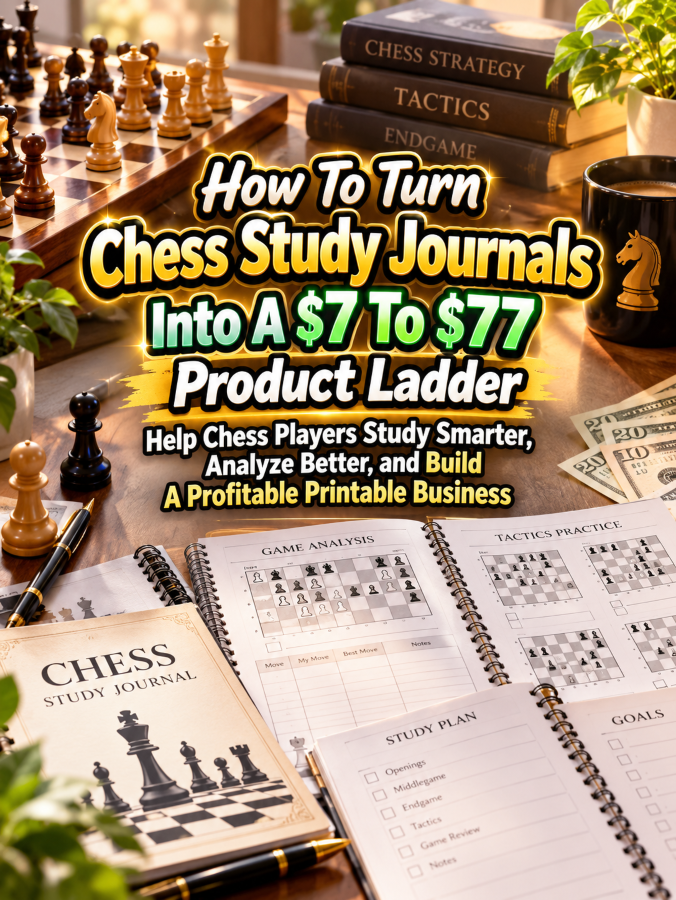
A simple Chess Study Journal could include pages for the date, opponent, game type, opening, result, key positions, mistakes, good moves, lessons learned, and next steps. Add a few reflection questions such as “What did I miss?” and “What should I practice next?”
You could also include a small tactics or puzzle reflection page where players record the puzzle theme, their first idea, the correct solution, and what caused them to miss it.
What To Include
- Game analysis sheet
- Opening study notes
- Tactics practice log
- Mistake tracker
- Chess lesson notes
- Daily study reflection
- Weekly improvement review
Keep the first product focused. A buyer should be able to download it and immediately understand what to do with it.
The $17-$27 Chess Study Organization Kit
Once the basic journal works, the next step is to solve the organization problem. Chess players don’t just need to analyze one game. They need somewhere to keep their opening notes, puzzle results, study goals, favorite positions, lessons, and improvement observations.
Your $17-$27 kit can turn the basic journal into a complete study notebook. Include sections for opening preparation, tactical themes, endgame practice, game reviews, chess vocabulary, study goals, training schedules, and recurring mistakes.
You can also create different versions for different players. A beginner edition could focus on fundamentals. An intermediate edition could emphasize calculation, opening preparation, and game analysis. A tournament edition could include preparation and post-game review pages.
Possible Kit Components
- Chess Study Journal
- Opening Study Tracker
- Tactics Practice Log
- Endgame Study Tracker
- Game Analysis Sheets
- Mistake Pattern Tracker
- Weekly Chess Training Planner
- Monthly Progress Review
- Chess Goals Worksheet
- Study Topic Index
The $37-$47 Chess Improvement System
Now you’re moving beyond journaling and into a repeatable improvement system. That’s where the product becomes much more valuable.
The $37-$47 version could help a player decide what to study, schedule the work, record the results, review games, identify weaknesses, and choose the next area to practice.
Think of this as a chess training workflow rather than a collection of worksheets. The buyer should be able to start with a goal and move through a complete study cycle.
Build The System Around A Study Loop
- Choose a chess improvement goal.
- Identify the skill or weakness to work on.
- Schedule study and practice sessions.
- Record games, puzzles, lessons, and observations.
- Review the results and choose the next focus area.
You could also include a monthly dashboard where players record the number of games analyzed, puzzles completed, study sessions finished, openings reviewed, and recurring mistakes discovered.
That’s where your product starts feeling like a system instead of a printable notebook.
The $67-$77 Ultimate Chess Study Command Center
Your premium product should make the entire chess study process easier to manage. Instead of simply adding 100 more pages, create a complete command center for serious learners, club players, tournament players, coaches, or highly motivated hobbyists.
Include editable versions alongside finished PDFs. You could provide Canva templates, Google Sheets trackers, printable journals, study dashboards, tournament preparation worksheets, opening study pages, game review forms, and progress reports.
You can also include specialty editions. For example, one section could focus on opening preparation, another on tactics, another on endgames, and another on tournament preparation.
Premium Features Could Include
- Editable Canva Chess Study Journal
- Printable Chess Improvement Workbook
- Digital Study Tracker
- Opening Preparation System
- Tactics Training Tracker
- Endgame Study Planner
- Game Analysis Database Template
- Mistake Pattern Dashboard
- Tournament Preparation Planner
- Monthly and Quarterly Progress Reviews
- Chess Goal-Setting Worksheets
- Chess Study Schedule Templates
- Chess Coach Session Notes
- Promotional graphics and mockup templates
If you include commercial-use or resale rights, make sure those rights are clearly defined and that every included asset is properly licensed for that use. Don’t accidentally build a premium product around assets you’re only allowed to use personally.
Example $7 To $77 Chess Study Product Ladder
Here’s one practical way to structure the ladder:
| Price | Product | Main Value |
|---|---|---|
| $7 | Chess Study Journal | Analyze games, record lessons, and track daily study. |
| $17-$27 | Chess Study Organization Kit | Organize openings, tactics, endgames, games, goals, and study sessions. |
| $37-$47 | Chess Improvement System | Create a repeatable study, practice, review, and progress workflow. |
| $67-$77 | Ultimate Chess Study Command Center | Combine printable, editable, digital, tournament, and progress-tracking resources. |
Notice how the value increases at every stage. You’re not simply selling the same journal four times with different covers.
Tools You Can Use To Create This Ladder
You don’t need an expensive software stack to build a useful chess printable business. A small collection of familiar tools can handle most of the work.
Canva is useful for designing printable journals, worksheets, covers, cards, promotional graphics, and editable templates. You can create a consistent visual system across your entire product ladder.
Google Docs can help you build text-heavy worksheets and study guides, while Google Sheets works well for digital game logs, study trackers, progress dashboards, and sortable databases.
ChatGPT can help you brainstorm worksheet questions, organize product sections, create customer-friendly instructions, generate marketing angles, and turn rough ideas into structured product concepts. You’ll still want to review chess-specific content carefully for accuracy.
Google Trends can help you research whether interest is rising around topics such as chess puzzles, chess openings, tournament preparation, chess journals, beginner chess, or chess training.
For selling, you could research marketplaces such as Etsy, or use platforms such as Payhip and Gumroad for direct digital sales.
How To Know If Your Chess Product Price Is Fair
Before publishing a product, compare it with the problem it solves. Ask yourself what the buyer can actually accomplish with the resource.
A $7 journal that helps someone organize their next ten game reviews may be perfectly reasonable. A $77 bundle that contains the same journal with a different cover probably isn’t.
Look at competing products, but don’t copy them. Study what they include, how they describe the result, what formats they offer, and what buyers appear to care about. Then identify the gap your product can fill.
One useful test is this: if a buyer removed your product from their routine tomorrow, what useful process would they lose? The clearer the answer, the easier it becomes to explain your value.
Your 5-Step Action Plan
Now let’s turn the idea into something you can actually build.
Step 1: Choose One Chess Study Problem
Don’t begin with “I’m going to make the ultimate chess planner.” Begin with one problem. Game analysis, opening study, tactics tracking, tournament preparation, or mistake tracking can all become strong starting points.
Step 2: Build The $7 Version First
Create a focused product that solves that one problem. Keep the design clean and make the instructions obvious. Your first product doesn’t need to contain the entire chess universe.
Step 3: Expand Into A $17-$27 Kit
Add related tools that naturally belong with the first product. If your starter product focuses on game analysis, add opening notes, mistake tracking, tactics logs, study goals, and progress reviews.
Step 4: Build The Complete Improvement System
At the $37-$47 level, connect the pieces. Show the buyer how to move from goal setting to study, practice, game analysis, review, and improvement.
Step 5: Create The Premium Command Center
Add editable formats, digital trackers, specialty editions, tournament tools, dashboards, and promotional resources. Make the premium version easier to use and more flexible, not merely larger.
3 Ways To Stand Out From The Thundering Herd
The chess printable market may contain plenty of generic journals. That means your opportunity isn’t necessarily to create another page that says “Date, Opponent, Result.”
1. Build Around Real Chess Study Habits
Design pages around how players actually study. Include opening preparation, tactical themes, calculation notes, recurring mistakes, game review, and next-study decisions.
2. Create Level-Specific Editions
A beginner doesn’t need the same journal as an experienced tournament player. Create versions for beginners, intermediate players, tournament players, chess parents, or coaches.
3. Make The Journal Help Players Think
Don’t only ask players to record information. Ask questions that encourage reflection. “What was your plan?” “Where did your evaluation change?” “What pattern did you miss?” “What will you practice before your next game?”
That’s where a journal becomes a learning tool instead of a fancy score sheet.
3 Nifty Ways To Find Customers
Once the product exists, you need people who actually care about chess to see it. Fortunately, chess has communities everywhere.
1. Target Chess Study Communities
Look for chess clubs, chess communities, beginner groups, tournament communities, and chess-learning audiences. Focus your content on useful study tips rather than constantly shouting, “Buy my printable!”
2. Create Chess Improvement Content
Share posts such as “5 Questions To Ask After Every Chess Game” or “How To Track Your Recurring Chess Mistakes.” Then connect the educational content to your journal naturally.
3. Use Pinterest And Marketplace Search
Create pins around specific search ideas such as chess study journal, chess game analysis worksheet, chess opening tracker, chess tournament planner, and chess improvement tracker. Specific problems often make better marketing hooks than broad product names.
3 Takeaways You Won’t Find Elsewhere
Here are three ideas that can make your chess journal business more interesting.
1. Sell The Review Habit
The real value isn’t the blank page. It’s helping players build the habit of reviewing what happened and deciding what to do next.
2. Create A Mistake Pattern Library
Instead of letting players record mistakes randomly, create categories such as missed tactics, opening knowledge gaps, time management problems, calculation errors, poor exchanges, king safety issues, or endgame technique.
Over time, the player can see which patterns keep showing up. That’s useful information.
3. Turn Improvement Into A Story
A player could use your journal for several months and look back at old games, old mistakes, old goals, and old study notes. That creates a progress story that a simple printable checklist doesn’t provide.
Common Pricing Mistakes To Avoid
One common mistake is putting everything into the $7 product. That makes the entry product difficult to understand and leaves you nowhere useful to go.
Another mistake is making every tier almost identical. If the $7 product contains 90 percent of the value of the $77 product, customers have little reason to move upward.
Don’t make the premium version expensive simply because it has a lot of pages. More pages aren’t automatically more valuable. A clean digital tracker, useful dashboard, editable templates, and a logical workflow may be worth more than 200 repetitive worksheets.
Scaling Your Results
Once your first Chess Study Journal starts getting attention, you don’t necessarily need to start from scratch for every new product.
You can create related products from the same design system. Consider a Chess Opening Study Planner, Chess Tournament Preparation Planner, Chess Tactics Tracker, Chess Game Analysis Workbook, Chess Endgame Study Journal, or Chess Coach Session Notes.
You can also create bundles. For example, your game analysis journal can become part of a broader Chess Improvement Bundle. Your tournament planner can become a seasonal product. Your beginner journal can become part of a starter collection.
That’s how one product idea can turn into a small product ecosystem.
Simple Promo Angles
Your marketing doesn’t need to make wild promises about suddenly becoming a chess grandmaster overnight. Keep it practical.
- “Stop Losing Your Chess Lessons Between Games”
- “A Simple Way To Review Every Chess Game”
- “Track Your Mistakes Before They Become Habits”
- “Build A Chess Study Routine You Can Actually Follow”
- “Turn Your Chess Games Into Your Own Study Material”
- “Know What To Practice Before Your Next Game”
You can turn these angles into Pinterest pins, marketplace images, social posts, email content, short videos, and product descriptions.
Affiliate Opportunities
A Chess Study Journal business can also create natural opportunities for relevant affiliate content, depending on the programs available to you.
You could create educational content around chess books, chess boards, tournament equipment, notation supplies, study resources, online chess platforms, clocks, or other legitimate chess-learning tools. Always check the current terms of the affiliate program before promoting anything.
The important part is relevance. Don’t attach random affiliate links to a chess journal just because you found a commission opportunity. That’s not a good thing. Recommend tools that genuinely fit the buyer’s study journey.
Internal Link Ideas
If you’re building a website around printable products, use internal links to connect your chess content naturally.
- Chess Study Journals
- Chess Opening Study Planners
- Chess Tournament Preparation Printables
- Chess Tactics Trackers
- Game Analysis Worksheets
- Printable Study Planners
- Hobby Journals For Skill Development
- Digital Planning Templates
Internal linking helps visitors discover related products while also giving search engines more context about the topics your site covers.
Pinterest Ideas
Pinterest can work particularly well for visual printable products because the product itself is highly visual.
- “Chess Study Journal For Serious Beginners”
- “How To Analyze Your Chess Games”
- “Chess Mistake Tracker Printable”
- “Chess Opening Study Worksheet”
- “Chess Improvement Planner”
- “Chess Tournament Preparation Checklist”
- “Chess Tactics Practice Tracker”
- “Chess Study Routine Printable”
Create several pin designs for the same product rather than making one pin and hoping it magically becomes the internet’s next big thingee.
FAQ
Who Is A Chess Study Journal For?
It can work for beginners, intermediate players, tournament players, chess club members, students, coaches, and hobby players who want a more organized way to study.
What Should A Chess Study Journal Track?
Useful fields can include games, openings, tactics, mistakes, lessons, study goals, practice sessions, endgames, tournament preparation, and progress reviews.
Can I Sell A Chess Study Journal On Etsy?
You can research Etsy’s current marketplace rules and digital-product requirements before listing. Your product should use original or properly licensed content and follow the platform’s policies.
Should The Journal Be Printable Or Digital?
You don’t have to choose only one. A strong product ladder can include printable PDFs at lower tiers and editable or digital versions at higher tiers.
How Can I Make The $77 Product Worth More?
Focus on usefulness rather than page count. Add editable templates, digital trackers, study dashboards, tournament preparation tools, specialty editions, and a clear system that connects all the resources.
Your Next Steps
Start small. Pick one chess study problem and build the $7 solution first.
Then use the first product as the foundation for your next three offers. Expand organization at $17-$27, build a complete improvement system at $37-$47, and add flexibility and advanced resources at $67-$77.
Before publishing, test the journal yourself. Walk through a real game and see whether the questions help you understand what happened. If a page doesn’t help the user make a decision, learn something, organize something, or track something useful, ask whether it belongs in the product.
Final Product Ladder Summary
| Tier | Product | What The Customer Gets |
|---|---|---|
| $7 | Chess Study Journal | Focused game analysis, study notes, tactics, mistakes, and reflections. |
| $17-$27 | Chess Study Organization Kit | Opening, tactics, endgame, goal, game, and study organization tools. |
| $37-$47 | Chess Improvement System | A complete workflow for planning, studying, practicing, reviewing, and improving. |
| $67-$77 | Ultimate Chess Study Command Center | Editable templates, digital trackers, dashboards, tournament tools, specialty editions, and premium study resources. |
Conclusion
A Chess Study Journal may look like a simple printable idea, but there’s a much bigger opportunity hiding inside it.
Chess players are constantly collecting information. They study openings, solve tactics, play games, make mistakes, watch lessons, prepare for tournaments, and try to remember what they learned. Your job is to turn that scattered information into a system they can actually use.
Start with the $7 journal. Make it useful. Then build upward by solving bigger problems. The $17-$27 kit organizes the study process. The $37-$47 system connects the pieces. The $67-$77 command center gives serious users more flexibility and control.
And remember, you’re not really selling paper. You’re selling a better way to study.
That’s always a good thing.
Here’s what you uncovered today. If something made you pause, smile, or feel curious, follow that spark and start working toward it today. Momentum begins with one decision.
Enjoy!