Introduction
Gouache painting looks simple until you’re staring at twelve paint tubes, three brushes, a half-finished sketch, and a color mixture that somehow went from “soft peach” to “mystery orange.” That’s where a good project planner can become genuinely useful. Artists don’t always need another painting tutorial. Sometimes they need a better way to plan what they’re painting, remember what worked, track their materials, and improve from one project to the next.
That makes Gouache Painting Project Planners an interesting digital product opportunity. You can start with one small planner that solves a specific problem, then turn it into a larger organization kit, a complete painting workflow, and eventually a premium editable system. You don’t need to build a 400-page monster manual wearing a business hat. You need to make each version more useful than the one before it.
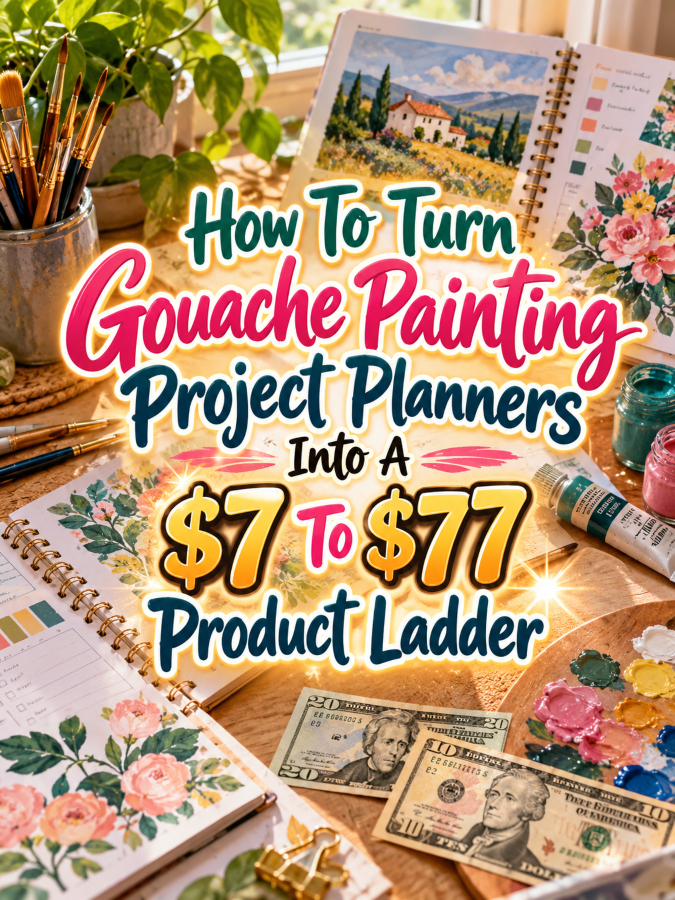
The important part is the value jump. A $7 product should give the buyer a quick win. A $27 product should make planning easier. A $47 product should help organize an actual painting workflow. And a $77 product should save serious time through editable files, examples, customization options, and ready-to-use promotional assets.
Quick Answer
A $7 to $77 product ladder for Gouache Painting Project Planners can begin with a simple painting project worksheet and grow into a complete gouache planning system. The starter product might help an artist plan one painting. The larger versions can add color-mixing records, reference planning, supply tracking, painting logs, practice trackers, project reviews, and editable templates.
The premium version becomes valuable when it helps the buyer customize the system, reuse it for many paintings, organize their workflow, or even adapt the templates for their own creative audience. The goal isn’t to charge more because you added more pages. It’s to charge more because you added more useful work-saving features.
Once you understand that difference, the ladder becomes much easier to build. Let’s look at why gouache is especially suited to this type of product.
Why Gouache Painting Project Planners Work As A Product Ladder
Gouache artists have several small problems that can be handled with practical planning tools. They may want to record color combinations, remember which paper they used, track brush choices, organize reference images, plan a painting before starting, or review what went right and wrong afterward. One simple worksheet can solve one of those problems. A collection of connected worksheets can solve several.
There’s also a natural progression in how artists use planning tools. A beginner may only want a simple project page. A more serious hobby artist may want a full painting journal. An art teacher might want reusable worksheets for students. A content creator may want editable templates they can customize for their own audience. That gives you several legitimate reasons to create different product levels without making every version look like the same PDF wearing a different hat.
The trick is to organize the ladder around the artist’s workflow. Think about what happens before the painting, during the painting, and after the painting. That gives you plenty of room to increase usefulness without stuffing the product with random pages.
The Reasonable Pricing Rule
Before creating four products, decide what each price actually represents. The easiest way to do that is to tie price to usefulness. You’re not charging more because the file got heavier. You’re charging more because the buyer can do more with it.
$7 is for a quick win. This could be a simple Gouache Painting Project Planner with a project overview, reference sketch area, color plan, materials checklist, and short reflection section.
$17 to $27 is for a better kit. Add color-mixing records, palette planning, reference worksheets, supply lists, practice pages, painting review sheets, and multiple project templates.
$37 to $47 is for a working bundle. This should help an artist manage a repeatable painting workflow. You might include a project planner, gouache color journal, practice tracker, painting inventory, reference organizer, project review system, and quick-start guide.
$67 to $77 is for a premium small offer. At this level, editable Canva templates, finished PDFs, customization instructions, promotional copy, mockup ideas, and commercial-use options where appropriate can make the offer much more useful.
The important rule is simple: don’t force a $77 price onto a product that doesn’t deserve it. If the premium version is still basically a short PDF, $77 will feel like a stretch. That’s not a good thing.
With the pricing foundation in place, let’s build the actual ladder.
The $7 Starter Product For Gouache Painting Project Planners
Your $7 offer should be small enough to understand immediately and useful enough that the buyer can use it during their next painting session. A good name could be Gouache Painting Project Planner – 10 Project Pages. The promise isn’t “become a better artist overnight.” It’s simply “plan and review your gouache paintings in one organized place.”
The planner could include project title, date, painting goal, reference inspiration, thumbnail sketch, paper type, surface size, paint colors, brushes, color-mixing notes, composition notes, and a short post-painting review. You could also include one page for “What I’d Change Next Time?” because artists learn a lot from their mistakes, even when the painting itself would prefer everyone forget what happened.
Keep the $7 version focused. Don’t add a giant library of color charts, business worksheets, social media templates, and 60 bonus pages just because you can. Save those additions for the next level. The starter product should feel quick, approachable, and easy to print or use digitally.
What The $7 Product Can Include
- 10 reusable gouache project planning pages
- Painting goal and project title section
- Reference image and thumbnail sketch areas
- Color palette planning section
- Materials checklist
- Painting notes
- Post-project review
- Simple instructions for using the planner
That is enough to create a useful first offer without turning your $7 product into a small publishing company.
Once buyers need more than one project page, you have a natural reason to expand the offer.
The $17 To $27 Expanded Kit For Gouache Painting Project Planners
The next version should feel like a real artist’s organization kit rather than simply “the $7 planner plus 20 more copies of the same page.” A stronger product could be called the Gouache Painting Organization Kit. It can help artists plan projects, document experiments, manage supplies, and keep useful painting information together.
This is where you can introduce specialized worksheets. A color-mixing record can help artists remember how they created a particular shade. A paper comparison page can help them note how different surfaces behaved. A brush and tool tracker can make it easier to remember which tools produced certain effects. A reference planning sheet can help artists move from inspiration to a workable composition.
What To Add At This Level
- Multiple project planner layouts
- Gouache color-mixing records
- Palette planning sheets
- Paper and surface testing logs
- Brush and tool tracking pages
- Reference image planning worksheets
- Painting practice tracker
- Finished painting review pages
- Beginner-friendly instructions
- Example completed pages
A $17 to $27 price makes sense when the buyer isn’t just receiving more paper. They’re receiving a system that helps them organize their painting process and remember useful information they would otherwise lose in a sketchbook pile.
And if you want to move beyond organization into repeatable workflow, that’s where the $37 to $47 bundle comes in.
The $37 To $47 Working Bundle For Gouache Painting Project Planners
At this level, think bigger than a planner. Build a Gouache Painting Project Management System that artists can use across an entire collection of paintings. The buyer should be able to plan a project, prepare materials, document the process, track experiments, review the finished work, and use what they learned on the next project.
You could include a main guide explaining the workflow, a printable workbook, project planners, color-mixing logs, practice trackers, reference planning pages, supply inventory sheets, finished-work reviews, and a simple project index. A digital version could make the system easier to duplicate and reuse.
The bundle can also include practical “decision pages.” For example, a project planning worksheet could ask whether the painting is a study, finished artwork, gift, commission, portfolio piece, or personal experiment. That small detail changes how an artist approaches the project and makes the planner feel much more thoughtful.
Possible Working Bundle Contents
- Complete gouache project planning guide
- Project workbook
- Color recipe and mixing log
- Painting practice tracker
- Reference planning worksheets
- Paper and surface testing log
- Brush and tool inventory
- Painting project index
- Finished artwork review system
- Quick-start workflow
- Painting troubleshooting notes
- Simple project ideas list
This version saves time because the artist doesn’t have to invent their own tracking system every time they begin a new painting. They can open the planner and get moving.
That’s always a good thing, especially when the alternative is spending 45 minutes organizing the art supplies and somehow never actually painting.
Once you’ve created a useful working system, you can build a premium version around customization and editable assets.
The $67 To $77 Editable Premium Kit For Gouache Painting Project Planners
The premium product should feel like a ready-to-customize creative system. A strong name could be Ultimate Gouache Painting Planner Command Center. Instead of simply adding more worksheets, give the buyer flexible assets they can edit, duplicate, brand, print, or adapt.
For example, you could include editable Canva templates, finished PDF versions, digital planning pages, multiple cover designs, alternate page layouts, sample completed pages, and a customization guide. If the product is intended for teachers, art coaches, or creative businesses, you could offer appropriately licensed commercial-use rights. If resale or PLR rights are offered, the license must clearly explain exactly what buyers may and may not do.
You can also add promotional assets. Give the buyer product mockup ideas, listing copy, short social captions, email copy, and suggestions for packaging the templates for a specific audience. The premium value comes from helping someone move from “I have a bunch of templates” to “I know exactly how to use these.”
Possible Premium Contents
- Editable Canva planner templates
- Finished printable PDF versions
- Digital-use versions
- Multiple cover designs
- Color palette and project log templates
- Example completed planner pages
- Customization guide
- Product packaging checklist
- Listing description templates
- Social media promotional copy
- Email promotional copy
- Mockup prompt ideas
- Commercial-use or other clearly defined licensing options where appropriate
The $77 version isn’t more expensive because it has a mountain of pages. It’s more expensive because it can save the buyer time, give them editable assets, and make customization much easier. That’s a real value increase.
Now let’s put the entire ladder in one easy-to-see example.
Example $7 To $77 Ladder For Gouache Painting Project Planners
Here’s one practical way to structure the offers:
| Price | Product | What Gets Added |
|---|---|---|
| $7 | Gouache Painting Project Planner | 10 project pages, color planning, materials, reference planning, painting review |
| $17-$27 | Gouache Painting Organization Kit | Color logs, practice trackers, paper tests, brush tracking, multiple templates, examples |
| $37-$47 | Gouache Painting Project Management System | Complete workflow, workbook, project index, troubleshooting, inventory, planning system |
| $67-$77 | Ultimate Gouache Painting Planner Command Center | Editable templates, digital files, customization guide, promo assets, examples, licensing options where appropriate |
Notice that each level solves a bigger problem. The $7 version helps with one painting. The middle levels help organize repeated painting work. The premium level adds flexibility and saves the buyer from building the entire system themselves.
That’s the secret sauce. You’re not selling four versions of the same thing. You’re creating four levels of usefulness.
Next, let’s look at the tools that can help you build the products without turning the creation process into its own full-time hobby.
Tools You Can Use To Create This Ladder
You don’t need a complicated software stack to create Gouache Painting Project Planners. A small collection of familiar tools can handle most of the work, especially if you’re creating printable PDFs and editable templates.
- Canva for planner layouts, covers, editable templates, mockups, and promotional graphics
- Google Docs for writing instructions, guides, and editable text-based worksheets
- Google Sheets for color inventories, project indexes, supply trackers, or digital logs
- ChatGPT for brainstorming worksheet ideas, organizing sections, writing instructions, and creating product descriptions
- Google Trends for exploring interest around gouache painting, art journaling, painting planners, and related searches
- Etsy for researching how similar digital products are presented and packaged
- Payhip for selling downloadable products
- Gumroad for selling small digital products and bundles
Keep your workflow simple. Create the master version first, then duplicate it for the different price levels. This makes updates much easier when you discover that one worksheet needs a little fixing.
Before you decide that $27 or $77 is the magic number, there’s one more important question to answer: does the product actually feel worth the price?
How To Know If Your Price Is Fair
Pricing becomes easier when you stop asking, “How many pages did I make?” and start asking, “What does this help the buyer accomplish?” A 12-page planner that helps an artist organize every painting project can be more useful than a 70-page PDF full of decorative filler.
Ask yourself a few simple questions before publishing each version. Does the product save the buyer time? Does it help them finish something? Does it include examples? Are the instructions clear? Does the premium version actually offer editable files or other meaningful benefits? Would you feel comfortable buying it at that price?
- Does it save the buyer time?
- Does it help them complete a painting project?
- Does it make information easier to remember?
- Does it include useful examples?
- Does it provide editable files where promised?
- Does it solve a real planning or organization problem?
- Can the buyer see how to use it immediately?
- Does the price match the usefulness?
A higher price becomes easier to justify when the product helps the buyer finish faster, avoid repeated mistakes, customize the system, or use the finished assets in a meaningful way.
Now let’s turn the idea into five manageable steps.
5-Step Action Plan For Gouache Painting Project Planners
Step 1: Pick One Buyer Problem
Start with one specific problem. Don’t begin by trying to create the ultimate art planner for every artist on Planet Earth. Choose something such as planning a painting, recording color mixes, tracking painting practice, or reviewing finished work.
Step 2: Create The $7 Quick Win
Build the smallest useful version around that problem. Create a clean project planner with enough structure to help someone immediately. Make it easy to understand, easy to print, and easy to use.
Step 3: Expand It Into A Kit
Add complementary worksheets that naturally belong with the first product. Color logs, reference planning, brush tracking, paper testing, and practice pages can turn a single worksheet into a useful organization kit.
Step 4: Build The Premium Version
Add editable Canva files, digital versions, examples, customization instructions, promotional assets, and appropriate licensing options. The goal is to remove work for the buyer, not simply make the PDF fatter.
Step 5: Test The Ladder
Review every level from the buyer’s point of view. Make sure each upgrade has a clear reason to exist. If two products feel almost identical, improve the higher version or simplify the ladder. Then test your product descriptions and pricing with real audience feedback.
Once your ladder is built, watch for the pricing mistakes that can quietly turn a useful product into a confusing offer.
3 Ways To Stand Out From The Thundering Herd
Gouache is a popular art medium, which means a generic “painting planner” can easily disappear among dozens of similar-looking products. Your advantage comes from making the planner specific enough that the intended buyer immediately recognizes its usefulness.
1. Build Around Gouache-Specific Workflows
Don’t make a generic art planner and sprinkle the word “gouache” on the cover. Include color-mixing records, opacity notes, layering observations, paper testing, palette planning, and other details that actually matter to gouache artists.
2. Add Real Examples
Show buyers what a completed planner page looks like. A sample project with a reference sketch, palette notes, materials, and final review makes the product much easier to understand.
3. Create Different Artist Versions
Consider separate editions for beginners, hobby artists, art students, teachers, or artists building a portfolio. You don’t have to build all of them at once. One focused edition can become the seed for an entire product family.
Once your product has a clear identity, you need people who actually want it. Fortunately, you don’t have to shout into the internet and hope somebody hears you.
3 Nifty Ways To Find Customers
1. Use Art-Focused Communities
Look for online communities where gouache artists discuss supplies, painting practice, sketchbooks, and creative workflows. Pay attention to repeated questions. Those questions can reveal what people struggle to organize.
2. Use Pinterest For Search-Friendly Content
Create useful pins around phrases such as “gouache painting planner,” “gouache color mixing journal,” “gouache practice tracker,” and “painting project worksheet.” Each pin can lead to a related product or free sample.
3. Sell Through Digital Product Marketplaces
Platforms such as Etsy can help you study how buyers search for printable art resources. You can also use Payhip or Gumroad if you want a simple storefront for your digital products.
Don’t just copy marketplace titles and call it research. Look for patterns in customer needs, product presentation, and the types of features people repeatedly mention.
There are also a few lessons here that are easy to miss if you’re focused only on the price points.
3 Takeaways You Won’t Find Elsewhere
1. A Painting Planner Can Become A Learning Tool
The real value isn’t just organization. When artists record what they used and review the finished painting, the planner becomes a record of their learning. That’s a much stronger product idea than a pretty checklist.
2. Color Records Can Become A Standalone Product
Gouache color mixing is its own little rabbit hole. A well-designed color recipe and mixing journal could become a separate low-cost product, a bundle bonus, or an upgrade path from the main planner.
3. The Best Premium Feature May Be Flexibility
Artists don’t all work the same way. Editable templates let buyers change headings, colors, page sizes, categories, and layouts. That flexibility can be more valuable than another 50 static pages.
Of course, even a good idea can go sideways if the pricing ladder gets bloated. Let’s avoid the usual traps.
Common Pricing Mistakes To Avoid
Charging $77 for a thin PDF: A premium price needs premium usefulness. If the buyer receives only a short printable, don’t pretend it is a command center.
Adding pages instead of usefulness: Ten useful pages beat 60 repetitive ones. Artists can spot filler faster than you might think.
Making every version too similar: Each level should solve a different amount of the buyer’s problem. If the $7 and $47 products feel almost identical, the ladder needs work.
Forgetting editable files: If you charge a premium for customization, actually provide editable assets. “Editable” shouldn’t mean the buyer can print it and write on it with a pen.
Offering resale rights without clear terms: If you include commercial use, resale, or PLR rights, explain exactly what the buyer can do. Don’t leave licensing rules vague.
Using fake income claims: Your product can be useful without promising that buyers will make money. Let the usefulness do the selling.
Making the ladder confusing: Buyers should understand the difference between $7, $27, $47, and $77 in seconds. Confusion is not a premium feature.
Once the basic ladder works, you can expand the business without immediately creating 47 new products.
Scaling Your Results
Start by improving the product that already exists. Add better examples, clearer instructions, more useful page layouts, or a digital version based on customer questions. A small update can make an existing product more valuable than launching another random printable.
Then create related products from the same customer. A gouache artist who buys a project planner might also need a color mixing journal, painting challenge tracker, art supply inventory, sketchbook planner, painting habit tracker, or portfolio project planner. That’s how one good product can become a small product family.
You can also create themed editions. Think botanical gouache, landscape gouache, food illustration, children’s illustration, travel sketching, or seasonal painting projects. The underlying system can remain similar while the examples and prompts change.
That’s much smarter than rebuilding your entire business from scratch every Tuesday.
With the product family growing, you’ll need promotional language that makes the offer easy to understand.
Simple Promo Angles For Gouache Painting Project Planners
Keep your promotional messages focused on the problem the planner solves. You don’t need dramatic promises. A clear benefit can be much more convincing.
- “Plan your next gouache painting before you touch the brush.”
- “Keep your color mixes, materials, and painting notes in one place.”
- “Stop losing the notes that could help you paint the next one better.”
- “Turn your gouache practice into an organized creative routine.”
- “Use the templates instead of building your own art planner from scratch.”
- “Customize your painting planner to fit the way you actually create.”
You can turn these angles into Pinterest titles, Etsy listing headlines, short videos, email subject lines, or social posts. Keep the promise specific and believable.
There are also a few natural affiliate opportunities that can fit this niche without turning the article into a shopping catalog.
Affiliate Opportunities
If you use affiliate marketing alongside your digital products, focus on tools that genuinely support the artist’s workflow. Art supplies, sketchbooks, brushes, storage solutions, digital tablets, printing supplies, and creative software can all fit naturally around a gouache planning audience.
You can also recommend the tools you use to create and sell the planner. Canva is relevant for editable designs, while Payhip and Gumroad can fit a digital-product selling workflow. If you use affiliate links, disclose them clearly and only recommend products you genuinely believe are useful.
The strongest affiliate content won’t feel like “Here are 19 things you can buy.” It will feel like helpful advice from someone who understands the workflow.
And because this topic fits neatly into a broader creative-printables site, you can build internal links that encourage readers to explore related products.
Internal Link Ideas
If you’re building a larger printable business, link this article to related topics such as:
- Painting Practice Trackers
- Watercolor Project Planners
- Sketchbook Project Planners
- Art Supply Inventory Printables
- Creative Project Planners
- Color Palette Journals
- Artist Portfolio Planners
- Art Business Planners
These links help readers discover related solutions while also giving search engines more context about the topics your site covers.
Pinterest is another natural fit because planners are visual products. A few smart pin concepts can keep sending attention toward the offer long after the original post is published.
Pinterest Ideas For Gouache Painting Project Planners
- “Gouache Painting Planner Printable”
- “Gouache Color Mixing Journal”
- “How To Plan A Gouache Painting”
- “Gouache Painting Practice Tracker”
- “Printable Art Project Planner”
- “Gouache Artist Organization Ideas”
- “Painting Journal Pages For Gouache Artists”
- “Creative Printable Ideas For Artists”
Show actual planner pages in your pins whenever possible. A close-up of a useful worksheet gives people a reason to click because they can see what they’re getting.
Before wrapping up, let’s answer the questions a potential buyer or product creator is likely to ask.
Frequently Asked Questions
Can I sell a Gouache Painting Project Planner for $7?
Yes. A focused planner that solves one clear problem can work well as a low-cost digital product. Keep it useful and specific rather than trying to make it a complete art education program.
What should go into a gouache painting planner?
Useful sections can include project goals, reference planning, thumbnail sketches, color palettes, paint colors, paper or surface information, brushes, materials, painting notes, and a finished-project review.
How can I make the product worth $27?
Add useful companion tools rather than simply adding repeated planner pages. Color-mixing logs, practice trackers, reference planning sheets, paper testing logs, examples, and better instructions can create a meaningful upgrade.
What makes a $47 gouache planner bundle different?
The $47 version should function more like a complete working system. It can combine the planner, workbook, color records, supply tracking, project index, troubleshooting resources, and a repeatable workflow.
What could justify a $77 version?
Editable Canva templates, finished PDFs, digital versions, examples, customization instructions, promotional assets, and appropriate licensing options can justify the higher price when they genuinely save the buyer time.
Do I need to be a professional gouache artist to create these products?
No, but you should understand the buyer’s needs well enough to create something useful. You can research artist workflows, study common planning problems, gather feedback, and build a product around organization rather than pretending to teach advanced painting techniques you don’t understand.
Can I create different versions for different artists?
Absolutely. You could create beginner, hobby artist, teacher, sketchbook, landscape, botanical, or illustration-focused versions. Start with one audience before expanding.
Now you’ve got the structure. The next step is to stop admiring the idea and build the first useful version.
Your Next Steps
Start with the $7 product. Choose one problem that a gouache artist would genuinely like to solve. Build a clean planner around that problem and make sure someone can understand how to use it without needing a 30-minute orientation call.
Once that version is solid, expand it into the $17 to $27 kit. Add useful companion worksheets, examples, and instructions. Then turn the best pieces into a $37 to $47 working system. Only after those products make sense should you build the premium editable version.
Remember, you don’t need everything finished today. One useful product is enough to get the process moving. Then you improve it based on what buyers actually need.
Here’s the ladder one more time so you can see the whole thing at a glance.
Final Ladder Summary
$7 Starter: Gouache Painting Project Planner with project goals, reference planning, color palette notes, materials, painting notes, and a finished-project review.
$17 to $27 Kit: Gouache Painting Organization Kit with multiple planner layouts, color-mixing records, practice trackers, paper testing, brush tracking, reference planning, and examples.
$37 to $47 Bundle: Gouache Painting Project Management System with the complete workflow, workbook, project index, inventory tools, troubleshooting, planning resources, and reusable project management pages.
$67 to $77 Premium Kit: Ultimate Gouache Painting Planner Command Center with editable templates, digital files, finished PDFs, customization instructions, examples, promotional assets, and clearly defined licensing options where appropriate.
The $7 version gives the buyer a quick win. The $17 to $27 version gives more help. The $37 to $47 version gives them a working system. The $67 to $77 version gives them flexibility, editable assets, and time-saving implementation support.
That’s a real ladder. No fluff staircase required.
And that brings us to the big takeaway.
Conclusion
Gouache Painting Project Planners can start as a tiny printable and grow into a useful digital product family. The opportunity isn’t in making the biggest planner possible. It’s in understanding what artists need before, during, and after a painting project, then turning those needs into practical tools.
Start with one $7 quick win. Make it genuinely useful. Then listen to what buyers need next. Add the right templates, examples, tracking pages, and workflow tools. When you eventually reach the premium level, make sure the price reflects real convenience and flexibility rather than a mountain of extra pages.
If you want to build this product, open Canva, choose one clear buyer problem, and create the first planner page today. You don’t need the whole ladder yet. You just need the first useful step.
So here’s what you discovered today. If something sparked your interest, take it as your sign to start moving toward that goal now. Even one small step counts.
Enjoy!