
Introduction
There are people who walk through the woods and see a fallen log, a patch of moss, and some strange little mushroom growing underneath a tree. Then there are people who stop, take a picture, wonder what they’re looking at, and suddenly realize they’ve spent twenty minutes staring at fungi. If you’re creating digital products, that curiosity is exactly where an interesting niche can begin.
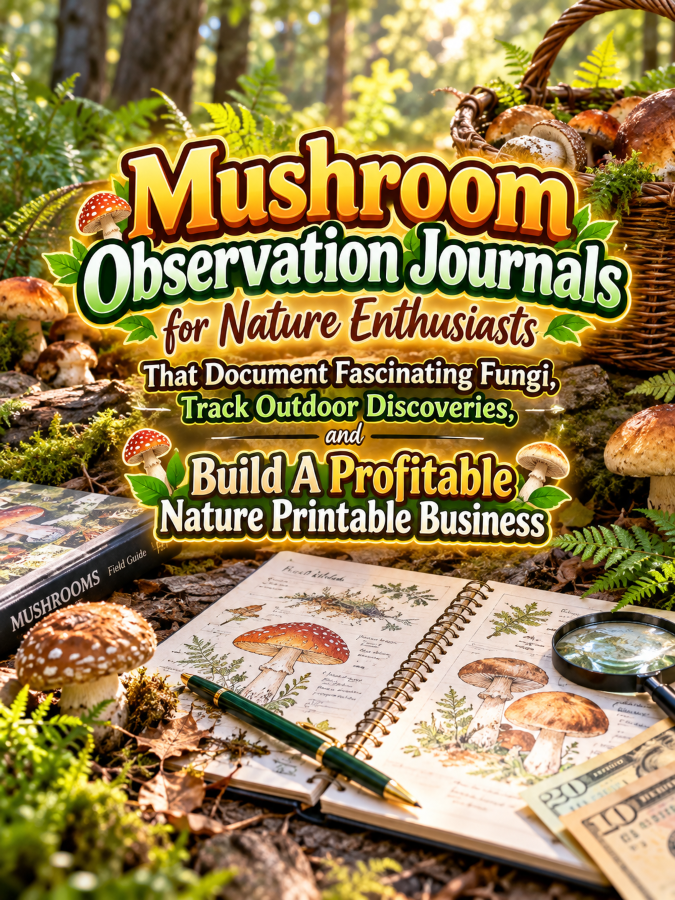
Mushroom Observation Journals give nature enthusiasts a simple way to record what they discover outdoors without turning the product into a complicated scientific textbook. You can create pages for sightings, locations, weather, habitat, photographs, personal observations, and seasonal patterns. Good Thing, because you don’t need to become a mycology professor before creating a useful observation journal.
This niche also has something every digital product creator loves: a natural connection between the hobby and documentation. People who enjoy observing mushrooms may want to remember where they found them, what they looked like, what the surroundings were like, and when they appeared. That means you’re not selling a pretty PDF just because it has mushrooms on the cover; you’re selling a system for turning outdoor discoveries into an organized personal collection.
Quick Answer
Mushroom Observation Journals can become profitable digital products by helping nature enthusiasts document mushroom sightings, record habitat conditions, organize photographs, track seasonal discoveries, and build a personal fungi observation collection. Start with a simple $7 journal containing sighting and observation pages, then expand into field notebooks, seasonal trackers, photography logs, nature journals, and larger mushroom observation bundles. Focus your product on recording observations rather than making claims about mushroom safety, edibility, or identification.
Why This Niche Works
Nature hobbies often create a natural desire to keep records. Birdwatchers maintain life lists, hikers record trails, gardeners track plants, and photographers catalog locations, so mushroom enthusiasts can have their own version of an organized discovery system. A journal gives them a place to turn random sightings into something they can revisit later.
Mushrooms are also visually fascinating, which gives your product excellent opportunities for attractive covers and interior pages. Different shapes, textures, colors, habitats, seasons, and growth patterns can inspire beautiful journal designs without requiring complicated artwork. Your buyers aren’t necessarily looking for another generic notebook; they’re looking for something that feels connected to the hobby they already enjoy.
And here’s the sneaky-good part: the same basic product can branch into multiple related products. You could create beginner observation journals, mushroom photography logs, forest discovery journals, seasonal fungi trackers, nature walk journals, and collection-style observation books. That’s Not a Good Thing if you build everything at once, but it is a very Good Thing when you’re ready to expand a product line.
What You Can Put Inside Your Mushroom Observation Journal
1. Mushroom Observation Profile
Start with a simple page that gives every observation its own identity. Include fields for observation date, general location, habitat, weather conditions, nearby plants or trees, and the observer’s own notes. You can also include a space for a photograph or sketch so the page becomes a visual record rather than just a collection of words.
Keep the wording focused on observation rather than definitive identification. A field such as “My Description” is safer and more useful than forcing users to declare exactly what species they found. That lets the journal work for beginners while leaving scientific identification to appropriate references or qualified experts.
2. Mushroom Sighting Log
A straightforward sighting log can become one of the most-used pages in the entire journal. Give users space to record when they spotted something interesting, where they were, what the surroundings looked like, and what caught their attention. Add a small rating or checkbox section for things such as unusual shape, interesting texture, large cluster, unusual color, or favorite discovery.
This page works especially well because it can be completed quickly while someone is outdoors or immediately after returning home. You want the journal to feel useful rather than like homework. If the page takes longer to complete than the walk itself, you’ve probably created a thingee that needs a little trimming.
3. Habitat and Environment Notes
Mushrooms can appear in very different environments, so create a dedicated page for recording the surroundings. Users could note whether the observation occurred in woodland, grassland, garden areas, near fallen wood, around leaf litter, or in another general environment. They can also record weather observations, moisture, shade, and other visible environmental details.
This turns the journal into more than a collection of mushroom pictures. Over time, users may notice patterns in where and when they make interesting observations. You’re giving them a structured way to pay attention to the environment around the discovery.
4. Mushroom Photography Log
Photography and mushroom observation make a natural combination. Create pages where users can record the date and general location of a photograph, camera or phone used, lighting conditions, composition notes, and what they liked about the image. Include a large photograph area so the journal can become a visual collection.
You could even create a separate Mushroom Photography Challenge section with prompts such as close-up texture, mushroom in habitat, mushroom beside natural surroundings, cluster composition, and seasonal comparison. These pages add a creative element without requiring you to teach photography. You’re simply helping people organize the photographs they’re already taking.
5. Nature Walk Discovery Log
Don’t make every page about the mushroom itself. A nature enthusiast may discover mushrooms while hiking, walking through a park, exploring a forest, or spending time in a garden. Create a broader discovery page where users can record other interesting plants, insects, birds, trees, rocks, or natural features they noticed during the same outing.
This makes your journal more useful to people who enjoy nature as a whole. You can still keep mushrooms as the main theme while allowing the surrounding environment to become part of the story. That makes the journal feel like an outdoor adventure record rather than a collection of isolated observations.
6. Seasonal Mushroom Observation Tracker
Create a calendar-style tracker where users can record observations throughout the year. They might note the month, general weather conditions, habitat, and whether the discovery was especially interesting. Over time, the tracker becomes a visual summary of their outdoor observation habits.
You can create separate pages for spring, summer, autumn, and winter or use a twelve-month annual tracker. This also gives you an easy product extension because a seasonal mushroom observation pack could become a standalone low-priced product later. See what I mean? One little page just gave you another thingee to sell.
7. Favorite Discovery Pages
Some observations are simply more memorable than others. Give users pages where they can record their favorite discoveries, add photographs, describe what made the observation special, and write down where they were when it happened. These pages can become the emotional heart of the journal.
You can add prompts such as “Most surprising discovery,” “Most unusual-looking observation,” “Favorite photograph,” and “Best nature walk.” Those prompts encourage people to tell the story behind the observation. And stories make ordinary tracking products much more memorable.
8. Personal Observation Collection Tracker
Finish the core journal with a master collection page. Users can number their observations, record dates, note general locations, and mark whether they photographed or sketched each discovery. This creates a satisfying sense of progress as the collection grows.
You could also add milestone pages for 10 observations, 25 observations, 50 observations, and 100 observations. These aren’t scientific claims or official records; they’re simply personal hobby milestones. That’s a Good Thing because the product remains useful without pretending to be an authoritative identification or research system.
Tools You’ll Need
You don’t need an expensive design studio to build your first Mushroom Observation Journal. Canva can handle the page layouts, covers, typography, decorative elements, and printable formatting. Google Docs can help you organize your written prompts and product structure before you move everything into your final design.
For selling and delivering your products, you can use platforms such as Gumroad or Teachable, depending on the type of product business you’re building. If you want to create an email audience around your nature-printable products, AWeber or GetResponse can help you manage your subscribers and promotional emails.
For market research, browse nature communities, photography groups, hiking discussions, craft marketplaces, and relevant search results to see what people actually want to record. You can also use Amazon mushroom journal and field-guide research to study existing formats, page ideas, and customer expectations. Don’t copy another creator’s product, of course; study the market so you can find gaps and build something useful in your own way.
Your 5-Step Action Plan
Step 1: Choose Your Mushroom Observer
Start by deciding who you’re creating for. Your audience could be beginner nature enthusiasts, mushroom photographers, hikers who enjoy fungi discoveries, nature journalers, families exploring outdoors, or collectors who simply love documenting unusual finds.
The more specific your first customer becomes, the easier your design decisions become. A beginner-friendly journal can use simple prompts and lots of writing space, while a photography-focused version might need larger image areas. Pick one audience first rather than trying to build the mushroom journal for every human who has ever walked past a tree.
Step 2: Build Your Core 10 to 15 Pages
Don’t start by creating 100 pages because bigger sounds more valuable. Create a useful core product containing your observation profile, sighting log, habitat notes, photography log, seasonal tracker, nature walk page, favorite discovery page, and collection tracker.
Then print or test the pages yourself. Can you understand what you’re supposed to write? Is there enough room for photographs? Are the checkboxes useful? If you notice yourself thinking, “Why is this box even here?” your buyer probably will too.
Step 3: Create a $7 Starter Product
Your first offer can be a simple Mushroom Observation Starter Journal priced around $7. Include enough pages to solve one clear problem: helping nature enthusiasts record and organize their mushroom observations.
Keep the product focused and easy to understand. Your listing should explain exactly who it’s for, what it contains, and how it can be used. Don’t hide the actual value under a mountain of decorative language and seventeen font styles.
Step 4: Create Related Products
Once your starter product is complete, look for natural extensions. A Mushroom Photography Log, Seasonal Mushroom Observation Tracker, Forest Nature Walk Journal, or Mushroom Discovery Challenge could each become a separate product.
These smaller products can eventually be bundled together. That gives customers more choices while giving you additional products to promote without inventing an entirely new niche every Tuesday morning.
Step 5: Build Your Product Ladder
Your product ladder can begin with the $7 starter journal and grow from there. A $17 expanded observation journal could add photography pages, seasonal trackers, nature walk logs, and additional observation sheets, while a $27 workbook could include a more complete year-round observation system.
Your $47 offer could become a Mushroom Nature Explorer Binder with multiple journal formats, challenge pages, seasonal sections, photography logs, and collection trackers. Your $77 offer could become a comprehensive Nature Observation Library combining mushroom journals with broader fungi and outdoor observation products, giving your best customers a larger collection without requiring you to create a completely unrelated business.
What Comes Next?
Once your first Mushroom Observation Journal is published, your next job isn’t necessarily creating another product immediately. First, watch what people respond to. Pay attention to which pages attract attention, which questions customers ask, and which parts of the product people seem most interested in.
Maybe buyers love the photography pages. Maybe they want more seasonal tracking. Maybe they want a version designed for kids or families. Those signals can tell you where to expand without relying on guesswork.
The goal isn’t to build a thundering herd of mushroom printables overnight. The goal is to build one useful product, learn from it, and then create the next useful product based on what your audience actually needs. That’s how a quirky little nature journal can turn into a real digital product collection.
3 Ways to Stand Out From The Thundering Herd!
1. Make It Feel Like a Nature Adventure, Not a Spreadsheet
There is absolutely nothing wrong with a useful tracker, but a mushroom journal can become much more interesting when it feels like an invitation to explore. Instead of filling every page with boxes and numbers, give users room for sketches, photographs, observations, memories, and little discoveries from the trail. You want someone to open the journal and think, “Ooooh, I want to go outside and find something!”
Use earthy layouts, generous writing areas, interesting observation prompts, and visual sections that make the journal enjoyable to complete. You can include pages such as “My Most Curious Discovery,” “Strangest Shape I’ve Seen,” or “Favorite Forest Walk.” That’s a Good Thing because you’re selling an experience around the hobby, not just a stack of printable forms.
2. Create a Mushroom Discovery Passport
Here’s a fun product feature that can make your journal feel different: turn the observation process into a personal discovery passport. Give users spaces for numbered observations, dates, general locations, photographs, and personal notes, then add milestone pages as their observation collection grows.
You could include milestones such as 10 observations, 25 observations, 50 observations, and 100 observations. These aren’t official scientific achievements, but personal hobby milestones can make people want to keep going. And once somebody starts thinking, “I’m only three observations away from my next milestone,” you’ve created a little bit of healthy journal momentum.
3. Build Versions for Different Nature Enthusiasts
One mushroom journal doesn’t have to serve everyone. You can create a beginner-friendly version with simple observation prompts, a photography version with larger image spaces, a family version with child-friendly prompts, or a nature journaling version that includes sketches and broader environmental observations.
You can even create a compact field version designed to be printed and carried outdoors, plus a larger keepsake version designed for completing observations at home. That’s Not a Good Thing if you make every variation before you’ve tested your first product, but it’s a very Good Thing once customer feedback shows you which audiences deserve their own version.
3 Nifty Ways to Find Customers
1. Find People Who Already Photograph Mushrooms
Photography communities are a natural place to look for potential customers because mushroom photography already creates a reason to document observations. Search for nature photography groups, fungi photography communities, hiking groups, outdoor photography pages, and social content featuring interesting mushroom discoveries.
Don’t approach those communities like a salesperson with a megaphone. Instead, create content that gives photographers and nature enthusiasts a reason to care about organizing their observations. A post showing “5 things to record every time you photograph an interesting mushroom” can naturally lead people toward a more complete observation journal.
2. Create a Free Mushroom Observation Sheet
A free one-page observation sheet can become your easiest lead magnet. Include the observation date, general location, habitat notes, weather, photograph area, personal description, and a “What made this discovery interesting?” section.
Let people download the sheet in exchange for joining your email list or following your content channel. Once they’re using the free page, you can introduce the expanded journal, seasonal tracker, photography log, or bundle. That’s a much smoother customer journey than shouting “BUY MY PDF!” into the internet void.
3. Create Content Around the Observation Hobby
Content marketing can work particularly well for unusual niches because people often search for inspiration before they search for a product. You could create posts about keeping a nature observation journal, organizing outdoor photographs, preparing for a mushroom-spotting walk, or creating a personal seasonal nature collection.
Each piece of content gives you another opportunity to demonstrate the usefulness of your journal. Pinterest graphics, short videos, blog posts, email newsletters, and social media posts can all show individual pages or explain how someone might use them. Five good messages beats 50 generic ones every single time, so focus each piece of content on one specific problem or curiosity.
3 Takeaways You Won’t Find Elsewhere!
1. You’re Really Selling the Memory of the Discovery
The mushroom itself may disappear, but the photograph, notes, location memory, and story can remain. That makes your journal more than a tracking tool because it becomes a record of time spent outdoors. Someone might eventually look through an old journal and remember the rainy afternoon, forest trail, or unexpected discovery that happened years earlier.
That emotional layer is something many generic trackers completely miss. Include enough space for users to explain why an observation mattered to them. When a product helps someone preserve a memory while also organizing information, you’ve increased its usefulness without making it complicated.
2. Observation Is More Important Than Knowing Everything
Your buyer doesn’t need to know every mushroom species before using the journal. In fact, beginners may enjoy the hobby precisely because they’re curious and still learning. Your product can encourage careful observation without requiring users to make definitive scientific claims.
Prompts such as “What did you notice?”, “Where was it growing?”, “What did the surroundings look like?”, and “What photograph did you capture?” keep the journal accessible. That makes it welcoming to curious beginners while still giving experienced nature enthusiasts plenty of room to record details.
3. One Observation Can Become Several Pieces of Content
Here’s a clever content-creation opportunity hiding inside the journal. One outdoor observation could produce a journal entry, a photograph, a social media post, a nature story, a seasonal comparison, or a personal collection milestone.
That means your product can encourage people to interact with their hobby in multiple ways. And as the creator, you can use the same idea when marketing the product: demonstrate one observation and show how the journal helps turn that moment into an organized record. That’s a Good Thing because you’re showing the product in action instead of merely telling people that it exists.
3 Common Mistakes to Avoid
1. Don’t Turn the Journal Into a Mushroom Identification Manual
This is probably the biggest distinction to keep clear. A journal can help people record what they observe, but it shouldn’t pretend to provide authoritative identification or safety guidance. Mushroom identification can involve serious expertise, and incorrect assumptions about wild mushrooms can have serious consequences.
Keep your product focused on observation, documentation, photography, habitat notes, and personal records. If you include a reminder about identification, encourage users to consult qualified experts and reliable specialist resources rather than treating your printable as an authority. Trust me, you’ll thank me later.
2. Don’t Make Every Page Too Complicated
Nature journaling should feel relaxing, not like filling out a tax return while standing in the woods. If every observation requires twenty fields, people may stop using the journal after their second outing. Give them enough structure to capture useful information while leaving room for simple observations.
A quick observation page can be especially valuable because users can complete it in a few minutes. Then you can offer longer reflection pages for people who enjoy spending more time documenting their discoveries. Give the customer options rather than forcing every observation into the same level of detail.
3. Don’t Forget the Broader Nature Experience
People often discover mushrooms while doing something else. They may be hiking, photographing nature, exploring a park, gardening, camping, or simply taking a walk after a rainy day. If your journal only talks about the mushroom and ignores the surrounding experience, you may miss part of what makes the hobby enjoyable.
Add a few pages for nature walks, weather observations, other wildlife, interesting plants, scenery, and favorite outdoor memories. This gives the journal more personality while still keeping mushrooms at the center of the product. That’s Not a Good Thing if you turn it into a completely generic nature journal, so keep those supporting pages connected to the main theme.
Scaling Your Results
Once your first journal is selling, you can build a small mushroom and nature observation product ladder around the same audience. Your $7 starter could be a Mushroom Observation Journal with essential sighting pages, while your $17 product could add photography logs, seasonal tracking, nature walks, and additional observation sheets. Your $27 workbook could become a full-year Mushroom Observation Workbook with monthly sections, discovery challenges, reflection pages, and collection milestones.
Then you can move into higher-value bundles. A $47 Mushroom Explorer Binder could combine several journal formats, field observation pages, photography logs, seasonal trackers, and nature discovery sheets, while a $77 Nature Observation Library could combine mushroom-focused products with broader fungi, forest, and outdoor observation resources. You don’t need to create everything at once; build one layer, see what customers respond to, and then add the next.
A collection containing 40 well-designed mushroom and nature observation products could potentially generate an additional $700 to $2,200 per month through bundles, repeat customers, memberships, and complementary offers, although actual results will vary based on traffic, pricing, product quality, audience fit, and marketing. The important word there is “potentially,” because digital products aren’t vending machines where you insert 40 PDFs and money magically falls out. Your traffic, positioning, presentation, customer demand, and consistency still matter.
Your Next Steps
Start with one simple audience and one clear purpose. For example, you could create a Mushroom Observation Journal for beginner nature enthusiasts who want to document interesting fungi they discover during walks. Keep the first version focused enough that you can actually finish it instead of spending six months choosing between 47 shades of mushroom brown.
Create your core pages, test them yourself, and make sure the writing areas are large enough for real-world use. Print a few pages and imagine carrying them outdoors, photographing something interesting, then filling them in later at home. If the process feels natural, you’re on the right track.
After publishing, create a few pieces of promotional content around the problems your journal solves. Show how one observation becomes a complete journal entry, explain why recording habitat details can make a nature walk more memorable, or demonstrate how a seasonal tracker works. Then watch the questions and comments you receive because your audience may hand you your next product idea without charging you a consulting fee.
Final Thoughts
Mushroom Observation Journals are a great example of how a seemingly unusual hobby can become a practical digital product niche. You’re taking curiosity, outdoor exploration, photography, and personal record-keeping and turning them into one organized experience. The key is to make the journal useful without pretending it is a scientific authority or a mushroom safety guide.
The real opportunity comes from building around the observer rather than the mushroom alone. Give people a way to remember where they went, what they noticed, what they photographed, what surprised them, and how their collection of observations grows over time. Suddenly, your printable isn’t just a bunch of pages; it’s a personal archive of outdoor discoveries.
And remember, you don’t need to build the ultimate mushroom journal on your first attempt. Start small, make it genuinely useful, listen to your buyers, and let their questions guide the next thingee you create. That’s it. That’s your beginning! If you were creating your first Mushroom Observation Journal tomorrow morning, would you make it a beginner discovery journal, a mushroom photography log, a seasonal observation tracker, or a full nature-walk journal with mushrooms as the main theme? Pick one, create the first few pages, and get that little fungi-focused product moving.
Enjoy!