Introduction
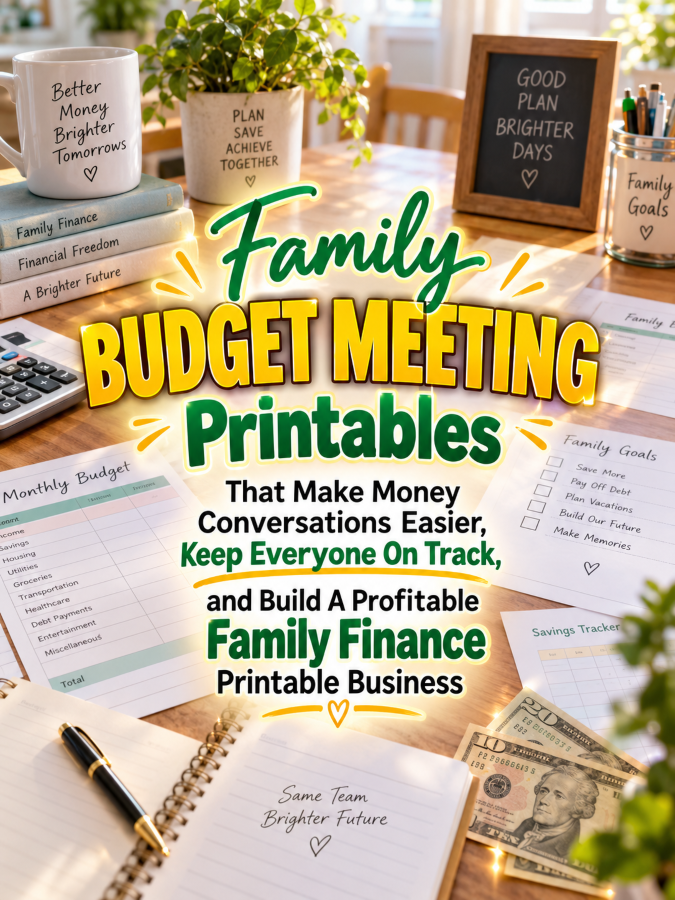
Money conversations can get awkward fast, especially when a family is trying to figure out bills, spending, savings, debt, groceries, and all those sneaky little expenses that somehow multiply when nobody is looking. One person says, “We need to cut back,” another says, “But I only bought a few things,” and suddenly the family budget meeting feels less like a planning session and more like a courtroom drama with snacks. That’s exactly why Family Budget Meeting Printables can become a useful digital product because they give families a simple structure for talking about money without making every conversation feel stressful.
The opportunity here isn’t really about creating another generic monthly budget sheet. It’s about helping families sit down together, look at the numbers, make decisions, and leave the conversation knowing what happens next. When your printable helps turn a confusing money discussion into a repeatable family routine, you’re no longer selling a worksheet; you’re selling clarity, cooperation, and fewer “Wait, who was supposed to pay that?” moments.
And here’s the Good Thing: you don’t need to be a financial expert to create a useful family budget meeting product. You need to understand the everyday questions families actually ask and organize those questions into simple pages that make sense. Trust me, you’ll thank me later when you realize that one strong meeting printable can become the starting point for an entire family finance product ladder.
Quick Answer
Family Budget Meeting Printables are reusable worksheets and planning pages that help households prepare for regular money meetings, review income and expenses, discuss upcoming costs, set priorities, and agree on financial actions. Instead of asking families to stare at a giant spreadsheet and hope somebody understands it, your product can guide them through one decision at a time. That makes the printable useful for couples, families with children, roommates, newlyweds, and anyone who wants a calmer way to talk about household money.
A simple $7 starter product could include a monthly family budget meeting agenda, income and expense review, upcoming bills page, savings check-in, spending discussion page, and action-items sheet. You can then expand the idea into a $17 meeting bundle, a $27 family finance workbook, a $47 household money management binder, and a $77 comprehensive family budgeting library. The goal is to create a product ladder where each purchase solves a bigger version of the same problem instead of throwing a completely unrelated bunch of thingees at the buyer.
Why This Niche Works
Families often know they should talk about money, but knowing you should do something and actually doing it are two very different things. A budget meeting can feel intimidating because there may be several accounts, bills, subscriptions, savings goals, debt payments, upcoming expenses, and spending habits to discuss. A printable gives the conversation a starting point and helps everyone focus on the same information instead of wandering into five different money arguments at once.
There’s also a strong recurring-use advantage because household finances change constantly. One month might involve school expenses, the next could bring car repairs, birthdays, insurance payments, medical bills, holidays, or an unusually large grocery bill. A reusable meeting system gives families a reason to return to the product instead of downloading it once and forgetting it exists.
Another opportunity comes from creating different versions for different households. A newlywed couple may need a very different meeting format from a family with teenagers, while a single-income household may have different discussion points from a dual-income household. You don’t have to build every version on day one, either, because one strong core product can become the foundation for several targeted products later.
What You Can Put Inside Family Budget Meeting Printables
1. Family Budget Meeting Agenda
Start with a simple meeting agenda that tells everyone exactly what the conversation will cover. You might include sections for checking last month’s results, reviewing current bills, discussing upcoming expenses, checking savings goals, identifying problem areas, and choosing next actions. The purpose isn’t to create a twelve-page corporate board meeting for people sitting around a kitchen table, because nobody needs that kind of excitement on a Tuesday night.
Keep the agenda short enough that families will actually use it. You could create checkboxes beside each discussion area so the family can move through the meeting without wondering what comes next. This page can become the anchor of the entire product because every other worksheet supports the conversation that happens around it.
2. Monthly Money Check-In
A monthly check-in page can help families quickly review what happened financially during the previous month. Include areas for total income, major expenses, unexpected expenses, savings progress, debt payments, and anything that needs attention. You can also include a small section asking, “What worked well?” because budgeting shouldn’t always feel like a list of things the family did wrong.
This page creates a simple before-and-after rhythm for the meeting. Families review what happened, decide what needs to change, and then record the next steps. That makes your printable feel more like a decision-making tool than another place to write numbers.
3. Upcoming Expenses Planner
Unexpected expenses are often less unexpected than families think because birthdays, school fees, annual subscriptions, holidays, insurance payments, and vehicle expenses usually have some warning attached to them. Create a page where families can list upcoming expenses, expected amounts, due dates, and how they plan to cover them. This helps turn future financial surprises into things the household can actually prepare for.
You can make this even more useful by adding categories such as household, transportation, school, family events, holidays, subscriptions, and annual expenses. The buyer can then scan the page during every budget meeting and decide which expenses need money set aside now. That little shift from “Oh no, that bill is coming” to “We knew this was coming” is a meaningful transformation.
4. Family Spending Discussion Sheet
This page can help families talk about spending without immediately turning the conversation into blame. Instead of asking, “Who spent too much?” you can use neutral prompts such as “Where did we spend more than expected?” and “Which expenses were worth it?” The goal is to make the conversation about patterns and decisions rather than pointing fingers.
You can include three simple columns for “Keep,” “Change,” and “Discuss.” Families can place spending categories into the appropriate column and talk through the items together. Suddenly, the meeting has a structure, and that structure can prevent the thundering herd of random opinions from taking over.
5. Savings Goal Check-In
Families often have several savings goals happening at the same time, such as an emergency fund, vacation, home project, vehicle, education, or special purchase. Create a visual page where each goal has a target amount, current amount, deadline, and next contribution. A progress bar or simple thermometer-style graphic can make the page more motivating without requiring complicated financial calculations.
You can also add a section for deciding which goal gets priority this month. That creates an important conversation because families usually have limited money and multiple things they want. Helping them choose what matters most makes the printable much more valuable than simply giving them another blank savings tracker.
6. Bill Review Sheet
A bill review page can help families identify what is due, when it is due, how much it normally costs, and whether anything has changed. Include recurring bills such as rent or mortgage, utilities, internet, insurance, subscriptions, transportation, and other household obligations. You could also add a column for “Needs attention” so families can flag bills that need cancellation, renegotiation, checking, or follow-up.
This can become especially useful when paired with an annual review section. Families can periodically look at subscriptions and recurring services and ask whether each expense is still necessary. That turns the printable into a money-saving tool instead of simply a record-keeping tool.
7. Family Financial Decisions Page
Some money conversations aren’t about routine expenses at all; they’re about decisions. Maybe the family is considering a vacation, replacing an appliance, buying a vehicle, enrolling a child in an activity, or starting a large home project. A decision page can give them space to record the estimated cost, benefits, alternatives, timing, and financial impact before making the decision.
This is a great place to create a simple “Can we afford it?” checklist. You can ask whether the expense fits the current budget, whether it affects savings goals, whether there are lower-cost alternatives, and whether the purchase is urgent. You’re not telling the family what decision to make, because that’s their job; you’re simply giving them a better way to have the conversation.
8. Family Money Action Plan
Every budget meeting should end with decisions that somebody can actually act on. Create a final action-plan page with columns for the task, person responsible, deadline, and status. This prevents the classic family budget meeting ending where everyone nods enthusiastically and then nobody remembers what they agreed to do three days later.
You can also add a small “Before our next meeting” section for reminders. Families might need to cancel a subscription, transfer money into savings, compare an insurance renewal, update a bill, or research a purchase. This page turns the meeting from a conversation into a simple operating system for household finances.
Tools You’ll Need
Canva can handle most of the design work for your Family Budget Meeting Printables. Use clean typography, generous writing space, clear sections, and simple visual cues so the pages feel approachable rather than intimidating. A family finance printable should look organized enough to inspire confidence without looking like it was designed by an accountant who has personally declared war on white space.
Google Docs can help you draft questions, meeting prompts, instructions, product descriptions, and worksheet wording before moving the final design into Canva. This is especially useful when you’re testing different questions because you can revise the language quickly. Clear wording matters because even a beautiful worksheet becomes a That’s Not a Good Thing if buyers don’t understand what they’re supposed to write.
AWeber can help you build an email list around simple family budgeting and household organization content. You could offer a free one-page Family Budget Meeting Starter Sheet in exchange for an email address and then introduce subscribers to your larger products. This gives you a way to keep talking to potential customers instead of hoping they randomly discover your shop again.
GetResponse is another option for building landing pages, email sequences, and simple marketing campaigns around your printable products. You could create a short welcome sequence that teaches subscribers how to hold a monthly family money meeting and naturally introduces your paid products. The important thing is to make the emails useful first because 5 good messages beats 50 generic ones every single time.
Gumroad can give you a straightforward place to sell downloadable versions of your family budgeting products. You can start with a small starter product and gradually add bundles, workbooks, and larger systems as you learn what buyers want. That lets you test the idea without spending months building a giant catalog nobody asked for.
Teachable can become useful if you eventually turn the printable concept into a mini-course or guided family budgeting program. Imagine selling a printable meeting kit alongside short lessons explaining how to prepare for the meeting, review spending, set priorities, and create follow-up actions. Now you’re building beyond a single PDF and creating multiple ways for customers to buy help around the same problem.
Amazon can help you research existing family budget planners, household finance books, budgeting worksheets, and related products. Pay attention to the questions customers ask in reviews because those comments can reveal what people find confusing, useful, missing, or frustrating. You’re not copying somebody else’s product; you’re listening for the problems your own printable could solve better.
Your 5-Step Action Plan
Step 1: Choose One Family Money Problem
Don’t begin by trying to create the ultimate family finance binder with enough pages to qualify as carry-on luggage. Start with one clear problem, such as families struggling to hold a monthly budget meeting without arguing or forgetting important topics. When the problem is specific, your product becomes much easier to design and explain.
Write one sentence describing the transformation your printable provides. For example, you might say, “This printable helps families hold a simple monthly money meeting and leave with clear financial action steps.” If every page supports that sentence, you’re moving in the right direction.
Step 2: Build the $7 Starter Product
Create a compact starter kit containing the meeting agenda, monthly money check-in, upcoming expenses planner, spending discussion sheet, savings check-in, and action plan. Keep the design clean and make every page immediately understandable. Your first goal isn’t to create the biggest product; it’s to create something useful enough that a buyer can print it tonight and use it at the next family budget meeting.
Add a one-page instruction sheet explaining how to prepare, how long the meeting can take, and how to use the worksheets. That little guide can make the product feel much more complete. It also gives you an opportunity to teach the buyer how to get results from the printable instead of simply handing them a stack of pages.
Step 3: Create a Free Sample
Turn one useful page into a free download, such as a Monthly Family Budget Meeting Agenda. Offer it through your email list, blog, social media content, or other channels where families interested in budgeting already spend time. The freebie should solve a small problem while naturally showing buyers why they might want the complete system.
Your content can demonstrate how to prepare for a budget meeting, what questions to ask, and how to keep money conversations from becoming blame sessions. You can create short posts around topics such as “5 Questions to Ask at Your Monthly Family Money Meeting” or “What to Review Before Your Family Budget Meeting.” Each piece of content can point toward the free printable and eventually toward the paid product.
Step 4: Build the Product Ladder
Once your starter product is working, expand it logically. Your $7 offer could become a $17 Family Budget Meeting Bundle, a $27 Family Finance Workbook, a $47 Household Money Management Binder, and a $77 Family Budgeting Library containing specialized planners, trackers, goal sheets, and meeting systems. Each level should add meaningful depth rather than simply adding 40 pages of decorative thingees.
You can also create specialized versions for different audiences. Consider newlywed budget meetings, family budgeting with teenagers, single-parent household budgeting, annual family finance meetings, holiday spending meetings, back-to-school budget meetings, and family savings goal planners. One strong idea can become an entire product family when you keep solving closely related problems.
Step 5: Test, Improve, and Expand
Put the first version in front of real people and watch what they actually use. If buyers repeatedly skip a page, struggle with a question, or ask for a missing section, those are clues for your next version. Good products aren’t carved into stone; they’re improved through observation, feedback, and repeated use.
Keep a simple list of customer questions and requests. Those questions can eventually become new products, blog posts, email topics, bonuses, or upgrades. That’s it. That’s your beginning!
What Comes Next
The real opportunity with Family Budget Meeting Printables is that the meeting itself becomes the center of a much larger household money organization system. Once you help families prepare for the conversation, you can create tools for tracking what they discuss, organizing their goals, preparing for annual expenses, reviewing subscriptions, planning large purchases, and following up on decisions. You’re building a connected product ecosystem rather than a random pile of budget PDFs.
That ecosystem can also create repeat customers because families’ financial planning needs change throughout the year. Back-to-school season can create one need, the holidays can create another, and tax or annual planning periods can create another. When your products meet those recurring moments, your shop has more opportunities to stay relevant.
And remember, you don’t need a thundering herd of products to get started. One genuinely useful Family Budget Meeting Printable can give you the foundation for the next product, the next email, the next blog post, and the next customer conversation. Build the first useful thingee, learn from the people who use it, and then make the next thingee better.
Here’s Part 2, continuing the Family Budget Meeting Printables product strategy with differentiation, customer-finding ideas, scaling, and the next practical steps.
3 Ways to Stand Out From The Thundering Herd!
Way 1: Sell the Conversation, Not Just the Budget
Most budget printables focus heavily on numbers, categories, and totals, but your product can focus on what happens when two or more people actually sit down to discuss those numbers. Include conversation prompts that help families talk about priorities, upcoming expenses, spending concerns, savings goals, and decisions without turning every category into a blame game. This gives your printable a different purpose because you’re helping people communicate about money, not simply record it.
You could create prompts such as “What surprised us this month?”, “What expense needs attention?”, “What are we saving for right now?”, and “What financial decision do we need to make together?” Keep the questions neutral and practical so the family can discuss the issue without immediately assigning fault. That little shift can make your product feel less like a spreadsheet and more like a useful family routine.
Way 2: Create a “No-Blame Budget Meeting” System
Money can become emotional very quickly, so build a system that deliberately keeps the meeting focused on facts, choices, and next steps. You could include a simple rule page that encourages everyone to review the numbers before discussing them, separate problems from people, and finish each issue with a clear action. You’re not promising to eliminate every disagreement, because let’s be honest, families are still families, but you are giving the conversation some guardrails.
Consider adding sections called “What Happened,” “What We Need to Decide,” and “What We’ll Do Next.” This creates a simple progression that prevents the meeting from getting stuck in complaints about the past. It also gives your product a memorable feature that you can mention repeatedly in your marketing.
Way 3: Build Around Real Family Money Moments
Instead of creating one enormous generic budgeting system, create specialized meeting pages for situations families actually experience. You could have a Back-to-School Budget Meeting, Holiday Spending Meeting, Vacation Planning Meeting, New Baby Budget Meeting, Home Project Budget Meeting, or Annual Family Finance Meeting. These targeted products make it easier for buyers to recognize themselves in your offer.
They also give you more opportunities to create content throughout the year. A back-to-school budget product can become a summer marketing campaign, while a holiday spending meeting kit can become a seasonal product. Suddenly your printable business has a calendar instead of one lonely product sitting on a digital shelf hoping somebody wanders past it.
3 Nifty Ways to Find Customers
Way 1: Talk About the Money Questions Families Already Have
Create content around the questions that make household budgeting difficult rather than simply posting pictures of your printable. Topics such as “How Often Should Couples Talk About Money?”, “What Should You Discuss at a Monthly Budget Meeting?”, and “How Do You Plan for Large Family Expenses?” can attract people who are already thinking about the problem. Then offer a free Family Budget Meeting Agenda as the natural next step.
Keep the content practical and approachable because people don’t need another lecture about how they should magically become perfect budgeters. Show them how to prepare for a 20-minute conversation, what information to bring, and which questions to ask. When your free content helps someone have a better conversation, your paid printable becomes a logical extension rather than a hard sell.
Way 2: Create a Free “Family Money Meeting Starter Kit”
Your freebie could contain one meeting agenda, five conversation prompts, an upcoming-expenses page, and a simple action-items sheet. That gives people enough value to try the concept while leaving room for the full paid system to provide more depth. Make the free version genuinely useful because the best lead magnet doesn’t just collect an email address; it demonstrates that you understand the buyer’s problem.
Once someone downloads it, your email sequence can show them how to run their first meeting. One message could explain preparation, another could cover spending discussions, another could cover savings goals, and another could introduce your complete printable system. This creates a helpful journey from “I don’t know where to start” to “I have a system I can actually use.”
Way 3: Create Versions for Specific Family Situations
Specificity can make marketing much easier because a person is more likely to notice a product that describes their actual situation. Consider creating versions for couples combining finances, families with teenagers, families preparing for a major purchase, households trying to reduce unnecessary spending, or families working toward a shared savings goal. You can also create seasonal versions around holidays, vacations, school expenses, and annual financial reviews.
Each version can have a slightly different set of prompts while keeping the same core meeting framework. That means you’re not rebuilding your entire business from scratch every time you create a new product. You’re adapting a proven system to a different family money moment, which is a much smarter use of your creative energy.
3 Takeaways You Won’t Find Elsewhere!
Takeaway 1: The Real Product Is Better Decisions
A family doesn’t really want another sheet of paper covered with boxes. They want to know what needs attention, what they can afford to prioritize, what needs to change, and what everyone agreed to do next. Your printable becomes valuable when it helps the family move from information to decisions.
That means every page should have a job. If a worksheet collects information but doesn’t help the family discuss, decide, plan, or act, ask whether it really belongs in the product. Pretty pages are nice, but useful pages are what create repeat buyers and referrals.
Takeaway 2: Make Progress Visible
Families can lose motivation when budgeting feels like an endless cycle of bills and restrictions. Add simple ways to see progress, such as savings goal bars, debt-payment milestones, monthly wins, upcoming goals, or “things we improved this month” sections. These elements help the family see that budgeting isn’t only about saying no; it’s also about making room for things that matter.
You could even add a monthly “Money Win” box where the family records one positive result. Maybe they avoided an unnecessary purchase, increased savings, paid an extra bill, canceled an unused subscription, or simply held the meeting when they normally would’ve skipped it. Small wins make the system feel human, and human products tend to get used more than intimidating ones.
Takeaway 3: Design for the Next Meeting
A clever feature is to make every meeting prepare the family for the next one. Include a “Bring to Next Meeting” section where users can record receipts, questions, upcoming bills, decisions that need follow-up, or financial information they need to gather. This creates a natural loop that encourages continued use.
You can also add a recurring meeting checklist that families print once and reuse each month. When buyers start thinking of your printable as part of their household routine, you’ve moved beyond a one-time download. That’s a Good Thing because recurring usefulness is one of the strongest qualities a printable product can have.
3 Common Mistakes to Avoid
Mistake 1: Making It Feel Like an Accounting Workbook
Families don’t necessarily want to become amateur accountants during their Tuesday night budget meeting. If every page is filled with tiny boxes, complicated calculations, and dense financial terminology, people may close the PDF before they reach page three. Keep the language simple and focus on decisions that ordinary households actually need to make.
Use clear headings, generous writing space, and short prompts. You can make the product comprehensive without making every page look busy. Remember that clarity is part of the product, not merely a design preference.
Mistake 2: Creating a Rigid System That Doesn’t Fit Real Families
Not every household gets paid on the same schedule, uses the same accounts, or handles money in the same way. Some families have irregular income, some have one primary income source, and others have several sources that change throughout the year. If your printable assumes one perfect budgeting method, you may accidentally exclude the very people who need flexibility.
Give users room to adapt the system. Instead of forcing every family into identical categories, allow them to add their own priorities and expense types. Flexible design makes your printable useful across more households without requiring you to create a completely different product for every buyer.
Mistake 3: Forgetting the Follow-Up
A meeting without follow-up can become an expensive way to have a nice conversation and accomplish absolutely nothing. If your printable ends after the family discusses the numbers, you’re missing one of the most important parts of the process. Include action items, deadlines, responsibilities, and a simple way to check progress before the next meeting.
You can even create a “Last Meeting / This Meeting” comparison page. Families can quickly review what they said they would do and whether those actions happened. That creates accountability without turning your printable into a nagging spouse with a clipboard.
Scaling Your Results
Once your core Family Budget Meeting Printable is finished, you can turn the idea into a complete family finance collection. Your $7 starter product might contain the basic meeting agenda and worksheets, while a $17 bundle could add seasonal meeting pages and specialized conversation prompts. A $27 workbook could provide a complete 12-month family money meeting system, while a $47 binder could organize household bills, goals, savings, spending reviews, and annual planning.
Your $77 offer could become the Family Money Meeting Library, containing monthly meeting kits, annual review pages, seasonal budgeting systems, savings goal trackers, large-purchase decision sheets, subscription review pages, family financial goal planners, and versions for different household situations. You can also create add-on products rather than forcing everything into one giant package. This gives customers choices while giving you more opportunities to sell closely related products.
There are also content opportunities hiding inside the product. You could publish blog posts about preparing for a family budget meeting, create short videos showing how to use each section, offer email challenges that encourage families to hold their first meeting, and create seasonal campaigns around major spending periods. One printable can become a product, a freebie, a blog series, an email sequence, a social media campaign, and several follow-up products.
A collection containing 40 well-designed family finance products could potentially generate an additional $700 to $2,200 per month through bundles, repeat customers, memberships, and complementary offers, although actual results will vary based on traffic, pricing, product quality, audience fit, and marketing. The number isn’t the promise; the important idea is that a focused catalog can create several related paths to revenue. You don’t need 40 products immediately, and you certainly don’t need to stay awake until 2 a.m. designing page 38 just because page 37 looked lonely.
Your Next Steps
Start by creating your simplest useful version of the Family Budget Meeting Printable. Build the agenda first, then add the monthly money check-in, upcoming expenses page, spending discussion sheet, savings check-in, and action plan. Print the pages yourself and pretend you’re using them during an actual family meeting because that will quickly reveal which questions feel useful and which ones sound like they escaped from a finance textbook.
Next, create a small free sample and use it to start collecting interested buyers. Write helpful content around family money conversations rather than constantly saying “Buy my printable!” because people need to understand the problem before they understand why your product matters. Once you see which questions and topics attract attention, use that information to decide what your next paid product should contain.
Then build your product ladder slowly. Add seasonal versions, specialized family versions, larger bundles, and eventually a complete household money management system. Don’t let the thundering herd convince you that you need 100 products before you can make a sale because thoughtful, useful, problem-focused products can do far more work than a mountain of generic PDFs.
Final Thoughts
Family Budget Meeting Printables solve a surprisingly human problem because household finances aren’t only about numbers; they’re also about communication, priorities, expectations, and decisions. A good printable gives everyone a shared place to look, a clear set of questions to discuss, and a practical way to record what happens next. That’s what makes this niche interesting for a digital product creator because the value comes from improving the process, not simply decorating another budget worksheet.
Your biggest opportunity is to make the product feel approachable. Families shouldn’t need a finance degree, a calculator the size of a microwave, or three cups of coffee just to understand the first page. Give them simple prompts, useful structure, enough writing space, and a repeatable routine, and you’ve created something that can become part of their household system.
And don’t forget to build around the moments when families naturally need financial conversations. Back-to-school expenses, holidays, vacations, major purchases, annual planning, changing income, and new family goals can all become specialized products that grow from your original idea. One useful printable can become a whole family finance product line when you keep solving the next logical problem instead of chasing every shiny new niche that runs past your window.
That’s it. That’s your beginning! If you were creating your first Family Budget Meeting Printable tomorrow morning, would you start with the monthly money check-in, the upcoming-expenses planner, or the no-blame conversation guide? Pick the page that solves the biggest headache first, make it genuinely useful, and then build the rest of the system around it.
Enjoy!