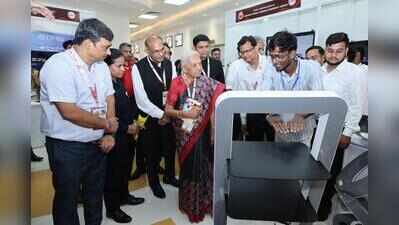
 The two-day AI manthan began at CSJMU on Saturday
 The two-day AI manthan began at CSJMU on Saturday
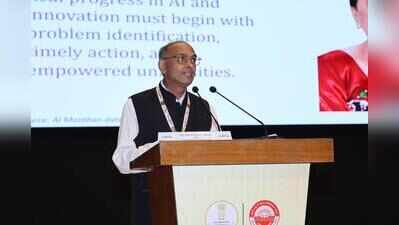 The two-day AI manthan began at CSJMU on SaturdayThe two-day AI manthan began at CSJMU on SaturdayThe two-day AI manthan began at CSJMU on SaturdayThe two-day AI manthan began at CSJMU on SaturdayThe two-day AI manthan began at CSJMU on Saturday Kanpur: Over 56 lakh students across UP are actively registered on the Samarth portal. During the academic session 2025-26, admissions of nearly 22.5 lakh first-semester students in 7,200-plus colleges were done online. More than 21 lakh results were also processed through this digital platform introduced by the Centre for automating and managing administrative and academic operations for higher education institutions.The figures were shared by OSD to Governor Sudhir M Bobde during the second edition of AI Manthan hosted by Chhatrapati Sahu Ji Maharaj University (CSJMU), Kanpur, on Saturday.Showing a PowerPoint presentation, Bobde said over the past two years, 49 state universities and more than 9,600 colleges in the state had been brought onto the Samarth platform.He also applauded CSJMU for adopting the highest of 38 modules – 100% coverage – in the Samarth portal.Highlighting AI Manthan’s journey and UP’s digital transformation, CSJMU vice-chancellor Prof Vinay Pathak said: “Expanding the scope of AI discussions, we have incorporated healthcare, agriculture and other sectors prominently into the second edition of the summit. The first edition of AI Manthan primarily focused on higher and technical education.”Tracing the development of AI from the late 1950s to the present era of generative AI, IIT Kanpur director Prof Manindra Agrawal said: “There is immense excitement around AI today, but the core concept has been intertwined with computing since day one. AI is not a sudden breakthrough; its underlying mathematical and structural concepts have evolved alongside computing since the late 1950s.”Stressing the need for responsible governance, institutional safeguards and ethical frameworks in ensuring that AI remains beneficial to society, Prof Agrawal said: “Higher education institutions (HEIs) must place greater emphasis on critical thinking, problem-solving, and original research.”Stating that India needs to pay greater attention to smaller language models trained on local datasets, former IIT Kharagpur director Prof Partha Pratim Chakrabarti said: “AI models trained primarily on Western data may not adequately understand the languages, cultures and social conditions of Indian communities.”He also stressed that AI does not have an inherent understanding of human ethics. Human feedback is therefore required to ensure that AI systems remain aligned with human expectations and values.Speaking on the application of AI in healthcare, Dinesh MS from Philips India said: “AI can help doctors by reducing repetitive work and providing additional information during diagnosis. In radiology, for instance, AI can act as a secondary reader and help identify subtle abnormalities that may be missed because of fatigue or differences in interpretation.”
Content Curated Originally From Here