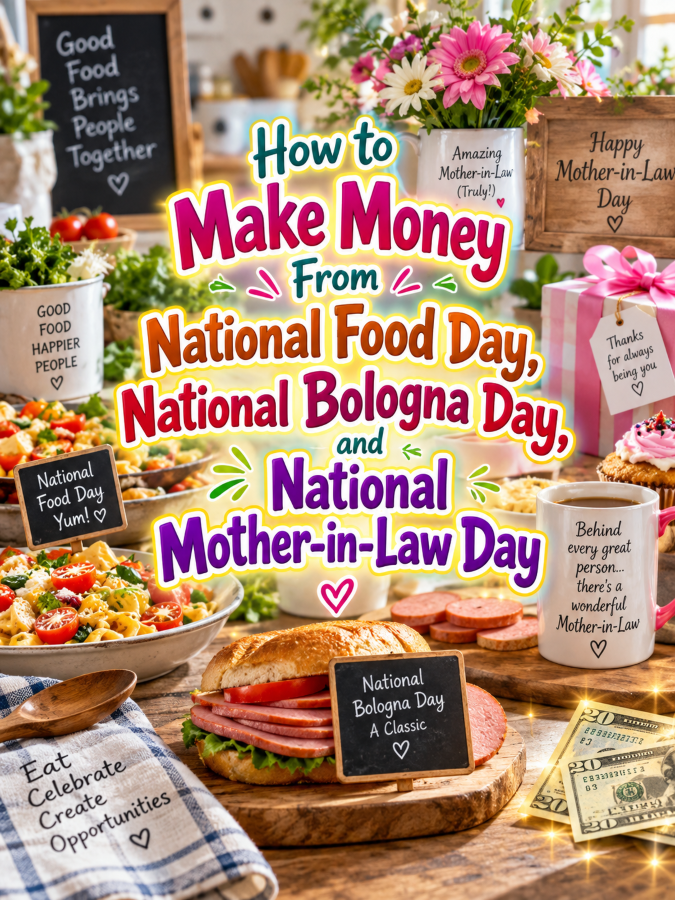
Turn Three Unexpected October Observances Into Delicious, Giftable, and Highly Marketable Digital Products!
Some holidays practically hand you a product idea on a silver platter. National Food Day is one of those holidays. It gives us an enormous playground filled with recipes, meal planning, grocery organization, food budgeting, kitchen systems, family meals, food education, sustainability, and all the little things that happen between “What should we eat tonight?” and “Why did I buy three jars of mustard again?”
Then we have National Bologna Day, which takes us into nostalgic food, sandwiches, recipes, humor, parties, and quirky celebration products. And finally, National Mother-in-Law Day gives us an entirely different market built around appreciation, family gatherings, gift giving, personalized printables, and relationship-focused products. Three observances, three audiences, three very different reasons people might open their wallets.
That makes this another excellent example of the holiday-product strategy. We aren’t trying to convince people that they desperately need a printable because a particular date appeared on the calendar. We’re using the date as a marketing hook for products that solve real problems or help people celebrate something meaningful.
National Food Day — October 24, 2026
National Food Day gives digital product creators one of the broadest audiences imaginable because, well, people eat. Every single day. Sometimes several times a day. Occasionally while standing in front of the refrigerator insisting there is “nothing to eat” while staring directly at enough food to feed a small committee.
The opportunity is much bigger than recipes. Food touches planning, budgeting, shopping, organization, family routines, entertaining, cooking, food education, sustainability, and personal record keeping. That means you can approach this holiday from dozens of angles while still creating products that remain useful long after October 24.
Start Your Research
- Google Search: National Food Day October 24
- Google Search: National Food Day Activities and Ideas
- Google Search: National Food Day Recipe Ideas
- Google Search: National Food Day Food Education Activities
What Is National Food Day?
National Food Day is observed annually on October 24 and focuses attention on food and the larger food system. It has been associated with encouraging people to think more intentionally about the food they eat, food education, healthier choices, and a more sustainable food system.
From a digital-product perspective, this creates a huge opportunity because the holiday can attract people interested in making better food decisions without requiring you to create medical or individualized nutrition advice. You can stay firmly in the practical organization lane: planning meals, organizing recipes, reducing food waste, preparing grocery lists, tracking pantry items, planning family meals, and creating more intentional food routines.
How Is National Food Day Celebrated?
People can celebrate National Food Day by learning about food, preparing meals, trying new recipes, discussing where food comes from, supporting local food sources, planning meals, exploring food-related education, and becoming more intentional about food choices. Schools, community organizations, families, food businesses, and food creators can all approach the observance differently.
That flexibility is fantastic for digital products. You could create a classroom food-education pack, a family meal-planning kit, a recipe organization system, a grocery planner, a pantry inventory, or a food-waste reduction worksheet. One holiday gives you access to multiple audiences without forcing them into the same product.
3 Ways to Make Money From National Food Day
1. Create Meal Planning and Grocery Organization Printables
Meal planning is one of the most evergreen food-related product categories you can build. A well-designed meal planner can include weekly menus, grocery lists, pantry checks, freezer inventories, meal-prep schedules, recipe references, leftovers planning, and notes for future meals.
You can make specialized versions for different audiences, too. Create a family meal planner, a busy-parent meal planner, a monthly meal planner, a freezer-meal planner, a budget-conscious grocery planner, or a meal-prep workbook. The core concept stays the same while the positioning changes. And positioning matters because “meal planner” is broad, while “family meal planner that helps organize dinners and grocery shopping” tells the buyer exactly why they should care.
2. Build Recipe Journals and Recipe Organization Systems
Recipe organization is another strong opportunity because many people have recipes scattered everywhere. They have screenshots, handwritten cards, bookmarks, social-media saves, old family recipes, cookbooks, and approximately seventeen recipes called “THE ONE” that may or may not actually be the one.
Create a printable recipe journal with structured sections for ingredients, preparation, cooking time, serving size, source, substitutions, notes, ratings, and “make again” status. You could also include pages for family favorites, holiday recipes, recipes to try, seasonal meals, recipes from friends, and treasured family recipes.
3. Create Food Organization and Food-Waste Reduction Printables
National Food Day can also become the perfect launch point for kitchen organization products. Pantry inventory sheets, freezer trackers, expiration-date logs, leftover planners, food-storage labels, grocery inventory pages, and “use what you have” meal-planning worksheets can all help customers become more organized.
This category is especially appealing because the customer benefit is concrete. You’re not simply giving someone a pretty printable. You’re helping them see what they already have, plan what they need, and reduce unnecessary duplicate purchases. If the printable helps someone discover they already own four bottles of soy sauce, you’ve done the Lord’s work.
Money-Making Tip #1: Solve the Food-Planning Problem, Not Just the Food-Planning Theme
It’s tempting to decorate a printable with vegetables, utensils, pretty recipe cards, and cute kitchen illustrations and call it a product. But design alone isn’t the value. The value comes from helping someone accomplish something faster, more easily, or with less mental clutter.
Ask yourself what the customer is struggling with. Are they tired of deciding what to cook? Do they waste groceries? Do they forget ingredients? Do they have recipes scattered across multiple places? Do they need a better family meal system? The answer to those questions should determine the pages you create.
Build a National Food Day Product Ladder
National Food Day gives us enough territory to create a substantial product ladder. Start with a small, affordable printable and then expand into more comprehensive systems. Customers who like the first product can naturally move toward a larger bundle.
- $7: Weekly Meal Planner and Grocery List
- $12: Recipe Organization Journal
- $17: Monthly Meal Planning Workbook
- $27: Pantry, Freezer, and Grocery Organization Bundle
- $47: Complete Family Meal Planning System
- $77: Ultimate Kitchen and Food Organization Collection
The higher-priced bundle could include meal planners, recipe journals, grocery lists, pantry inventories, freezer trackers, food-prep pages, leftovers planners, seasonal meal planners, kitchen organization sheets, and family food-planning resources.
Create Products for Different Food Audiences
One of the smartest ways to expand your National Food Day product line is to segment the audience. A parent managing family dinners has different needs from a food blogger. A homeschool teacher needs something different from a meal-prep enthusiast. A recipe collector wants a different experience from someone trying to organize their pantry.
- Families: meal planners, grocery organizers, family recipe journals, and weekly dinner systems.
- Home cooks: recipe journals, cooking logs, meal-prep planners, and recipe collections.
- Food bloggers: recipe-development journals, content calendars, photography checklists, and editorial planners.
- Teachers: food-education activities, food-system worksheets, and classroom discussion resources.
- Homeschoolers: food science activities, cooking planners, food research worksheets, and family cooking projects.
- Organization enthusiasts: pantry inventories, freezer trackers, food-storage labels, and kitchen systems.
National Food Day for Food Bloggers and Creators
Food bloggers have another reason to love this holiday: content. A single food observance can inspire recipes, articles, videos, social posts, newsletters, shopping guides, educational content, and printable freebies. That creates an opportunity for digital products that help food creators organize the entire process.
Consider creating a recipe-content planner with pages for recipe ideas, testing notes, ingredient costs, photography plans, article outlines, keywords, social-media posts, email campaigns, publication dates, and content repurposing. You could also create a seasonal food-content calendar that helps creators plan content around food holidays throughout the year.
National Food Day for Teachers and Homeschoolers
Food is also a terrific educational topic because it connects science, geography, culture, agriculture, economics, history, and everyday life. You could create age-appropriate printable activities that explore where food comes from, food production, food waste, seasonal foods, farming, food traditions, or the journey from farm to table.
For younger learners, keep activities simple and visual. For older students, you can create research prompts, food-system diagrams, writing activities, comparison charts, and project planners. The key is to avoid presenting individualized dietary or medical advice. Keep the focus on general education and organization.
Other Ways to Make Money Around National Food Day
Think beyond the kitchen. Food-related digital products can include entertaining planners, recipe exchange cards, dinner-party organizers, potluck planners, food-tasting sheets, farmers-market planners, seasonal produce trackers, cookbook planners, family food-memory journals, and culinary travel journals.
You can also create products around food memories. A family recipe journal could include spaces for who created the recipe, where it came from, when the family traditionally prepares it, special memories connected to it, and photographs. That transforms an ordinary recipe collection into a keepsake.
Research Food Products Before You Design
Before creating anything, research what customers are already purchasing. Look at meal planners, pantry inventories, recipe journals, grocery organizers, kitchen printables, and food-business templates. Notice the product sizes, page counts, layouts, wording, themes, and customer reviews.
- Research Meal Planners on Etsy
- Research Recipe Journals on Etsy
- Research Pantry Inventory Printables on Etsy
- Design Food Printables in Canva
- Research Meal Planner Ideas on Pinterest
- Research Food Organization Printables on Google
Amazon Research for Food and Kitchen Products
Amazon can help you understand the physical products surrounding the food organization market. Search for recipe binders, meal planners, kitchen organizers, pantry labels, food journals, grocery planners, and cookbooks. Customer reviews can reveal useful clues about what people find helpful and what frustrates them.
- Meal Planners on Amazon
- Recipe Journals on Amazon
- Pantry Organization Products on Amazon
- Grocery Planners on Amazon
Promote National Food Day Before October 24
Start your promotional content early. You can publish posts about meal-planning ideas, recipe organization, food-storage tips, grocery organization, kitchen routines, family meal systems, or ways to celebrate National Food Day. Each piece of content can naturally point toward a relevant printable.
Pinterest is particularly useful because food and organization content are highly visual and highly searchable. Create several pins around different problems instead of creating twenty versions of the same graphic. One pin might focus on meal planning, another on pantry organization, another on recipe collection, and another on reducing food waste.
Turn National Food Day Into an Evergreen Business
The strongest products here don’t need October 24 at all. A meal planner can sell in January when people are organizing their routines. A grocery planner can sell every week. A recipe journal can become a holiday gift. A pantry inventory can become part of a broader home-organization system. A food-content planner can serve bloggers all year.
That means National Food Day is simply your promotional doorway. Once customers discover your products, you can continue serving them with related resources. This is the difference between creating a holiday novelty and building a digital-product catalog.
Next, we’re going to take one of the most wonderfully nostalgic foods imaginable and see how bologna can inspire recipe cards, sandwich planners, tasting trackers, retro-food printables, party products, humorous gifts, and a surprisingly entertaining little digital-product ladder.
National Bologna Day — October 24, 2026
Now we arrive at the holiday nobody saw coming: National Bologna Day. Yes, bologna. The humble lunch-meat staple that has spent decades appearing in school lunches, quick sandwiches, family refrigerators, and jokes about things being, well, “baloney.” And while it may not sound like an obvious digital-product niche, that is precisely why I want to explore it.
Quirky holidays can be surprisingly useful because they give you permission to be playful. National Bologna Day can support nostalgic food products, sandwich recipes, tasting activities, retro-food journals, party printables, humorous products, and content designed for people who enjoy unusual food observances. You don’t have to build an entire business around bologna. You simply need to recognize that a funny little holiday can create a reason for people to search, share, celebrate, and buy.
Start Your Research
- Google Search: National Bologna Day October 24
- Google Search: National Bologna Day Activities and Ideas
- Google Search: Bologna Sandwich Recipe Ideas
- Google Search: Retro Food Party Ideas
What Is National Bologna Day?
National Bologna Day is observed on October 24 as a celebration of bologna and the many ways people enjoy this familiar food. Traditional celebrations can be as simple as making a bologna sandwich, trying a different preparation, sharing childhood food memories, or having a little fun with one of America’s classic lunch-meat staples.
From a digital-product perspective, the most interesting part isn’t the food itself. It’s the combination of nostalgia + humor + recipes + celebration. Those four ingredients can produce products that are fun, giftable, easy to promote, and inexpensive to create. And unlike a complicated niche requiring a PhD in something-or-other, this one mostly requires creativity and a willingness to embrace the silliness.
How Is National Bologna Day Celebrated?
People can celebrate by preparing favorite bologna sandwiches, trying fried bologna, experimenting with different toppings, sharing recipes, hosting a retro-food gathering, or simply reminiscing about meals they enjoyed growing up. Food bloggers can use the holiday for recipe content, while families can turn it into a playful themed lunch or dinner.
This gives us several product angles. You can create printable recipe cards, sandwich-building worksheets, tasting trackers, retro-food journals, party games, food-memory prompts, and themed celebration kits. The products can be intentionally humorous or can lean more heavily into nostalgia and family memories.
3 Ways to Make Money From National Bologna Day
1. Create Nostalgic Recipe and Sandwich Printables
A simple product could be a collection of printable recipe cards focused on sandwiches and nostalgic lunch foods. Include spaces for ingredients, preparation instructions, favorite toppings, substitutions, ratings, and notes. You can expand the idea into a “Retro Lunch Recipe Journal” containing pages for classic sandwiches, lunchbox favorites, family recipes, and childhood food memories.
You can also create sandwich-building worksheets where customers can record bread choices, fillings, toppings, sauces, cheeses, preparation methods, and ratings. That turns an ordinary sandwich into a tiny food experiment. Is it necessary? Absolutely not. Is it fun? Also absolutely yes.
2. Build Bologna Day Party and Tasting Printables
Quirky food holidays are perfect for small gatherings. Create a printable Bologna Day party kit with invitations, menu cards, food labels, tasting sheets, voting cards, recipe cards, conversation prompts, and humorous certificates. You could even create a “Best Bologna Creation” voting sheet for a family or friend-group tasting.
For a broader product, turn the concept into a retro-food tasting party kit. Bologna can be the featured example, while the product itself supports gatherings around nostalgic foods, old-fashioned snacks, classic sandwiches, or childhood favorites. This makes the product much more evergreen.
3. Create Food Nostalgia Journals and Memory Products
Food memories can be surprisingly powerful. Create a journal where customers record foods they remember from childhood, favorite school lunches, family recipes, holiday meals, restaurants they loved, foods they couldn’t stand, and recipes passed down through generations.
National Bologna Day can provide the humorous entry point, but the underlying product becomes a broader food-memory journal. You could create versions for grandparents, parents, families, couples, or anyone who enjoys documenting personal history through food. Suddenly our humble slice of lunch meat has become a gateway to storytelling.
Money-Making Tip #2: Let the Humor Get Attention, Then Give Customers Something Useful
Quirky holidays are excellent for grabbing attention, but attention alone doesn’t create a strong product business. Use the humor to make people stop scrolling, then give them a product that actually does something. A funny Bologna Day graphic might attract the click, while a nostalgic recipe journal or retro-food party kit gives the customer a reason to buy.
This is an important distinction for novelty products. You can absolutely create humorous printables, but the strongest products usually have a second layer of usefulness. A funny bologna-themed party invitation is cute. A complete retro-lunch party kit with invitations, menu cards, tasting sheets, games, and recipe cards has much more perceived value.
Build a Bologna Day Product Ladder
Because this is a quirky holiday, you don’t necessarily need a huge catalog. A small ladder of focused products can be enough. Start with a low-priced novelty product and then move customers toward broader nostalgia or food-related collections.
- $7: Bologna Day Recipe and Tasting Cards
- $12: Retro Sandwich Recipe Journal
- $17: Nostalgic Food Memory Journal
- $27: Retro Food Party Printable Kit
- $47: Classic Lunch and Food Nostalgia Bundle
- $77: Ultimate Retro Food Celebration Collection
The $77 collection could include recipe cards, sandwich planners, food-memory journals, tasting sheets, party games, invitations, menu cards, food labels, and nostalgic food prompts. Bologna becomes the fun launch theme, but the larger collection can appeal to anyone interested in retro food and family memories.
Use Bologna Day for Humorous Digital Products
Not every product has to be serious. In fact, a holiday like this gives you an excellent opportunity to experiment with humor. You could create printable lunchbox notes, funny kitchen signs, retro-food bingo cards, silly food awards, sandwich-rating cards, or humorous kitchen conversation cards.
Keep the humor original and avoid relying on copyrighted characters, logos, slogans, or other protected material. The best humor is often simple anyway. A clever phrase, an exaggerated food rating system, or a ridiculous sandwich award can be enough to make a product memorable.
Expand Beyond Bologna
This is where the real business opportunity appears. If a Bologna Day product gets attention, you can expand into a larger retro-food collection. Think classic sandwiches, nostalgic lunchbox foods, old-fashioned desserts, vintage party menus, family recipes, childhood snacks, and food-memory journals.
Now you’ve created something that can be marketed throughout the year. The customer who discovers you through a silly Bologna Day product might eventually buy a family recipe journal, a retro party kit, or a broader food-memory collection. The thundering herd may have arrived because of bologna, but they don’t have to stay there.
Products for Families and Nostalgia Lovers
- Families: family recipe journals, food-memory prompts, lunch planners, and recipe-card collections.
- Grandparents: family-food-history journals and recipe keepsakes.
- Retro-food fans: vintage recipe collections, tasting trackers, and nostalgia journals.
- Party planners: retro-food party kits, invitations, menus, games, and food labels.
- Food creators: recipe-content planners, tasting trackers, and food-blogging resources.
Research the Nostalgia and Food Market
Before creating your products, research what customers are already buying. Search for retro recipe journals, food-memory books, sandwich planners, tasting sheets, party kits, and humorous kitchen printables. Look at the wording customers respond to and the kinds of products that receive reviews.
- Research Food Memory Journals on Etsy
- Research Recipe Journals on Etsy
- Research Food Party Printables on Etsy
- Design Food and Party Printables in Canva
- Research Retro Food Party Ideas on Pinterest
Amazon Research for Nostalgic Food Products
Amazon can help you explore the physical-product side of the niche. Search for retro cookbooks, recipe journals, food-memory books, sandwich cookbooks, party books, and nostalgic food gifts. Customer reviews can help you understand what people enjoy about these products and where they see room for improvement.
- Retro Cookbooks on Amazon
- Recipe Journals on Amazon
- Food Memory Books on Amazon
- Sandwich Cookbooks on Amazon
Promote Bologna Day With Humor
This is where you can have fun with your content. Create social posts asking followers to reveal their favorite bologna preparation. Ask whether they prefer it cold, fried, with cheese, with mustard, or in some bizarre family combination that should probably remain classified. Run a sandwich-rating challenge or create a nostalgic food poll.
Use those conversations to introduce your printable products naturally. A post about favorite childhood lunches can lead into a food-memory journal. A Bologna Day tasting post can lead into a tasting tracker. A retro-food party idea can lead into a complete celebration kit.
Turn the Quirky Holiday Into an Evergreen Product
The best move is to let Bologna Day introduce a broader product category. Instead of keeping the product permanently trapped inside October 24, position it around nostalgia, family recipes, retro food, sandwich lovers, food memories, or entertaining.
That way, your product has plenty of opportunities to return to the marketplace. You can promote it around family reunions, birthdays, nostalgia-themed parties, holidays, recipe exchanges, Mother’s Day, Father’s Day, grandparents’ gifts, and other occasions where food memories make sense.
The Bigger Lesson From Bologna Day
This holiday proves that not every digital product needs to begin with a serious problem. Sometimes people buy because something is fun, nostalgic, funny, personal, or perfect for a particular occasion. That’s a legitimate buying motivation.
Just remember to give the novelty some substance. If your product makes someone smile and gives them something useful to do, record, organize, share, or remember, you’ve created something considerably stronger than a one-joke novelty download.
National Mother-in-Law Day — October 25, 2026
Now we’re moving from meal planning and bologna sandwiches into a completely different kind of product opportunity: family appreciation. National Mother-in-Law Day gives us a chance to create products around gratitude, family relationships, celebrations, memories, gifting, and those wonderfully complicated family dynamics that can produce both heartfelt moments and stories that mysteriously get retold at every holiday dinner.
From a digital-product perspective, the interesting part is that this observance doesn’t have to be treated as a novelty holiday. It can become a marketing hook for giftable journals, appreciation cards, family celebration planners, memory books, personalized printables, gathering organizers, and relationship-focused keepsakes. The buyer may be looking for something specifically for a mother-in-law, but the underlying products can often be adapted for mothers, grandmothers, parents, step-parents, mentors, and other important people.
Start Your Research
- Google Search: National Mother-in-Law Day October 25, 2026
- Google Search: National Mother-in-Law Day Activities and Ideas
- Google Search: Mother-in-Law Gift Ideas and Printables
- Google Search: Family Memory Journal Ideas
What Is National Mother-in-Law Day?
National Mother-in-Law Day is an occasion for recognizing and appreciating mothers-in-law and the role they can play within families. Like many appreciation days, celebrations can range from a simple message or card to a family meal, thoughtful gift, visit, phone call, flowers, or another personal gesture.
That gives digital-product creators a particularly useful opportunity because appreciation products are naturally gift-oriented. And gift buyers are often looking for something that feels personal without requiring them to spend hours creating it themselves. A thoughtful printable can bridge that gap beautifully.
How Is National Mother-in-Law Day Celebrated?
Families can celebrate by spending time together, sharing a meal, sending a card, giving a small gift, writing a personal message, creating a keepsake, or simply acknowledging the person. Some families may prefer something sentimental, while others may appreciate humor or a lighter approach.
This gives you room to create several different product styles. You can design heartfelt appreciation cards, humorous cards, printable coupons for acts of kindness, family memory journals, conversation cards, celebration planners, gift organizers, or customizable keepsakes. The trick is to create products that help the buyer express something they already want to say or do.
3 Ways to Make Money From National Mother-in-Law Day
1. Create Giftable Appreciation Printables
The most direct opportunity is a collection of printable appreciation products. Create cards, mini certificates, appreciation pages, “reasons we appreciate you” sheets, memory prompts, compliment cards, or printable coupons for experiences such as lunch together, a coffee date, a family outing, or a relaxing afternoon.
You can offer different emotional styles because not every family communicates affection in exactly the same way. Create elegant and sentimental versions, cheerful versions, minimalist versions, and humorous versions. A customer who wants heartfelt appreciation shouldn’t have to buy a card featuring a joke about surviving family gatherings, while another customer may consider that joke the most honest expression of love they’ve ever seen.
2. Build Family Memory and Keepsake Journals
A more substantial product is a family memory journal. Create prompts that encourage people to record family stories, traditions, favorite meals, holidays, childhood memories, funny moments, family recipes, photographs, meaningful advice, and special occasions.
You could make a mother-in-law-specific edition with prompts about family traditions, memories of raising children, favorite family celebrations, recipes, stories from different generations, and messages for future family members. With thoughtful design, this becomes a keepsake rather than simply another printable.
3. Create Family Celebration and Gift Planning Products
Another strong opportunity is organization. Create a family celebration planner that helps customers track birthdays, anniversaries, Mother’s Day, Father’s Day, family reunions, holidays, gift ideas, favorite foods, sizes, preferences, and important dates. The Mother-in-Law Day occasion can become the launch point for a broader family-gifting system.
This type of product has excellent evergreen potential because families have birthdays and celebrations all year. You can also create a smaller gift-planning printable as the entry product and then expand it into a complete family celebration organizer.
Money-Making Tip #3: Make Gift Buyers Feel Like Thoughtful Heroes
Gift buyers aren’t simply buying paper or pixels. They’re trying to communicate something. They want the recipient to feel appreciated, remembered, loved, celebrated, or understood. Your product should make that process easier.
A printable that says “Happy Mother-in-Law Day” may be useful, but a beautifully designed keepsake with prompts that help someone write a genuinely personal message has greater perceived value. You’re not selling ink on paper. You’re helping the buyer create a meaningful moment. That’s a much stronger proposition.
Build a Mother-in-Law Day Product Ladder
Gift-oriented products can work especially well with a product ladder because you can provide simple impulse purchases alongside more substantial keepsakes. Start with a quick, inexpensive product and then offer increasingly comprehensive options.
- $7: Mother-in-Law Appreciation Card and Printable Set
- $12: Appreciation Coupon and Compliment Card Bundle
- $17: Mother-in-Law Memory Journal
- $27: Family Celebration and Gift Planner
- $47: Complete Family Appreciation Bundle
- $77: Ultimate Family Memories and Celebration Collection
The larger collection could include appreciation cards, memory prompts, family celebration pages, gift-planning worksheets, family recipe pages, conversation cards, keepsake pages, and printable certificates. The product can then be repositioned for other family occasions throughout the year.
Don’t Make Everything Sentimental
There is a huge temptation with appreciation holidays to make everything soft, floral, and covered in elegant script fonts. That can work, but it’s only one market. Some families prefer humor, sarcasm, modern typography, bright colors, minimalist designs, or playful family jokes.
Consider creating distinct collections instead of trying to make one product appeal to everyone. A sentimental collection might focus on gratitude and memories. A humorous collection could use light family humor. A modern collection could be clean and minimalist. This gives you multiple listings while keeping each product visually and emotionally focused.
Create Personalized Mother-in-Law Products
Personalization can be particularly powerful for gift products. Create templates where customers can add names, dates, family messages, photographs, favorite sayings, or personal memories. A customizable “Why We Appreciate You” keepsake can feel much more special than a generic card.
If you’re selling editable templates, make the editing instructions exceptionally clear. Customers should understand what they can change, what software they need, and how the finished product is intended to be printed or shared. The less friction they encounter, the better their experience.
Expand the Product Beyond Mother-in-Law Day
This is where you can turn a very specific holiday into an evergreen family-gifting business. Create versions for mothers, grandmothers, fathers, grandparents, parents, step-parents, aunts, uncles, mentors, teachers, and other important people. The underlying product structure can remain similar while the messaging and prompts change.
One appreciation journal could therefore become an entire family appreciation collection. One gift planner could become a complete annual family gifting system. One set of printable cards could become a library of cards for dozens of occasions. You don’t need to reinvent the wheel every time. You simply need to change the audience and context thoughtfully.
Mother-in-Law Day for Family Historians
There is another interesting niche here: family history. A mother-in-law may have stories, recipes, photographs, traditions, and memories that younger generations want to preserve. A family-history interview journal could provide structured prompts for recording childhood memories, family traditions, important life events, favorite recipes, historical events, family sayings, and lessons learned.
This turns the holiday into an opportunity to promote something much more enduring. Instead of “What should I buy for Mother-in-Law Day?” the customer is introduced to the idea of preserving family history. That’s a much larger and more meaningful product category.
Other Ways to Make Money Around Mother-in-Law Day
- Printable cards: sentimental, humorous, elegant, minimalist, or personalized.
- Gift certificates: printable coupons for family activities and shared experiences.
- Conversation cards: prompts designed to encourage family storytelling.
- Memory books: family stories, recipes, photographs, and traditions.
- Gift planners: annual gift tracking and family preference organizers.
- Celebration planners: family birthdays, anniversaries, holidays, and gatherings.
- Family recipe journals: recipes combined with memories and stories.
Research the Gift and Family Memory Market
Before creating your products, research what people are already buying. Look at appreciation cards, family journals, memory books, gift planners, personalized keepsakes, and family-history products. Pay particular attention to customer reviews because gift buyers often explain exactly what made a product feel special—or what made it feel generic.
- Research Mother-in-Law Gifts on Etsy
- Research Family Memory Journals on Etsy
- Research Family Gift Planners on Etsy
- Design Gift and Keepsake Printables in Canva
- Research Mother-in-Law Gift Ideas on Pinterest
- Research Family Memory Book Ideas on Google
Amazon Research for Gift and Keepsake Ideas
Amazon can provide useful research into physical gift categories such as family memory books, journals, keepsakes, gift books, family recipe books, and relationship-focused products. Look at the categories and customer reviews to identify themes you could translate into printable or editable digital products.
- Family Memory Journals on Amazon
- Family Recipe Journals on Amazon
- Family Gift Planners on Amazon
- Family Keepsake Journals on Amazon
Promote Mother-in-Law Day as a Gift-Giving Deadline
Gift products have one major advantage: urgency. A customer who remembers an appreciation holiday a few days before the date may be actively searching for something they can purchase, personalize, download, and print quickly. Make that convenience clear in your product positioning.
Content can focus on ideas such as “Last-Minute Mother-in-Law Gift Ideas,” “Thoughtful Mother-in-Law Day Printables,” “Ways to Preserve Family Memories,” or “Simple Family Appreciation Ideas.” Your content should solve the customer’s immediate problem while introducing the product as an easy next step.
Use the Holiday to Build a Year-Round Gift Business
Mother-in-Law Day is only one possible marketing moment. The products you create can be adapted for birthdays, anniversaries, Mother’s Day, Father’s Day, Christmas, family reunions, grandparents’ gifts, weddings, milestone celebrations, and other family occasions.
That means you can build a product catalog around appreciation and family memories rather than around one date. October 25 simply gives you a timely reason to launch or promote the collection. Once the holiday passes, the products can continue earning their keep.
Bring the Three Holidays Together
We now have three very different product ecosystems. National Food Day gives us practical organization products. National Bologna Day gives us humor, nostalgia, and quirky celebration products. National Mother-in-Law Day gives us appreciation, gifting, and family-memory products.
There may not be an obvious connection between pantry inventory and mother-in-law appreciation—and honestly, let’s not force one. The useful connection is strategic. Each holiday teaches us how to identify an audience, find what that audience wants, create a product around that desire, and then expand the idea into a product ladder.
Turn Three October Holidays Into a Repeatable Digital Product Business
We started this article with three holidays that could hardly be more different. National Food Day gives us a huge evergreen market built around meals, recipes, grocery planning, kitchen organization, and food education. National Bologna Day gives us the wonderfully strange combination of nostalgia, humor, recipes, and quirky celebrations. National Mother-in-Law Day gives us appreciation, gifting, family memories, and personalized keepsakes.
At first glance, these topics may seem like three separate little islands floating around the October calendar. And they are. That’s actually the point. You don’t need your entire holiday-product business to revolve around one niche. What you need is a repeatable method for spotting audiences, identifying their interests, creating useful products, and using timely observances to put those products in front of people.
The Holiday Is the Hook, Not the Business
This is probably the most important concept in the entire strategy. National Food Day isn’t your business. A meal planner is the business opportunity. National Bologna Day isn’t your business. A nostalgic food journal or retro party kit is the opportunity. National Mother-in-Law Day isn’t your business. A family appreciation journal or gift-planning system is the opportunity.
The holiday simply gives you a reason to talk about the product right now. It gives your content a timely angle and gives customers a reason to search for something related. Once they discover your product, the product itself needs to remain useful after the calendar page turns.
Build Three Product Ladders
Let’s put the entire strategy into three simple ladders. These don’t have to be the exact products you create, but they show how a tiny holiday idea can become a much larger catalog.
National Food Day
- $7: Weekly Meal Planner and Grocery List
- $12: Recipe Organization Journal
- $17: Monthly Meal Planning Workbook
- $27: Pantry, Freezer, and Grocery Bundle
- $47: Complete Family Meal Planning System
- $77: Ultimate Kitchen and Food Organization Collection
National Bologna Day
- $7: Bologna Day Recipe and Tasting Cards
- $12: Retro Sandwich Recipe Journal
- $17: Nostalgic Food Memory Journal
- $27: Retro Food Party Printable Kit
- $47: Classic Lunch and Food Nostalgia Bundle
- $77: Ultimate Retro Food Celebration Collection
National Mother-in-Law Day
- $7: Appreciation Card and Printable Set
- $12: Appreciation Coupon and Compliment Bundle
- $17: Mother-in-Law Memory Journal
- $27: Family Celebration and Gift Planner
- $47: Complete Family Appreciation Bundle
- $77: Ultimate Family Memories and Celebration Collection
Notice that every ladder follows the same basic progression. Start with one focused solution. Add more depth. Create a broader system. Then package the entire ecosystem into a premium collection. You can use this framework for almost any holiday where you can identify a strong audience and a useful problem.
Use National Food Day as Your Evergreen Anchor
Of these three holidays, National Food Day has the broadest potential for year-round sales. Meal planning, grocery organization, recipe journals, pantry inventories, freezer trackers, and kitchen organization products don’t disappear when October ends. In fact, some of them can be marketed every week.
That makes food organization a particularly useful category for building a deeper product catalog. You can expand from meal planning into pantry organization, freezer management, recipe preservation, family meal routines, grocery budgeting, seasonal cooking, entertaining, and food-related content creation. One product can lead naturally to another.
Use National Bologna Day as Your Attention Magnet
Bologna Day is different. Its biggest strength is not necessarily evergreen demand. Its strength is attention. It’s weird. It’s funny. It’s nostalgic. It gives you an excuse to create content that people might actually stop scrolling to look at.
That makes it a useful testing ground for humorous marketing. Create a playful blog post, social graphic, tasting challenge, retro-food quiz, or funny printable. If people respond, you’ve learned something about the audience. You can then direct that attention toward broader products involving food nostalgia, family memories, retro entertaining, recipes, and themed celebrations.
In other words, Bologna Day can be the door. It doesn’t have to be the whole house.
Use Mother-in-Law Day for Giftable Products
Mother-in-Law Day has a different commercial advantage: the customer may be shopping for someone else. Gift buyers often have a specific occasion, a deadline, and a desire for something that feels personal. That makes appreciation cards, keepsakes, journals, and family-memory products especially interesting.
Personalization can increase that appeal. Give customers ways to add names, dates, photos, family messages, memories, or custom wording. The more the finished product feels like something created specifically for the recipient, the less it feels like a generic printable pulled from a digital-product shelf.
Repurpose Each Product Into Multiple Offers
Don’t let a large product sit there doing only one job. Break it into useful components. A meal-planning system could produce a weekly planner, grocery list, pantry inventory, freezer tracker, recipe journal, and full bundle. A family-memory journal could produce individual prompt packs, recipe-memory pages, appreciation cards, and a complete keepsake collection.
This strategy allows you to create multiple price points without constantly inventing brand-new concepts. The work you do on one comprehensive product can provide the raw material for an entire product family.
Create Multiple Marketing Angles for the Same Product
A single product can also be marketed from several directions. Your meal planner can be positioned around saving time, organizing groceries, reducing decision fatigue, preparing family meals, or getting control of the kitchen. Your memory journal can be positioned around gifting, family history, appreciation, storytelling, or preserving traditions.
Each angle can become a separate blog post, Pinterest pin, email, short-form video, or social post. You aren’t repeating yourself. You’re showing different audiences why the same resource matters to them.
Plan Your Promotion Before the Holiday
For an October 24–25 campaign, don’t wait until the actual holiday. Ideally, your products should already be available when people begin searching for ideas. Use the weeks leading up to the holiday to publish helpful content, create pins, prepare email messages, and optimize your listings.
- 3–4 weeks before: Research keywords, competitors, customer needs, and product opportunities.
- 2–3 weeks before: Finish the product, create mockups, and publish listings.
- 1–2 weeks before: Publish blog content and begin Pinterest and social promotion.
- Final week: Emphasize quick-download, last-minute, giftable, and celebration-focused products.
- After the holiday: Remove the seasonal emphasis and reposition evergreen products for broader year-round use.
This approach keeps you from doing the classic “Oh! The holiday is tomorrow!” digital-product dance. Nobody needs that level of excitement in their business.
Use Pinterest to Extend the Life of Your Content
Create multiple Pinterest graphics for each major product. One can target the holiday itself. Another can focus on the problem your product solves. Another can focus on a related evergreen topic. A meal planner, for example, could have pins targeting National Food Day, weekly meal planning, family dinner organization, grocery shopping, and kitchen organization.
The same approach works for the other two holidays. A Mother-in-Law Day product can become a family-memory pin, a gift-idea pin, an appreciation pin, and a family-history pin. Your Bologna Day product can become a retro-food pin, sandwich idea pin, nostalgic recipe pin, and quirky-party pin.
Research Marketplaces and Communities
Continue researching marketplaces and communities even after your products are live. Search Etsy listings, Pinterest trends, Google results, and relevant Reddit and Facebook communities. Look for new questions, changing language, customer complaints, and underserved audiences.
The goal isn’t simply to discover what already exists. It’s to discover where the market is still asking for something better, clearer, easier, more organized, more attractive, or more specific.
Use Customer Feedback to Build the Next Product
Your first product doesn’t have to be perfect. In fact, customer questions can tell you what the second product should be. If people ask whether you have a monthly version, create one. If they want a larger bundle, create it. If they need a different family configuration, consider making it. If they love one section of your product, expand that section.
This creates a feedback loop: holiday → product → customer → feedback → improved product → bundle → evergreen catalog. That is a much more sustainable strategy than constantly guessing what people might want.
Combine Digital Products With Affiliate Content
You can also create a broader content strategy around these holidays. A food-planning article can include relevant kitchen and organization recommendations. A retro-food article can point readers toward cookbooks and food-related products. A family-memory article can recommend journals, keepsake supplies, or related gift ideas.
Keep recommendations genuinely relevant to the article. The goal is to enhance the reader’s experience, not turn your content into an affiliate-link thundering herd where every paragraph suddenly wants to sell something.
- Meal Planning Products on Amazon
- Recipe Journals on Amazon
- Family Memory Journals on Amazon
- Retro Cookbooks on Amazon
Turn Holiday Research Into a Repeatable System
Once you get comfortable with this process, create a holiday research spreadsheet or content calendar. Track the observance, date, audience, product ideas, search phrases, marketplace competition, design status, listing status, promotion dates, Pinterest content, blog content, and evergreen opportunities.
Over time, you’ll develop your own database of potential product ideas. Some holidays will produce a $7 printable. Others may inspire an entire $77 collection. Some will be excellent for affiliate content. Some will simply provide a funny blog post that attracts new readers. That’s perfectly fine. Not every little holiday needs to become the next Amazon.
Your Simple Holiday-to-Product Formula
- Find an interesting observance.
- Identify who cares about it.
- Find something that audience wants to organize, learn, celebrate, remember, or accomplish.
- Create a small product that solves one clear problem.
- Expand it into complementary products.
- Bundle the products into higher-value offers.
- Create useful holiday content around the topic.
- Use Pinterest, marketplaces, communities, and search to attract attention.
- After the holiday, reposition the product for evergreen use.
- Use customer feedback to decide what to create next.
Final Thoughts
National Food Day, National Bologna Day, and National Mother-in-Law Day prove just how much opportunity can hide inside an ordinary-looking October calendar. One holiday can lead to practical food-organization systems. Another can lead to playful nostalgia products. Another can lead to meaningful gifts and family keepsakes.
The real magic isn’t the holiday itself. It’s learning to see the customer behind the holiday. Once you know who you’re talking to and what they want, the product ideas become much easier to find.
So the next time you see an obscure observance and think, “What on earth could I possibly make for that?” pause before you dismiss it. Ask who might care, what they might need, and how you could turn that need into something useful, beautiful, funny, memorable, or giftable.
Because sometimes the most profitable product idea isn’t hiding inside a major holiday with millions of searches. Sometimes it’s sitting quietly on October 24 wearing a bologna sandwich costume.
Enjoy!