Introduction
Turning a craft you love into a business can be exciting right up until the moment you realize that making beautiful things is only one part of the adventure. Suddenly there are product ideas, supplies, pricing, customer messages, markets, social media, inventory, expenses, launches, and approximately 4,000 tiny thingees asking for your attention. That’s Not a Good Thing when everything feels equally urgent, but it creates a wonderful opportunity for a craft business goal planner that helps makers decide what actually deserves their time.
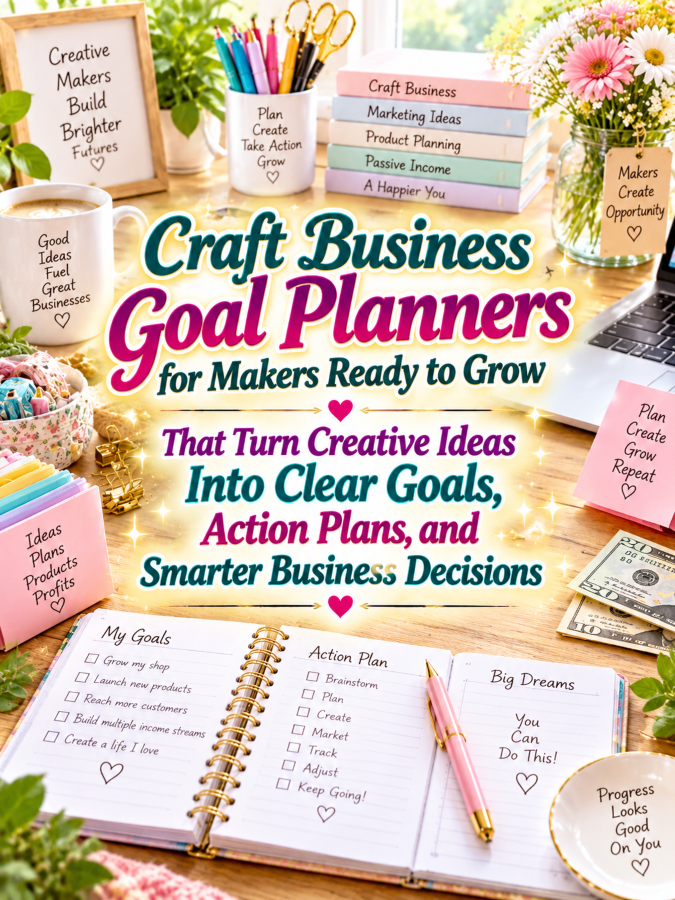
A craft business goal planner can give makers a place to define what they want from their business and then turn those goals into smaller actions. It can include annual goals, quarterly priorities, monthly targets, weekly action plans, product-development goals, marketing plans, inventory targets, event preparation, customer goals, and end-of-period reviews. The purpose isn’t to promise a certain income or magically transform a hobby into a thriving business, but to help makers make clearer decisions and keep moving forward.
This is also an excellent digital-product niche because makers often need different levels of support as their businesses grow. You could begin with a $7 Craft Business Goal Planner, expand into a $17 Goal-Setting Workbook, create a $27 Maker Business Planning Bundle, build a $47 Complete Craft Business Planner, and eventually offer a $77 Maker Growth Planning Library. Actual results will vary based on audience fit, product quality, traffic, pricing, and marketing, but the product ladder gives you plenty of room to grow alongside the customers you’re serving.
Quick Answer
Quick Answer
Craft business goal planners are printable or digital planning systems that help makers organize business goals and turn those goals into manageable actions. Useful sections can include yearly vision pages, quarterly goals, monthly priorities, weekly plans, product goals, marketing tasks, inventory planning, event preparation, customer notes, and business reviews. The planner gives creative entrepreneurs a place to step out of daily reaction mode and decide what they actually want to accomplish.
A simple product ladder could start with a $7 goal-setting starter, move to a $17 craft business planning workbook, expand into a $27 collection of maker business worksheets, grow into a $47 complete business planning system, and eventually become a $77 library of goal planners, launch tools, inventory trackers, marketing worksheets, and review pages. You can also create versions for Etsy sellers, craft-fair vendors, handmade product businesses, custom-order makers, or creators selling digital and physical products. The opportunity comes from solving real planning problems, not from promising that a particular planner will guarantee sales or profits.
Why This Niche Works
Many makers begin with a product rather than a business plan. They create something they love, sell a few pieces, receive encouraging feedback, and then discover that growing beyond those first sales requires more organization than they expected. Without clear priorities, a maker can spend an entire week making inventory while neglecting marketing, or spend hours posting online while having nothing ready to sell.
A goal planner helps make those tradeoffs visible. A maker can decide whether the current priority is creating new products, preparing for a market, improving an online shop, building an email list, organizing inventory, or simply creating a more sustainable weekly routine. That’s a Good Thing because not every business task deserves to be invited to the front row every single day.
Goal planning also gives you an opportunity to create products for different stages of a maker’s journey. A beginner might need help turning a hobby into a simple plan, while an established seller may need quarterly planning, product launches, event goals, revenue tracking, or catalog reviews. This creates a natural path for developing additional products without having to abandon your original audience.
The niche is broad enough to support many craft categories while still allowing you to create specialized editions. You could build planners for jewelry makers, fiber artists, candle makers, ceramic artists, woodworkers, paper crafters, soap makers, sewing businesses, macramé creators, or general handmade-product sellers. Start with one clear audience, make the first planner genuinely useful, and let customer feedback show you where the next opportunity lives.
What You Can Put Inside a Craft Business Goal Planner
Start with a business vision page that asks the maker what they actually want their business to look like. They might want occasional weekend sales, a steady side business, more craft-fair opportunities, a larger online shop, or simply a more organized way to sell their creations. Giving customers room to define their own version of growth keeps the planner practical rather than assuming every maker wants to build a giant company.
Then break that vision into larger goals. Annual and quarterly goal pages can help makers identify a few major priorities, while monthly and weekly pages can turn those priorities into smaller actions. You could include sections for product development, marketing, sales channels, customer relationships, inventory, events, and business organization so users can choose the areas that matter most to them.
A review section is equally important. Give makers a place to record what they accomplished, what took longer than expected, what customers responded to, what products received attention, and what they want to change. This creates a feedback loop where planning isn’t just about making predictions; it’s about learning from what actually happened.
Tools You’ll Need
You can create this product with a fairly simple toolkit. Canva can help you design goal pages, worksheets, trackers, calendars, covers, and promotional graphics, while Google Docs can help you draft the questions, organize the workbook structure, and refine the written content before designing the final pages.
For building your audience, AWeber and GetResponse can help you create email campaigns for makers interested in business organization and growth planning. You can sell your digital products through Gumroad, while Teachable can become useful if you eventually add courses or guided programs about planning a handmade business.
For research, Amazon Craft Business Planner Research can help you study related products, customer language, planning categories, and common features. Pay attention to what customers appear to need rather than simply what existing planners contain. You’re trying to discover opportunities for better solutions, not create a new thingee that looks suspiciously like one that already exists.
Your 5-Step Action Plan
Step 1: Define What “Growth” Means to Your Maker
The word “growth” can mean completely different things to different makers. One person may want more sales, another may want fewer but higher-value orders, another may want to attend more markets, and another may simply want to stop feeling overwhelmed by their own craft business. Your planner should begin by helping customers define the kind of growth they actually want.
Create a “My Definition of Growth” page with prompts about time, products, customers, sales channels, workload, and personal priorities. This helps the maker build goals around their own circumstances instead of blindly copying someone else’s version of success. That’s a Good Thing because a business plan that requires someone to become a completely different human being is probably not a very useful business plan.
Step 2: Create Annual and Quarterly Goals
Once the maker knows what they want, help them choose a small number of larger goals. These might include launching a new collection, improving product photography, preparing for three craft fairs, adding an online sales channel, or organizing their inventory system. Encourage customers to focus on a manageable number of priorities instead of turning the planner into a wish list containing every business idea they’ve ever had.
Quarterly planning provides a useful middle ground between huge annual goals and tiny daily tasks. A maker can choose two or three priorities for the next three months and then break each one into smaller projects. This creates enough structure to provide direction without pretending that the maker can predict exactly what will happen twelve months from now.
Step 3: Turn Goals Into Weekly Actions
A goal isn’t particularly helpful if it stays floating around as a sentence on page six. Add weekly planning pages that ask what action will move the maker closer to each current goal. The actions should be specific enough to complete, such as photograph five products, update three listings, prepare market inventory, contact a potential event organizer, or develop one new product.
You can also add a “Must Do / Should Do / Could Do” section. This helps makers separate essential work from optional work when the week becomes crowded. Without that distinction, every tiny task can start screaming for attention at once, and suddenly changing a product description feels just as urgent as preparing for tomorrow’s market.
Step 4: Add Business Review Pages
Review pages can turn your planner from a calendar into a learning tool. At the end of each month or quarter, ask makers what they accomplished, which products received attention, what customers asked about, which marketing activities they enjoyed, and what they want to change. Keep the questions practical and encourage users to record observations rather than judge themselves.
You can also include a “Keep / Change / Stop / Try” framework. A maker might decide to keep a successful product line, change their packaging process, stop spending time on a low-value task, and try a new marketing channel. This simple review can help turn experience into better decisions, and that’s always a Good Thing.
Step 5: Build Your Own Product Ladder
Your craft business goal planner can become the foundation for a larger collection. Start with a $7 starter planner containing basic goal-setting pages, then create a $17 workbook with quarterly planning, weekly action sheets, reviews, and business priorities. A $27 bundle can add product-development goals, marketing planners, event preparation, inventory planning, and customer worksheets.
Your $47 offer can become a Complete Craft Business Planning System, while your $77 library can combine business goals, product planning, marketing, launch calendars, inventory tools, event worksheets, and review systems. You can then create specialty editions for different maker businesses, giving your audience increasingly specific tools as their needs become clearer.
Don’t build the entire empire at once. Start with one useful planner, learn what makers actually need, and let those lessons guide your next thingee. That’s it. That’s your beginning!
Once you’ve figured out all of the above, the next step is turning your goal planner into a practical system that helps makers focus on the work that matters instead of simply becoming busier.
3 Ways to Stand Out From The Thundering Herd!
Way 1: Make “My Version of Growth” the Starting Point
Many business planners assume that every maker wants the same thing: more sales, more products, more customers, and eventually a business large enough to require a building with a very serious-looking reception desk. That’s not necessarily what your customer wants, and your planner can stand out by starting with the maker’s own definition of success. Ask whether they want more income, more creative freedom, better organization, fewer rushed orders, more time for making, or simply a more predictable business routine.
Create a dedicated “My Version of Growth” page where makers can identify what they want more of and what they want less of. You could include prompts for time, workload, products, customers, sales channels, events, and creative energy. This makes your planner feel more personal because it helps the maker build a business around their actual life instead of forcing their life to squeeze itself around a generic business plan.
Way 2: Connect Goals to Actual Projects
A goal such as “Grow my handmade business” sounds inspiring, but it doesn’t tell someone what to do on Wednesday afternoon. Your planner can connect every larger goal to specific projects and actions so the maker can see how the pieces fit together. If the goal is to prepare for a craft fair, for example, the planner could connect that goal to inventory preparation, product selection, pricing review, packaging, signage, promotion, and event-day planning.
This makes the planner more practical than a page filled with motivational quotes and empty boxes. The maker can move from “I want to grow” to “Here are the three projects that support that goal” and then to “Here are the actions I need to complete this week.” That’s a Good Thing because motivation is lovely, but knowing what to do next is even lovelier.
Way 3: Include a “Not This Quarter” List
Here’s a slightly sneaky feature that can make your planner unusually useful: give makers a place to write down good ideas they are deliberately postponing. Creative entrepreneurs tend to generate new ideas constantly, and every new idea can feel urgent even when it isn’t. A “Not This Quarter” list lets them capture those ideas without allowing them to hijack the current plan.
This page protects focus without forcing the maker to forget their ideas. At the next quarterly review, they can look at the list and decide which ideas still matter. Sometimes they’ll discover a fantastic next project, while other times they’ll wonder why they were so excited about creating twelve matching aprons for imaginary llamas, and that’s perfectly fine too.
3 Nifty Ways to Find Customers
Way 1: Create Content Around Maker Business Overwhelm
Your ideal customers are already talking about the problems your planner can solve. Create useful content about choosing business priorities, planning product launches, preparing for craft fairs, organizing weekly maker tasks, deciding what to stop doing, and turning large goals into smaller actions. Each piece of content can demonstrate one small part of your planning philosophy.
For example, you could publish a post called “What Should a Handmade Business Work On This Month?” and walk readers through choosing one major priority and three supporting actions. Another post could explain how to turn a craft-fair goal into a simple preparation timeline. You’re helping before you sell, and that creates much stronger trust than simply telling everyone that your planner will magically make their business organized.
Way 2: Offer a Free Maker Goal Sheet
Create a one-page freebie that helps makers define one business goal and identify the next three actions required to move toward it. Keep it simple enough that someone can complete it quickly, then show how your full planner expands the process into monthly, quarterly, and annual planning. You can also include a small “What Will I Not Work On?” section because learning what to ignore can be just as useful as choosing what to pursue.
Use the free resource to build an email list around practical maker-business advice. Send helpful planning tips, examples, seasonal reminders, product-development ideas, and occasional invitations to explore your paid products. Five good messages beats 50 generic ones every single time, especially when your subscribers can actually use the information before they ever purchase a thingee.
Way 3: Build Separate Content for Different Maker Stages
A new maker and an established craft-business owner can both need goal planning, but their problems won’t be identical. A beginner might need help deciding what to sell and how to create a simple weekly routine, while an established seller may need help managing product lines, markets, inventory, launches, and competing priorities. Create content that speaks directly to those different stages.
You can then create specialized versions of your planner around those needs. A beginner edition might focus on turning a hobby into a simple business plan, while an established-maker edition could emphasize quarterly planning, product launches, events, inventory, and business reviews. This gives you additional product opportunities while keeping your marketing focused instead of throwing every possible message into one giant bucket.
3 Takeaways You Won’t Find Elsewhere!
Takeaway 1: Growth Should Include What You Want to Stop Doing
Business growth is often described entirely in terms of adding things. More products, more customers, more content, more events, more sales, more emails, more everything, until the maker is sitting beside a pile of unfinished projects wondering why they ever thought this was relaxing. Your planner can take a different approach by asking what the maker wants to simplify, eliminate, delegate, or stop doing.
Add a “What I Want Less Of” section to your goal-setting process. A maker might want fewer custom orders, fewer rushed deadlines, fewer products that barely sell, or fewer hours spent doing tasks they dislike. This helps customers create goals that improve the way their business operates rather than simply increasing the number of things happening inside it.
Takeaway 2: Every Goal Needs a Reason
A goal becomes more useful when the maker knows why it matters. “Attend three craft fairs” is a measurable target, but the underlying reason might be meeting local customers, testing new products, increasing visibility, or learning which products people notice in person. Ask users to record the reason behind each major goal so they can make better decisions if circumstances change.
If the reason for a goal disappears, the maker can reconsider the goal without feeling like they failed. That’s an important distinction because a business plan should be a decision-making tool, not a judge sitting behind a giant wooden desk stamping “DISAPPOINTING” on everyone’s forehead. Flexibility is a Good Thing when you’re running a creative business in the real world.
Takeaway 3: Review Goals Against Real Life
A goal that looks perfectly reasonable on January 1 can look completely ridiculous six weeks later. Makers have changing schedules, unexpected orders, seasonal demands, family commitments, creative energy shifts, and plenty of other things that can affect what is realistic. Your planner should make it easy to adjust goals without treating every change as a business disaster.
Include monthly and quarterly review pages where users can ask whether the goal still matters, whether the timeline is realistic, what changed, and what the next best action should be. This keeps the planning system alive instead of turning it into a rigid document that becomes obsolete the moment real life walks through the door. That’s always a Good Thing.
3 Common Mistakes to Avoid
Mistake 1: Filling the Planner With Unrealistic Goals
A planner can accidentally encourage customers to overcommit if every page contains space for dozens of goals. More boxes don’t create more time, unfortunately, even though the stationery industry would probably love us to believe otherwise. Encourage users to choose a small number of meaningful priorities and break them into manageable actions.
You can create a “Top Three Goals” page instead of asking users to list twenty. Then give each goal its own action plan and review section. This makes the planner feel calmer and more achievable, which is exactly what a maker who already has a thundering herd of responsibilities probably needs.
Mistake 2: Making the Planner All About Money
Financial goals can certainly belong in a craft business planner, but they shouldn’t be the only measure of progress. A maker may also care about creating a new collection, improving their workflow, building confidence, reducing waste, attending an event, developing a new skill, or getting better at managing their time. A broader planning system gives customers more ways to define meaningful progress.
You can still include optional pages for revenue goals, expenses, pricing, and sales tracking. Just frame them as planning and record-keeping tools rather than promises of financial results. That keeps your product useful without turning it into a magical income thingee that claims to know exactly what the future will do.
Mistake 3: Forgetting the Maker’s Creative Energy
A handmade business is different from many other businesses because the owner is often also the person doing the creative production. If the planner fills every week with marketing, administration, product development, customer service, and event preparation, there may be no room left for the actual making. That’s a recipe for frustration, and nobody wants a business planner that accidentally plans the creativity right out of the creative business.
Add a weekly creative-work section where makers can protect time for making, experimenting, designing, or practicing. You can also include a simple energy check-in so users can notice which tasks leave them energized and which ones consistently drain them. The purpose isn’t to prescribe a perfect schedule, but to help makers design a business that leaves room for the reason they started creating in the first place.
Scaling Your Results
Your first craft business goal planner can become the foundation for a much larger maker-business product line. Start with the $7 planner, then add a $17 workbook containing quarterly planning, weekly action sheets, business reviews, and priority-setting tools. Your $27 bundle could combine goal planning with product-development sheets, launch planners, craft-fair preparation pages, marketing calendars, and inventory planning.
The $47 Complete Craft Business Planner could become an all-in-one system covering goals, products, marketing, launches, events, inventory, customer planning, and business reviews. Then your $77 Maker Growth Planning Library could bring together multiple specialized planning systems for different stages of business growth. That’s how you create a useful ladder rather than simply making five versions of the same planner and changing the cover color.
You can also create niche editions based on maker type. A jewelry-business goal planner could include collection planning and materials tracking, while a sewing-business edition might focus on fabric inventory, custom orders, and seasonal collections. A craft-fair business edition could emphasize event planning, inventory preparation, booth setup, product selection, and post-event reviews.
A collection containing 40 well-designed craft-business planning products could potentially generate an additional $700 to $2,200 per month through bundles, repeat customers, memberships, complementary offers, and related products, although actual results will vary based on traffic, pricing, product quality, audience fit, and marketing. Those figures are possibilities rather than guarantees, and the real value comes from creating products that solve related problems for the same audience. Trust me, you’ll thank me later when you have a catalog that makes sense instead of a thundering herd of random business worksheets stampeding through your storefront.
Your Next Steps
Start by deciding which maker you want to serve and what “growth” means for that person. Build the first planner around a clear process: define the vision, choose a few priorities, turn them into projects, break those projects into actions, and review the results. Add a “Not This Quarter” list and a “What I Want Less Of” page because those little features can make your system feel much more grounded in real life.
Then create your $7 starter planner and test it with real business scenarios. Imagine a maker preparing for a craft fair, launching a new collection, trying to organize their online shop, or simply attempting to stop spending every Saturday night wondering what they should work on Monday. If your planner helps them answer those questions quickly, you’ve built something useful.
After that, start creating content around maker-business planning problems. Share practical goal-setting tips, show how to break large projects into smaller actions, demonstrate simple quarterly reviews, and talk about the importance of deciding what not to do. Use a free goal-setting worksheet to build your audience, then let customer questions guide the development of your larger product ladder.
Keep your system encouraging rather than intimidating. A maker doesn’t need another giant thingee reminding them of everything they haven’t accomplished; they need a clear way to decide what matters next and a place to recognize what they have already done. That’s it. That’s your beginning!
Final Thoughts
Craft business goal planners have strong potential because they sit at the intersection of creativity and organization. Makers already have the products, skills, ideas, and enthusiasm, but turning those ingredients into a sustainable business routine can require a surprising amount of planning. A thoughtful goal planner gives them a way to step back, choose priorities, and connect everyday actions with the larger direction they want their business to take.
The best planner won’t tell every maker to chase the same definition of success. Instead, it will help each customer decide what growth means to them, what they want more of, what they want less of, and which projects deserve attention right now. Add quarterly reviews, weekly action plans, creative-time protection, project tracking, and a place to park future ideas, and you’ve created a system that respects both sides of the maker’s life: the business owner and the person who simply wants to make beautiful things.
From there, your own product business can grow in the same way. Begin with one focused planner, listen to what customers need, add related worksheets, create specialized editions, develop bundles, and eventually build a comprehensive maker-business library. Keep your products connected, practical, and genuinely useful, because a smaller collection that helps customers solve real problems is far more valuable than a giant thundering herd of nearly identical PDFs.
If you were creating your first craft business goal planner tomorrow morning, what would you help a maker accomplish first: choose a business direction, organize their products, prepare for an upcoming event, create a weekly action plan, or simply figure out what they should stop doing? Start with that problem, build one clear solution, and let customer feedback show you where the next product belongs. Keep the goals realistic, protect the creative part of the business, and remember that every organized step forward counts, even when the next step involves nothing more glamorous than finding the missing thingee you need to finish today’s job.
Enjoy!