Let’s Turn October 17 Into Three Surprisingly Profitable Digital Product Opportunities!
Some dates practically scream for digital products. Others quietly sit on the calendar waiting for somebody clever to notice them. And then there are dates like October 17, which somehow give us pasta, second chances, and poverty-awareness education all on the same day. Honestly, the calendar has range!
Holiday-based digital products work because the date gives shoppers an immediate reason to search. But the real magic happens when you create something that remains useful after the holiday has passed. Instead of making a product that says, “Use me once on October 17,” think about creating resources that use the holiday as the hook while solving an ongoing problem.
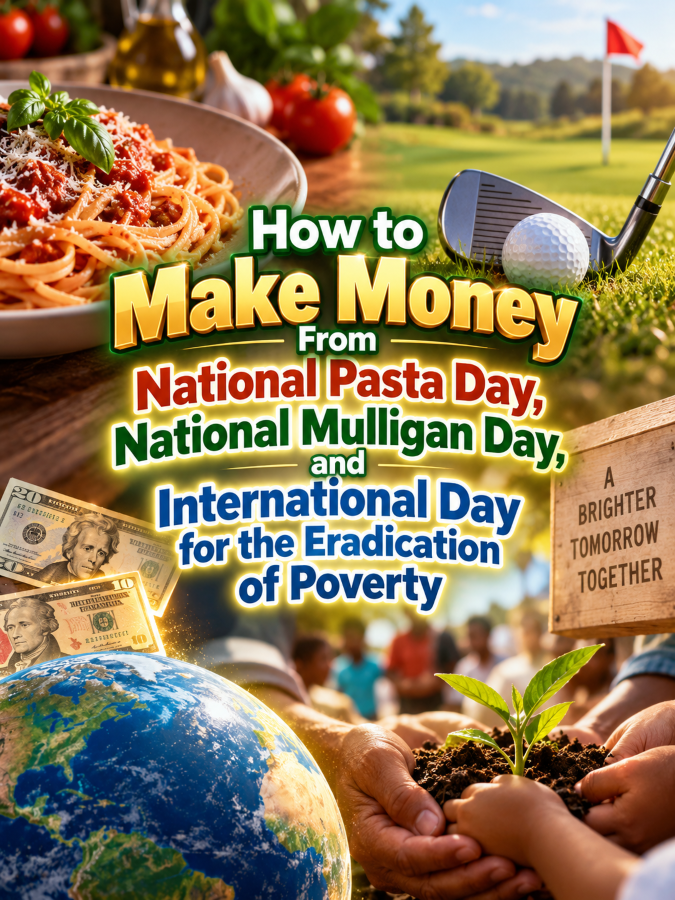
For this U.S.-focused roundup, three especially interesting opportunities are National Pasta Day, National Mulligan Day, and the International Day for the Eradication of Poverty.
That gives us three completely different markets: food lovers, people who love a fresh start, and educators, community organizations, nonprofits, families, and individuals interested in financial literacy and community action. In other words, there is plenty of room to build multiple product collections without making everything look like it came from the same digital-product factory.
National Pasta Day – October 17
Let’s begin with the easiest one to make delicious: National Pasta Day.
National Pasta Day is an ideal example of how a simple food observance can become much more than a single printable. Pasta is inexpensive, familiar, endlessly customizable, and connected to recipes, meal planning, cooking, entertaining, family activities, restaurants, food blogging, and even homemade-food hobbies.
That gives digital product creators a huge playground.
What Is National Pasta Day?
National Pasta Day is celebrated annually on October 17 in the United States. The observance gives pasta lovers an excuse to celebrate one of the world’s most recognizable comfort foods with favorite dishes, new recipes, restaurant specials, cooking projects, and pasta-themed gatherings.
You can research the observance and explore additional ideas through:
- National Day Calendar – National Pasta Day
- Google Search – National Pasta Day
- Google Search – National Pasta Day Recipes, Activities & Party Ideas
How Do People Celebrate National Pasta Day?
Celebrations can be as simple as cooking a favorite pasta dinner or as elaborate as hosting an Italian-inspired dinner party. Families can try a new pasta shape, food lovers can organize tastings, cooks can experiment with homemade pasta, and restaurants can use the occasion for promotions.
And there is your digital-product opportunity hiding in plain sight.
People don’t necessarily need another generic pasta recipe. They may need help organizing recipes, planning meals, hosting dinner, tracking favorite dishes, documenting homemade-pasta experiments, or creating a themed celebration.
3 Ways to Make Money From National Pasta Day
1. Create Pasta Recipe Journals
A pasta recipe journal can be much more valuable than a simple collection of recipes because it gives customers a place to record their own culinary discoveries.
Include pages for:
- Recipe name
- Pasta shape
- Sauce
- Ingredients
- Preparation time
- Cooking time
- Serving size
- Difficulty level
- Family rating
- Favorite toppings
- Substitutions
- Notes for next time
You could create several versions, including a family pasta recipe journal, homemade pasta journal, Italian recipe journal, or pasta lover’s cookbook planner.
2. Build Pasta Meal-Planning Printables
Meal planning is another excellent evergreen angle. Create weekly and monthly planners that help customers plan pasta dishes around ingredients they already have.
Add grocery-list pages, pantry inventory sheets, freezer inventory pages, leftover trackers, sauce-planning sheets, and family-favorite meal lists.
Now your National Pasta Day product isn’t really just a holiday product anymore. It’s a practical kitchen organization system that happens to have a delicious marketing hook.
3. Create Pasta Party Printables
People love themed gatherings, and a pasta night practically organizes itself.
Create printable invitations, menu cards, food labels, pasta-tasting scorecards, recipe cards, table signs, shopping lists, guest planners, and party checklists.
You could even create themed bundles such as:
- Pasta Night Party Kit
- Italian Dinner Party Planner
- Pasta Tasting Party Bundle
- Family Pasta Night Activity Pack
- Homemade Pasta Project Planner
Money-Making Tip #1: Build Around the Pasta Lover, Not Just the Holiday
This is one of those little strategy shifts that can make a big difference.
Don’t build your entire product around the words “National Pasta Day.” Build something that a pasta lover would happily use in November, January, March, or whenever the carb cravings come marching through the front door.
The holiday becomes your promotional hook. The usefulness becomes your long-term sales strategy.
Other National Pasta Day Income Ideas
Once you have one pasta product, you can expand it into an entire product ladder.
- Pasta recipe cards
- Pasta cooking planners
- Homemade pasta project worksheets
- Pasta tasting journals
- Italian dinner party kits
- Pasta-themed kids’ activity sheets
- Food blogger content planners
- Restaurant pasta promotion templates
- Pasta menu planners
- Italian-themed kitchen printables
- Meal-prep worksheets
- Pantry inventory trackers
And here’s the really fun part: you can sell individual products, mini-bundles, and larger collections. One idea can become a whole little pasta empire. We are not saying you need to become the digital-product equivalent of an Italian grandmother with twelve sauce recipes. But if it happens, embrace it.
Research & Design Resources
- Etsy – Pasta Recipe Journal Ideas
- Canva – Recipe Template Ideas
- Pinterest – Pasta Party Printable Ideas
- Google – Pasta Recipe Journal Research
Amazon Affiliate Opportunity
Pasta-themed content also gives you opportunities to recommend physical products alongside your digital products. Depending on your audience, you could feature pasta makers, recipe books, kitchen organizers, pasta servers, storage containers, cooking tools, or entertaining supplies.
For example, you can browse Amazon pasta-making tools or Amazon pasta recipe books and connect those recommendations naturally to your blog content.
Where to Promote Your Pasta Products
Pinterest is particularly useful for visual food-related products. Create pins featuring colorful pasta dishes, printable previews, recipe-planning pages, and dinner-party setups.
You can also research conversations and communities through:
Look for questions people are already asking. What are they trying to organize? What do they repeatedly forget? What do they wish they had a printable for?
Those questions are product research gold.
Why National Pasta Day Is More Than a One-Day Product Opportunity
The biggest mistake with food holidays is assuming you need to create something disposable.
You don’t.
A National Pasta Day product can become a permanent part of a larger cooking collection. A pasta recipe journal can lead to a general recipe journal. A pasta meal planner can lead to a complete meal-planning system. A pasta party kit can lead to themed dinner-party collections.
That is exactly how a small holiday product can become an evergreen digital-product business.
Start with the tiny door. Build the bigger room later.
National Pasta Day gives us recipes, meal planning, entertaining, and food-related products. But our next holiday takes us in a completely different direction.
National Mulligan Day is all about getting another chance, making a do-over, and giving yourself permission to try again.
And that opens the door to some surprisingly powerful products: reset planners, second-chance journals, goal-restarting workbooks, habit trackers, project restart kits, and business pivot resources.
Because sometimes the most profitable page in a planner is the one that says, “Okay. That didn’t work. Let’s try this again.”
National Mulligan Day – October 17
Now let’s move from pasta to something completely different: second chances.
National Mulligan Day is one of those wonderfully quirky observances that gives digital product creators a very useful concept to work with. A “mulligan” is essentially a do-over, and that simple idea connects beautifully with goal setting, productivity, personal organization, habit building, project management, business planning, and self-improvement.
And let’s be honest. Most of us have encountered a plan that deserved a mulligan.
Maybe the schedule was unrealistic. Maybe the project got abandoned halfway through. Maybe the habit lasted three days. Maybe the business idea needed a serious rethink. That’s not failure. That’s research with better lighting.
What Is National Mulligan Day?
National Mulligan Day is observed on October 17 and celebrates the idea of getting another chance to try something again. The term “mulligan” is commonly associated with golf, where it refers to an unofficial second attempt at a shot, although the word has grown into a broader expression for a do-over.
For additional research, explore:
- Google Search – National Mulligan Day
- Google Search – Mulligan Meaning and Second Chances
- Google Search – National Mulligan Day Ideas and Activities
How Can People Celebrate National Mulligan Day?
There is no shortage of ways to interpret a day centered around second chances. Someone might revisit a goal they abandoned, restart a personal project, retry a habit, redo a failed plan, clean up an unfinished task list, or simply give themselves permission to begin again.
That last idea is particularly important for digital products.
There is a huge difference between creating a generic productivity planner and creating a planner specifically designed for someone who needs to reset.
A reset product speaks to a moment. The customer isn’t simply looking for more blank pages. They’re looking for a way to regain control.
3 Ways to Make Money From National Mulligan Day
1. Create Goal Reset Planners
A Goal Reset Planner can help customers examine what they originally wanted, determine what went wrong, and create a more realistic plan for moving forward.
Useful sections could include:
- Original goal
- What worked
- What didn’t work
- What got in the way
- Lessons learned
- What needs to change
- New goal
- Next three actions
- Deadline
- Progress check-ins
- Reward or celebration
You could create versions for students, entrepreneurs, busy parents, fitness-minded customers, creatives, professionals, or anyone working toward personal goals.
Notice how quickly one product idea becomes a product family?
2. Build Second-Chance Journals
A Second-Chance Journal can take a more reflective approach. Instead of focusing entirely on productivity, it can help customers think through experiences, decisions, lessons, and future possibilities.
Include thoughtful prompts such as:
- What am I giving myself permission to try again?
- Why didn’t the first attempt work?
- What did I learn?
- What would I do differently?
- What is still worth pursuing?
- What can I let go of?
- What is one small step I can take today?
This kind of product can work especially well as a printable journal, guided digital journal, tablet-friendly PDF, or low-content workbook.
3. Create Project Restart Workbooks
Here’s where National Mulligan Day becomes especially interesting for business owners, freelancers, creators, and project-oriented customers.
People abandon projects all the time.
Sometimes they run out of time. Sometimes priorities change. Sometimes the original plan was simply too complicated. And sometimes the project is sitting inside a folder named “FINAL_FINAL_v7_REALLYFINAL” quietly waiting for someone to rescue it.
A Project Restart Workbook can help customers take that abandoned project, evaluate it, simplify it, and create a fresh action plan.
Include pages for:
- Project name
- Original purpose
- Current status
- What has already been completed
- What still needs to be done
- Why the project stalled
- What has changed
- What can be removed
- New priorities
- Next actions
- Milestones
- Completion date
This is a highly practical product because you’re not merely selling inspiration. You’re selling a process for getting unstuck.
Money-Making Tip #2: Turn the “Do-Over” Into a Product Ladder
Don’t stop with one reset planner.
The concept of starting over can become an entire collection of related products.
For example, you could create:
- Mini Product: 7-Day Reset Planner
- Core Product: 30-Day Goal Reset Workbook
- Premium Product: Complete Life Reset Planner
- Business Product: Project Restart Workbook
- Bundle: Second-Chance Planning Collection
Now you’re not depending on one listing. You’re creating a small ecosystem where different customers can enter at different price points.
And that’s always a good thing.
Other National Mulligan Day Income Ideas
The “second chance” concept is wonderfully flexible, which means you can take it into several niches.
- Monthly reset planners
- Quarterly reset workbooks
- Habit restart trackers
- Goal recovery worksheets
- Decluttering reset planners
- Business pivot planners
- Content calendar reset worksheets
- Project recovery templates
- Student study reset planners
- Budget reset worksheets
- Home organization reset checklists
- Creative project restart planners
- Career goal review workbooks
- Personal reflection journals
You can also create humorous versions. A “My Life Needs a Mulligan” printable journal could have a playful tone, while a professional “Project Reset Workbook” could look polished and corporate.
Same basic concept. Different audience. Different packaging.
National Mulligan Day for Teachers and Students
Education is another promising direction.
Teachers can use the concept of a do-over to encourage reflection after assignments, tests, projects, or classroom goals. Students can use reset worksheets to evaluate study habits and make adjustments.
Possible products include:
- Student Goal Reset Worksheets
- Study Habit Reset Trackers
- Test Reflection Pages
- Project Reflection Worksheets
- Academic Comeback Planners
- Homework Organization Reset Sheets
- Semester Reset Workbooks
For teachers, the key is to keep the concept positive. The message isn’t “You messed up.” It’s “You learned something, and now you have information for your next attempt.”
That is a much more empowering product experience.
Research & Design Resources
- Etsy – Goal Reset Planner Research
- Etsy – Habit Reset Planner Research
- Canva – Planner Templates
- Pinterest – Reset Planner Inspiration
- Google – Goal Reset Planner Research
Amazon Affiliate Opportunity
National Mulligan Day also gives you a natural opportunity to recommend physical planning and journaling products. You could feature notebooks, goal-setting books, productivity planners, desk organizers, journals, sticky notes, and organizational supplies.
Browse Amazon goal-setting journals or Amazon productivity planners and pair those recommendations with your printable reset products.
Where to Promote Your Reset Products
Reset and productivity products are highly visual, which makes Pinterest a natural promotional channel. Create pins showing before-and-after planning concepts, sample worksheet pages, reset checklists, and motivational snippets.
You can also research customer language through online communities:
- Reddit – Goal-Setting Discussions
- Reddit – Productivity Planner Discussions
- Pinterest – Goal-Setting Planner Ideas
- Facebook – Goal-Setting Communities
Pay particular attention to the words people use when describing their frustrations. “I can’t stay consistent,” “I need to start over,” “I fell off track,” and “I don’t know where to begin again” are not merely complaints.
They’re product clues.
The Bigger Opportunity Behind National Mulligan Day
The strongest business idea here isn’t actually the word “mulligan.” It’s the broader concept of resetting without starting completely from scratch.
That distinction matters.
A customer who abandoned a project doesn’t necessarily want to throw away everything they’ve already done. They want to identify what is useful, eliminate what isn’t, and move forward with a better plan.
Your printable can help them do exactly that.
And once you’ve created that framework, you can adapt it to goals, habits, businesses, studying, budgeting, organizing, content creation, and personal projects.
Connecting National Mulligan Day With National Pasta Day
At first glance, these two holidays couldn’t be more different.
One involves noodles. The other involves do-overs.
But here’s a clever product-development angle: use different holidays to attract completely different audiences while maintaining the same underlying digital-product strategy.
National Pasta Day can bring food lovers into your store. National Mulligan Day can bring planners and productivity enthusiasts into another collection. Both can then lead customers toward evergreen products that aren’t dependent on the holiday itself.
That’s the beauty of holiday-based product marketing. The calendar provides the conversation starter. Your product provides the reason to stay.
Our third October 17 opportunity takes us somewhere much more meaningful.
The International Day for the Eradication of Poverty provides opportunities for educational resources, financial-literacy materials, community-service planning tools, donation-drive organizers, nonprofit event resources, and classroom activities.
This one requires a little more thought and sensitivity because the goal isn’t to make poverty itself a marketing gimmick. The opportunity is to create useful resources that help people understand financial challenges, organize community action, teach financial literacy, and support meaningful causes.
And when a digital product genuinely helps people do something constructive, that’s a very different kind of win.
International Day for the Eradication of Poverty – October 17
Our third October 17 opportunity takes us into a very different category, and this is one where purpose and usefulness need to come before clever marketing.
The International Day for the Eradication of Poverty is observed each year on October 17. It is a United Nations observance focused on raising awareness of poverty, inequality, dignity, social inclusion, and the need for collective action toward ending poverty.
For digital product creators, the opportunity isn’t to treat poverty as a gimmick or turn hardship into a sales pitch. That’s not a good thing.
The opportunity is to create practical resources that help people learn about financial literacy, organize community support, coordinate service projects, teach economic concepts, manage donation drives, and encourage constructive action.
What Is the International Day for the Eradication of Poverty?
The International Day for the Eradication of Poverty is observed globally on October 17. The United Nations uses the day to promote awareness and action around poverty and the conditions that contribute to it, while emphasizing the dignity and rights of people experiencing poverty.
For reliable background research, start with:
- United Nations – International Day for the Eradication of Poverty
- Google Search – International Day for the Eradication of Poverty
- Google Search – Poverty Awareness Activities for October 17
How Can Organizations, Schools, and Communities Observe the Day?
Organizations and communities can use the observance as an opportunity for education, discussion, volunteering, fundraising, donation drives, financial-literacy activities, community-resource awareness, and other forms of constructive engagement.
Schools can explore age-appropriate lessons about economics, inequality, budgeting, community resources, and civic responsibility. Nonprofits and community organizations can organize events or service projects. Families can discuss charitable giving and responsible money management.
Each of those activities creates a possible need for a planning resource.
3 Ways to Make Money From This Observance
1. Create Financial Literacy Workbooks
Financial literacy is one of the strongest evergreen directions connected to this observance because it provides practical educational value without reducing poverty to a marketing theme.
You could create age-appropriate resources covering topics such as:
- Needs versus wants
- Basic budgeting
- Savings goals
- Understanding income and expenses
- Smart spending
- Emergency savings concepts
- Household budgeting
- Financial goal setting
- Money vocabulary
- Simple financial decision-making exercises
Create different versions for elementary students, teenagers, college students, families, and adults. A teacher-friendly classroom workbook could become a particularly useful product because educators often need ready-to-use worksheets and discussion activities.
Keep financial education factual, age-appropriate, and educational rather than presenting individualized financial advice.
2. Build Community Service and Donation-Drive Planners
Many schools, businesses, churches, clubs, community groups, and nonprofits organize service activities and donation campaigns throughout the year.
A Community Giving Planner can help organizers manage the practical side of those efforts.
Include pages for:
- Project purpose
- Organization or group information
- Partner organizations
- Donation goals
- Requested items
- Collection locations
- Volunteer assignments
- Event dates
- Promotion checklist
- Supply inventory
- Donation tracking
- Thank-you follow-up
- Post-event reflection
This product has an advantage beyond October 17 because community organizations conduct drives throughout the year.
That means your observance can introduce the product, while year-round community-service needs can keep it relevant.
3. Create Classroom Poverty-Awareness Resources
Teachers may be looking for age-appropriate ways to discuss poverty, economic inequality, community resources, dignity, empathy, and civic responsibility.
You can create classroom resources that encourage thoughtful learning rather than simply presenting statistics.
Possible products include:
- Discussion prompts
- Vocabulary worksheets
- Research organizers
- Reflection journals
- Community-resource mapping activities
- Financial-literacy worksheets
- Cause-and-effect graphic organizers
- Service-learning project planners
- Classroom kindness and community-action challenges
For younger students, focus on concepts such as sharing, community helpers, resources, fairness, kindness, and responsible decision-making. Older students can explore more complex social and economic concepts with appropriate context and teacher guidance.
Money-Making Tip #3: Sell Solutions That Support Action
This is where the strongest product strategy becomes especially important.
Don’t create a product simply because October 17 is approaching. Create something that helps a real customer accomplish a real task.
A teacher needs a lesson resource.
A nonprofit needs an event planner.
A community group needs a donation-drive organizer.
A family may want a financial-literacy activity.
A student may need a budgeting workbook.
Those are genuine needs, and your product can help address them.
Other Income Ideas for the International Day for the Eradication of Poverty
Once you have a core product, you can expand into related educational and organizational resources.
- Financial literacy planners
- Student budgeting worksheets
- Family budget organizers
- Community-service project planners
- Volunteer coordination templates
- Donation-drive checklists
- Nonprofit event planning kits
- Fundraising event organizers
- Classroom service-learning planners
- Community resource directories
- Charitable giving planners
- Money-management worksheets
- Teen financial-literacy workbooks
- College student budgeting planners
You can also develop a larger Community Action Bundle containing project-planning pages, volunteer sheets, donation trackers, promotional checklists, reflection pages, and thank-you templates.
Be Careful With the Messaging
This category deserves a thoughtful approach.
Avoid language that portrays people experiencing poverty as helpless, irresponsible, or somehow less worthy. Avoid sensational imagery and avoid suggesting that buying your printable somehow “solves poverty.” It doesn’t.
Instead, position your products around education, organization, awareness, service, financial literacy, and constructive community action.
That approach is not only more respectful; it also creates better products because you’re solving concrete organizational and educational problems.
Research & Design Resources
- United Nations – Official Observance Information
- Etsy – Financial Literacy Worksheet Research
- Canva – Education Template Ideas
- Pinterest – Financial Literacy Printable Ideas
- Google – Financial Literacy Printable Research
Amazon Affiliate Opportunity
Educational and organizational products can also support relevant affiliate content. Depending on your audience, you might recommend budgeting books, financial-literacy workbooks, notebooks, planners, classroom supplies, organizational materials, and educational resources.
For example, you can browse Amazon financial-literacy books or Amazon budget planners and place those recommendations alongside educational blog content.
Where to Promote These Products
For education-focused products, Pinterest can be useful for reaching teachers, parents, homeschoolers, and printable shoppers. Educational marketplaces and teacher communities can also provide valuable product research, depending on your target audience and platform rules.
You can research discussions and content ideas through:
- Reddit – Financial Literacy Discussions
- Reddit – Budgeting Discussions
- Pinterest – Financial Literacy for Students
- Facebook – Financial Literacy Communities
Again, you’re looking for customer language. What are teachers asking for? What do parents find difficult to explain? What do nonprofit organizers repeatedly need to track?
Those questions can lead directly to better products.
Turning October 17 Into a Three-Part Product Strategy
Now let’s step back and look at the entire October 17 opportunity.
We have National Pasta Day, National Mulligan Day, and the International Day for the Eradication of Poverty.
They appear unrelated-and that’s exactly what makes them interesting.
Each observance reaches a different audience and creates a different emotional or practical reason to buy.
- National Pasta Day: food, recipes, entertaining, meal planning, and cooking.
- National Mulligan Day: second chances, resets, goals, productivity, and personal organization.
- International Day for the Eradication of Poverty: financial literacy, education, community action, service projects, and nonprofit organization.
That means you can create three separate product collections instead of forcing one idea to fit all three holidays.
A Simple October 17 Product Ladder
Here’s one possible way to structure your offers:
- Entry-Level Products: single worksheets, checklists, recipe cards, and mini planners.
- Core Products: complete journals, workbooks, meal planners, and project planners.
- Premium Products: comprehensive bundles containing multiple coordinated resources.
- Evergreen Products: general recipe journals, reset planners, budgeting resources, and community-service organizers that remain relevant all year.
This is where holiday marketing becomes much more powerful. You’re not creating three products that disappear on October 18.
You’re creating three evergreen product families and using October 17 as the promotional doorway.
Promotion Ideas for the Three Holidays
For National Pasta Day, use colorful food photography, recipe previews, pasta-themed graphics, dinner-party inspiration, and short cooking-related content.
For National Mulligan Day, emphasize fresh starts, project resets, goal reviews, and “start again” messaging. Before-and-after planning graphics can work particularly well here.
For the International Day for the Eradication of Poverty, use respectful educational graphics, financial-literacy tips, community-action ideas, service-project resources, and informative content that encourages constructive participation.
Different audience. Different message. Different visual language.
Same underlying business principle: create something useful first, then give it a timely reason to be discovered.
Final Thoughts
National Pasta Day, National Mulligan Day, and the International Day for the Eradication of Poverty may look like three completely unrelated dates on the calendar, but they reveal exactly why holiday-based digital product research can be so much fun.
National Pasta Day gives you a delicious path into recipe journals, meal planners, pasta-making resources, dinner-party kits, and food-related products.
National Mulligan Day gives you an entirely different market centered around resets, second chances, goal planning, productivity, habits, and restarting unfinished projects.
The International Day for the Eradication of Poverty gives you an opportunity to create meaningful educational and organizational resources around financial literacy, community service, donation drives, nonprofit planning, and constructive awareness.
And here’s the biggest takeaway: the holiday doesn’t have to be the product.
The holiday can simply be the reason someone discovers your product.
That’s a much more sustainable strategy.
Create the recipe journal because people love organizing their favorite meals. Create the reset planner because people need help getting back on track. Create the financial-literacy workbook because teachers and families need practical educational tools.
Then use October 17 as the timely reason to put those products in front of the right audience.
That little shift-from holiday product to evergreen solution with a holiday marketing angle-can make your digital-product strategy considerably stronger.
So, whether you’re designing pasta recipe pages, building a “give it another shot” planner, or creating a community-service workbook, remember that the best products usually begin with a simple question:
“What does someone need help doing?”
Answer that question well, package the solution beautifully, and the calendar can do a surprising amount of promotional heavy lifting for you.
Happy creating! May National Pasta Day, National Mulligan Day, and the International Day for the Eradication of Poverty inspire three completely different-and potentially very useful-digital product collections. This article is giving you plenty of time to create, publish, and promote your October 17 products.
So here’s what you discovered today. If something sparked your interest, take it as your sign to start moving toward that goal now. Even one small step counts.
Enjoy!