
Introduction
Pottery has a wonderful way of turning a lump of clay into something that feels completely personal. A mug, bowl, vase, planter, sculpture, or decorative piece begins as an idea and gradually passes through wedging, shaping, drying, firing, glazing, and sometimes another firing before it becomes the finished creation. That process is exciting, but keeping track of everything can become surprisingly complicated once a potter has several projects underway.
Potters often experiment with different clay bodies, forms, firing temperatures, glazes, textures, techniques, and combinations of materials. One successful glaze combination may need to be remembered months later, while a failed firing can contain valuable information about what should be changed next time. That’s Not a Good Thing when those details are scattered across scraps of paper or forgotten entirely. A practical pottery project planner can turn those experiments into an organized creative record.
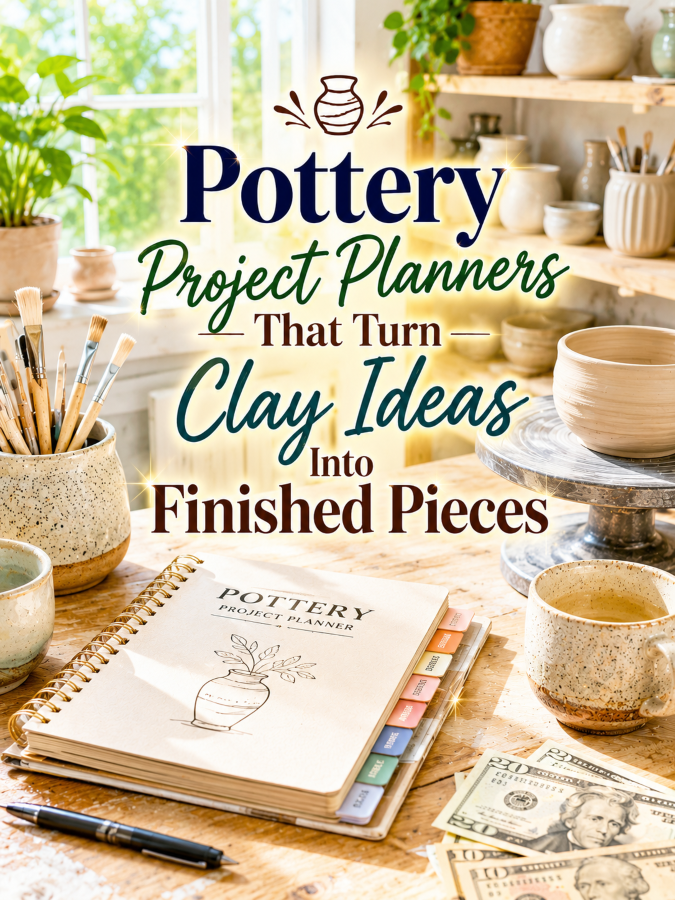
That’s exactly where Pottery Project Planners become incredibly valuable. A thoughtfully designed planner can help artists document project ideas, clay types, dimensions, techniques, drying dates, firing schedules, glaze combinations, kiln results, costs, and finished pieces. Over time, it becomes a personal pottery reference library that helps the maker understand what works, what doesn’t, and what deserves another try.
Pottery attracts beginners, studio artists, hobby potters, ceramic students, teachers, sculptors, makers, and small handmade businesses. Many of these creators work on several pieces at once and experiment constantly with materials and techniques. That creates an ongoing need for practical project organization and record keeping. It also creates plenty of opportunities for specialty printable products.
One well-designed Pottery Project Planner can become the foundation of a profitable printable business while helping ceramic artists keep their ideas organized, preserve their experiments, improve their techniques, and actually turn more clay ideas into finished pieces.
Quick Answer
Pottery Project Planners are downloadable printable systems that help ceramic artists record project ideas, clay bodies, dimensions, techniques, firing information, glaze tests, kiln results, costs, progress, and finished pieces.
A starter planner can comfortably sell for around $7. Expand it into glaze-testing journals, kiln logs, clay inventory sheets, pottery business planners, ceramic project binders, studio organization systems, and premium pottery libraries priced at $27, $47, and even $77.
Your customers aren’t simply buying worksheets. They’re investing in a system that helps them remember successful experiments, avoid repeating mistakes, manage multiple projects, and build a personal record of their ceramic journey.
Why This Niche Works
Pottery is an experimental craft. Even when an artist follows the same basic process, the result can change because of clay, moisture, thickness, drying conditions, firing temperatures, glaze combinations, application techniques, and kiln placement. Recording those variables helps artists understand their results instead of simply hoping the next piece turns out the way they imagined.
Pottery also naturally creates repeat projects. Once someone discovers a mug shape they love, they may want to make another version with a different handle, glaze, texture, or size. A project planner allows them to record what happened during the first attempt and use that information to improve the next one. That’s always a Good Thing because every experiment can become useful information.
There is also a strong business angle. Many ceramic artists eventually sell their work at craft fairs, online shops, studios, markets, or local events. Those makers need to track materials, firing costs, labor, inventory, product names, pricing, and customer orders. A pottery planner can therefore serve both hobbyists and aspiring ceramic entrepreneurs.
Once customers discover your Pottery Project Planners, they’ll naturally become interested in glaze journals, kiln logs, clay inventories, studio organizers, ceramic business planners, craft fair preparation sheets, pricing worksheets, and countless related thingees. One successful pottery printable can easily grow into an entire ceramic-artist product brand.
Unlike short-lived crafting trends, pottery is a skill that people can continue developing for years. Prior to pouncing upon this opportunity, you should first know all about the:
Tools You’ll Need
You don’t need to own a pottery studio to create useful organization products for ceramic artists. You need a practical design platform, a way to research real pottery challenges, and simple tools for marketing and selling your finished printables. Start with one focused product and expand as you discover what your audience actually needs.
- Canva for designing pottery project planners, glaze logs, kiln records, clay inventories, studio organizers, and ceramic business printables.
- Google Docs for organizing product ideas, worksheet content, instructions, and pottery-planning resources.
- AWeber for building an email list with pottery tips, printable freebies, creative prompts, and product announcements.
- GetResponse for newsletters, promotions, automated campaigns, and customer follow-up.
- Gumroad for selling downloadable pottery planners and ceramic-art printable bundles worldwide.
- Teachable if you’d eventually like to teach pottery organization, ceramic techniques, glazing, studio management, or handmade business systems.
- Amazon Pottery Planner Research for discovering which pottery journals, kiln logs, glaze records, and studio organization features artists appreciate the most.
Don’t spend three weeks deciding whether your clay illustrations need another shade of terracotta while a potter is trying to remember which glaze combination produced that gorgeous blue-green finish last spring. Your future customers care much more about useful record keeping than decorative perfection. Make the planner attractive, but make every page genuinely useful.
Next, move to:
Your 5-Step Action Plan
Follow these five steps unless you’d rather watch another printable creator become the pottery organization expert everyone recommends. The smartest entrepreneurs create products around the little details that artists repeatedly struggle to remember. Pottery provides plenty of those details, which means there is plenty of room for useful printable solutions.
Step 1. Research Real Pottery Challenges
Spend about 90 minutes exploring pottery Facebook groups, Reddit ceramic communities, Pinterest boards, pottery YouTube channels, studio forums, ceramic classes, and reviews of existing pottery journals. Pay attention to conversations about clay types, glaze testing, kiln firing, project organization, drying problems, failed pieces, and recording successful combinations. Those discussions reveal exactly what your printable should help solve.
Create a master list containing at least 40 to 50 printable pages. Include project records, clay inventories, glaze test sheets, firing logs, kiln schedules, sketch pages, measurement records, studio supply lists, cost calculators, progress trackers, finished-piece galleries, and business inventory pages. Your research becomes an X-ray machine that reveals where ceramic artists need practical organization.
Step 2. Build Your Core Pottery Project Planner
Create a collection containing 50 to 70 printable pages that support artists from their first project idea through the finished piece. Include project sketches, clay details, dimensions, techniques, drying information, firing notes, glaze information, and final results. Keep every page simple, practical, and easy to use because simplicity is always a Good Thing.
Include enough room for sketches and handwritten observations because pottery is a highly visual and hands-on process. Artists should be able to record what they planned to make, what actually happened, and what they would change next time. That creates a valuable learning loop instead of simply documenting a finished object.
Step 3. Create Specialty Editions
Build separate planners for beginners, wheel throwers, hand builders, ceramic sculptors, glaze experimenters, pottery students, studio artists, and ceramic businesses. Specialized editions immediately feel more valuable because customers recognize their specific process and creative needs.
You can also create planners focused on mugs, bowls, vases, planters, sculptures, ornaments, functional pottery, or large ceramic projects. Each specialty edition expands your audience while allowing you to reuse your strongest layouts and organizational framework.
Step 4. Add High-Value Bonuses
This is where your Pottery Project Planners begin standing out from the thundering herd. Include printable glaze test grids, kiln logs, clay inventory sheets, project sketch pages, firing checklists, studio cleaning schedules, supply shopping lists, finished-piece galleries, and pottery pricing worksheets.
You can also add “What Worked?” and “What Would I Change?” reflection pages after each completed project. Those bonus thingees require relatively little additional design work yet can dramatically increase the perceived value of your planner. You’re no longer selling a notebook; you’re creating a personal ceramic learning system.
Step 5. Build Your Product Ladder
Launch your starter Pottery Project Planner for $7 and let it become the foundation of a growing ceramic-artist printable business. Expand into premium glaze-testing systems around $27, complete studio binders around $47, and comprehensive pottery libraries approaching $77. Every additional product naturally complements the others while encouraging repeat purchases.
Before long, your business won’t simply be selling pottery worksheets. You’ll be helping ceramic artists organize their ideas, understand their experiments, manage their supplies, document their progress, and create a valuable record of their artistic development.
Once you’ve figured out all of the above, the next step is implementing:
3 Ways to Stand Out From The Thundering Herd!
The pottery printable market has plenty of ceramic journals and kiln logs, but many products focus on recording basic information after a project is already finished. The Good Thing is that ceramic artists need support throughout the entire creative process. Your opportunity is to create a planner that follows an idea from the first sketch through shaping, drying, firing, glazing, and finally celebrating the finished piece.
Way 1. Make the Glaze Lab Part of the Planner
Glazing is one of the most exciting and unpredictable parts of pottery, which makes it an excellent opportunity for a specialized printable section. Create glaze test grids where artists can record glaze names, combinations, application methods, firing temperatures, thickness, layering order, and final results. Include space for small painted or photographed samples so makers can build their own personal glaze reference library.
Add pages for successful combinations, failed experiments, favorite finishes, and future glaze ideas. Over time, these pages become a valuable reference that can help artists recreate beautiful results instead of trying to remember exactly what they did six months earlier. That’s always a Good Thing because successful glaze experiments are worth preserving.
Way 2. Track the Entire Project Journey
Don’t make your planner just a place to record the final firing. Create milestones for the initial idea, clay preparation, forming, trimming, drying, bisque firing, glazing, final firing, finishing, and photography. This gives artists a complete picture of how each piece developed.
Include space for dimensions before and after firing, notes about cracks or warping, changes made during construction, and lessons learned. Those details can help artists identify patterns in their work and improve future projects. Suddenly, your printable becomes a creative laboratory notebook rather than another generic planner.
Way 3. Add a Handmade Business Section
Many ceramic artists eventually discover that their hobby can become a small business. Add optional pages for material costs, clay usage, glaze costs, firing expenses, labor time, retail price, wholesale price, inventory quantities, product names, and sales channels. This gives hobbyists a natural path toward treating their pottery more professionally.
Include craft fair preparation sheets, product photography checklists, customer order trackers, and collection planning pages. These practical thingees expand your audience from hobbyists to makers who want to earn money from their work. That’s one of the easiest ways to rise above the thundering herd.
Next, here’s the thing. You’re probably NOT the only person offering this service. So you now require:
3 Nifty Ways to Find Customers
Your ideal customers are already sharing pottery, discussing glazes, showing studio setups, and documenting their ceramic experiments online. The challenge isn’t finding ceramic artists. The challenge is introducing your printable while they’re actively looking for ways to organize their creative process.
Way 1. Pottery and Ceramic Communities
Pottery Facebook groups, Reddit ceramic communities, studio forums, clay communities, ceramic student groups, and handmade-business communities are excellent places to introduce useful resources. Offer a free glaze test sheet, pottery project record, or kiln log before recommending your complete planner. Helping first builds trust much faster than immediately promoting a paid product.
Potters also love discussing successful glaze combinations, clay bodies, kiln results, studio organization, and project ideas. Those conversations can give you endless product-development ideas while putting your resources directly in front of enthusiastic makers.
Way 2. Pinterest
Pinterest is a natural fit for pottery because people constantly search for ceramic inspiration, glaze ideas, pottery projects, studio organization, pottery business ideas, and craft-room resources. Create attractive pins featuring glaze testing pages, project planning spreads, firing logs, pottery sketches, and finished-piece documentation.
Because Pinterest content can continue appearing in searches long after publication, a useful collection of pottery-related pins can keep bringing potential customers to your shop. Trust me, you’ll thank me later.
Way 3. Ceramic Artists and Pottery Teachers
Pottery instructors, ceramic YouTubers, studio owners, pottery bloggers, clay artists, online teachers, and handmade-business creators already have audiences interested in improving their craft. Reach out with affiliate partnerships, workshop bundles, classroom licenses, or printable collaborations that allow them to recommend your planner alongside their lessons.
A pottery teacher could use your project sheets during a class, while a ceramic YouTuber could demonstrate how a glaze log helps recreate successful experiments. Those collaborations introduce your product to customers who already trust the creator teaching them.
Speaking of long-term growth, now let’s move to:
3 Takeaways You Won’t Find Elsewhere!
Many printable creators think they’re selling pottery worksheets. The most successful entrepreneurs understand they’re helping artists preserve creative knowledge. That difference gives your Pottery Project Planner much more practical and emotional value.
Takeaway 1. You’re Selling Lessons From Every Firing
Your customers aren’t purchasing pages simply because they need somewhere to write down a glaze name. They’re investing in a system that helps them understand why a project succeeded, why another failed, and what they can change next time. Every firing becomes an opportunity to learn something useful.
When writing your product descriptions, emphasize that benefit. You’re helping artists build their own personal pottery reference library, one project at a time.
Takeaway 2. Failed Pieces Are Valuable Data
Not every pottery project comes out perfectly, and that’s part of the craft. A cracked mug, warped bowl, unexpected glaze result, or uneven form can reveal information about materials, techniques, drying, firing, or application. Give artists a dedicated place to record what happened so the mistake becomes a lesson rather than simply a disappointment.
That creates natural opportunities for troubleshooting workbooks, glaze experiment journals, firing logs, clay-testing sheets, and advanced ceramic practice resources. One imperfect project can become the reason a customer wants a more specialized printable.
Takeaway 3. One Planner Can Become an Entire Ceramic Brand
Your Pottery Project Planner can naturally expand into glaze-testing journals, kiln logs, clay inventories, studio organizers, pottery business planners, craft fair organizers, pricing worksheets, collection planners, and finished-ceramic journals. Those connected thingees encourage repeat purchases because each product supports another stage of the ceramic artist’s journey.
Before long, ceramic artists won’t simply recognize your pottery planner. They’ll know your shop as a dependable source of practical resources for organized, experimental, and growing pottery practices.
Now that you know the above, it’s time for:
3 Common Mistakes to Avoid
Many creators make pottery planners too generic. That’s Not a Good Thing. Ceramic artists need specific information about clay bodies, firing temperatures, dimensions, glazes, drying, construction methods, and project outcomes. Build your pages around those real-world details so the planner immediately feels relevant to potters.
Some sellers forget about experimentation. Pottery is not always a predictable process, and artists often need to document tests before committing to a larger piece. Include glaze experiments, clay tests, form variations, firing notes, and “try this next time” sections that encourage learning through experimentation.
Others stop after creating one planner. That’s like opening a pottery studio with one lump of clay. Continue expanding into glaze journals, kiln records, clay inventories, studio management, pottery business planning, and craft fair resources to create a much stronger printable business.
What else should you know? How about:
Scaling Your Results
Expand into a complete pottery ecosystem. Create glaze-testing systems, kiln logs, clay inventory sheets, studio cleaning planners, pottery business organizers, pricing worksheets, craft fair planners, finished-piece journals, and collection planning resources that naturally complement your original Pottery Project Planner. Every additional printable strengthens your catalog while encouraging repeat purchases from loyal ceramic artists.
Create a Pottery Practice Club. Release fresh printable pages every month featuring glaze challenges, pottery prompts, project-planning worksheets, firing logs, studio organization sheets, ceramic business resources, and creative experiments. Members receive fresh reasons to keep creating while your business benefits from dependable recurring revenue.
Build an email list potters genuinely appreciate. Share pottery organization tips, printable glaze charts, project prompts, studio resources, firing reminders, creative challenges, and handmade-business advice throughout the year. A collection containing 40 pottery-focused printable products could realistically generate an additional $700 to $2,200 each month through memberships, bundles, repeat customers, and affiliate partnerships. Trust me, you’ll thank me later.
Let’s now wrap up everything via the:
Your Next Steps
Start by listing everything a potter needs to remember from the first project idea through the finished piece. Think about clay, dimensions, construction, drying, trimming, bisque firing, glaze application, final firing, finishing, costs, and lessons learned. Those recurring details will naturally become the foundation of your printable collection.
Design your first Pottery Project Planner in Canva using clean layouts, generous writing space, sketch areas, practical tracking sections, and consistent branding that can easily expand into future ceramic products. Focus on making the planner genuinely useful rather than filling every page with decorative clay pots. Functional creative tools almost always become customer favorites.
Then introduce your planner to five pottery communities, Pinterest boards, ceramic groups, pottery teachers, or clay creators. Remember, 5 good messages beats 50 generic ones every single time. One thoughtfully designed Pottery Project Planner can quietly become the beginning of an entire ceramic-artist printable business.
Next, let’s finish with:
Final Thoughts
Pottery is a wonderfully imperfect process where the final piece can surprise you right up until it comes out of the kiln. A well-designed Pottery Project Planner helps artists capture those surprises, learn from their experiments, and remember what made their successful pieces work. That’s an incredible transformation from a simple printable product.
So, begin by creating one planner that solves one meaningful pottery organization challenge exceptionally well. Continue listening to customer feedback while expanding your collection into matching glaze, kiln, clay, studio, and ceramic-business resources that naturally work together. Before long, you’ll have a printable brand that potters happily recommend to fellow makers.
You don’t need bazillions of unrelated printables to build meaningful income. You simply need one thoughtfully designed Pottery Project Planner that helps ceramic artists turn scattered clay ideas into organized experiments, finished pieces, and a growing record of everything they’ve learned along the way.
That’s it. That’s your beginning!
If you were creating your first Pottery Project Planner tomorrow morning, would you design it for beginner potters, wheel throwers, hand builders, glaze experimenters, studio artists, or ceramic makers hoping to turn their craft into a business?
Enjoy!