
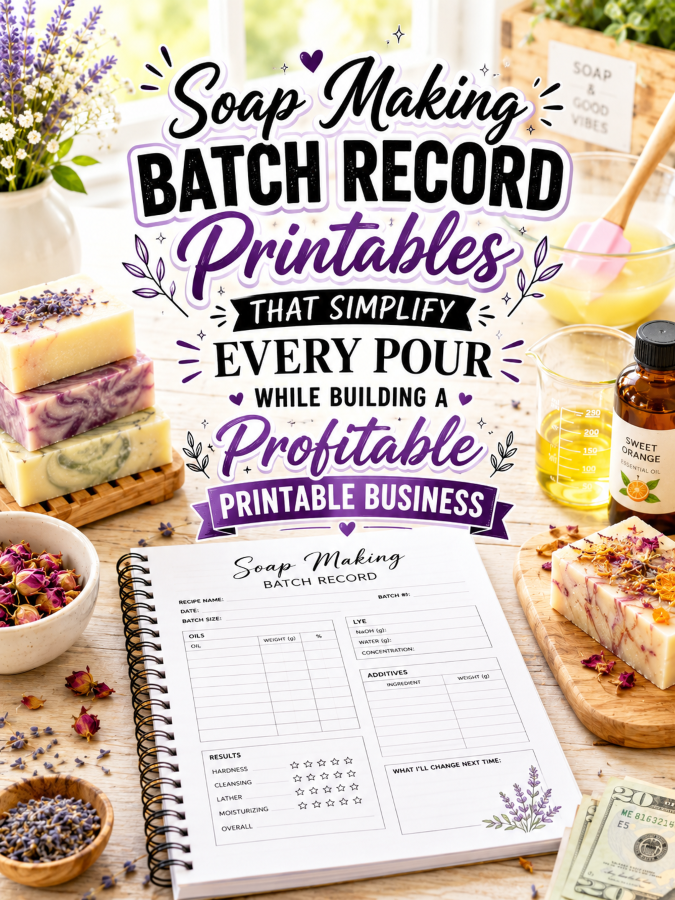
Introduction
Soap making is part science, part creativity, and part crossing your fingers while hoping today’s lavender swirl actually turns out looking like lavender instead of mashed potatoes.
Every batch begins with excitement.
You carefully measure your oils, prepare your fragrance, organize your molds, and confidently expect another beautiful handmade creation.
Then, somewhere between mixing and curing, reality shows up.
Which recipe did you use last month? How much essential oil created that amazing scent? Which colorant faded after curing? Did this batch gel completely? Which customers absolutely loved that goat milk soap?
The soap isn’t usually the difficult part.
Keeping accurate batch records is.
Whether someone creates soap as a relaxing hobby or operates a thriving handmade business, detailed records save time, improve consistency, reduce waste, and make successful recipes easy to reproduce.
That’s exactly why Soap Making Batch Record Printables continue selling year after year. They help makers produce consistently beautiful soaps while giving printable creators an evergreen niche with exceptional repeat-purchase potential.
One thoughtfully designed batch record system can quickly become the first printable every soap maker reaches for before mixing another batch.
Quick Answer
Soap Making Batch Record Printables are downloadable planning systems that include recipe worksheets, ingredient logs, oil calculators, fragrance trackers, curing schedules, testing notes, inventory sheets, cost calculators, and production records.
A starter planner can comfortably sell for around $7. Expand it into complete soap business systems, bath and body planners, candle-making organizers, cosmetic formulation journals, and premium maker libraries, and you’ve built a natural product ladder reaching $27, $47, and even $77.
Your customers aren’t simply buying printable pages. They’re buying consistency, organization, fewer failed batches, and greater confidence every time they make soap.
Why This Niche Works
Successful soap makers document everything.
One small change in oil ratios, temperatures, fragrance loads, or curing conditions can produce dramatically different results.
Without detailed notes, recreating a customer’s favorite soap becomes little more than educated guessing.
Once customers discover your planner, they’ll often return for recipe journals, inventory systems, production planners, business organizers, product testing logs, and countless related thingees.
Unlike seasonal craft trends, handmade soap remains popular year-round because people always need personal care products and handmade gifts.
Prior to pouncing upon this opportunity, you should first know all about the:
Tools You’ll Need
You don’t need a commercial soap factory or shelves overflowing with essential oils. These dependable tools are more than enough.
- Canva for designing batch record pages, recipe worksheets, labels, and printable layouts.
- Google Docs for organizing recipes, production notes, and instructional guides.
- AWeber for building your email list with soap making tips and printable updates.
- GetResponse for newsletters, launches, and customer follow-up.
- Gumroad for selling downloadable soap planners and printable bundles.
- Teachable if you’d eventually like to teach soap making, batch documentation, or handmade business management.
- Amazon Soap Making Journal Research for discovering the record pages makers value most.
Don’t spend three weeks deciding whether your ingredient tracker should have bubble graphics while your future customers are already trying to remember which recipe created their bestselling oatmeal soap.
Next, move to:
Your 5-Step Action Plan
Follow these five steps unless you’d rather spend 24 hours alphabetizing fragrance oils while somebody else’s printable quietly becomes the batch record system every soap maker recommends.
Step 1. Research Real Soap Making Challenges
Spend about 95 minutes exploring soap making Facebook groups, handmade business communities, YouTube soap channels, bath and body forums, and customer reviews.
Create a master list containing 30 to 40 planner pages. Include batch records, recipe worksheets, ingredient inventories, fragrance trackers, curing logs, production calendars, cost calculators, testing records, and sales trackers.
Your research becomes an X-ray machine that reveals exactly where makers struggle before, during, and after every batch.
Step 2. Build Your Core Planner
Create a collection containing 40 to 55 printable pages that guide makers from recipe development to finished products ready for customers.
Include production worksheets, batch logs, ingredient inventories, curing schedules, testing notes, inventory pages, and project reflections. Keep everything simple because simplicity is always a Good Thing.
Step 3. Create Specialty Editions
Build separate planners for cold process soap, hot process soap, melt-and-pour makers, goat milk soap creators, bath bomb businesses, beginners, market vendors, and handmade cosmetic businesses.
Specific planners always feel more valuable than one giant workbook attempting to organize every handmade product imaginable.
Your customers will appreciate having choices.
Step 4. Add High-Value Bonuses
This is where your planner begins standing out from the thundering herd.
Include printable oil property charts, fragrance blending worksheets, curing countdown calendars, label planning pages, ingredient substitution guides, safety checklists, and production scheduling worksheets.
Those bonus thingees require very little additional effort yet dramatically increase the perceived value of your planner.
Soap makers love complete systems that simplify every stage of production.
Step 5. Build Your Product Ladder
Launch your starter planner for $7. Expand into specialty maker collections around $27, then introduce premium bath and body business libraries approaching $77.
Before long, your business won’t simply be selling printable planners. You’ll be helping makers produce consistent, beautiful soaps while building organized and profitable handmade businesses.
Once you’ve figured out all of the above, the next step is implementing:
3 Ways to Stand Out From The Thundering Herd!
Let’s be honest. There are already plenty of soap-making journals and record books available.
The Good Thing is that many of them stop after providing a few blank recipe pages.
Your planner can become the production assistant every soap maker wishes they had from their very first batch to their thousandth.
Way 1. Track Every Detail That Matters
A successful batch depends on much more than ingredients.
Create pages that record oil percentages, lye concentration, water discounts, fragrance loads, colorants, additives, temperatures, trace consistency, mold type, curing conditions, final weight, and customer feedback.
Those record-keeping thingees help makers duplicate successful batches with confidence instead of relying on memory.
Consistency quickly becomes one of your planner’s greatest selling points.
Way 2. Help Makers Build a Recipe Library
Every great soap maker develops favorite recipes over time.
Include recipe index pages, ingredient reference sheets, fragrance blend logs, seasonal collection planners, bestseller trackers, and experiment journals.
Helping customers build their own soap-making encyclopedia dramatically increases the long-term value of your planner.
Way 3. Include Business Planning Pages
Many hobbyists eventually begin selling their creations.
Add pricing worksheets, inventory trackers, wholesale order forms, craft fair preparation pages, profit calculators, supplier lists, and customer order logs.
Supporting business growth transforms your printable into an investment rather than just another notebook.
Next, here’s the thing. You’re probably NOT the only person offering this service. So you now require:
3 Nifty Ways to Find Customers
Your ideal customers already gather wherever handmade products and creative businesses are discussed.
Way 1. Soap-Making Communities
Facebook groups, handmade soap forums, bath and body communities, and hobby groups are filled with makers asking recipe questions and sharing finished batches.
Offer free batch record sheets, fragrance trackers, or curing calendars before introducing your complete planner. Helpful creators become trusted creators remarkably quickly.
Way 2. Pinterest
Soap-making inspiration performs exceptionally well on Pinterest because makers constantly search for recipes, gift ideas, packaging inspiration, and production tips.
Create attractive pins featuring colorful soaps, organized batch journals, production binders, and printable planning pages that naturally encourage clicks.
Way 3. Handmade Business Educators
Many YouTubers, bloggers, and craft business coaches teach soap making and small business growth.
Affiliate partnerships and collaborations can introduce your planners to audiences already looking for better production systems.
Speaking of completed batches, now let’s move to:
3 Takeaways You Won’t Find Elsewhere!
These aren’t ordinary organization tips. They’re practical lessons that quietly transform one batch record printable into a thriving printable business.
Takeaway 1. You’re Selling Confidence
Customers aren’t purchasing blank worksheets.
They’re buying fewer failed batches, easier troubleshooting, consistent recipes, and the confidence to recreate customer favorites again and again.
Takeaway 2. Every Batch Creates New Knowledge
No two batches teach exactly the same lesson.
Every experiment, fragrance blend, and ingredient adjustment becomes valuable information worth preserving for future projects.
Your planner becomes more valuable every time it’s used.
Takeaway 3. One Planner Can Become an Entire Handmade Business Brand
Your Soap Making Batch Record Printables can naturally expand into candle-making planners, lotion formulation journals, cosmetic recipe binders, bath bomb production systems, skincare business planners, essential oil reference books, and craft fair preparation kits.
Those connected thingees make scaling dramatically easier because your customers already trust your organizational style.
Now that you know the above, it’s time for:
3 Common Mistakes to Avoid
Many creators leave out production details.
That’s Not a Good Thing. Small details like temperatures, cure times, humidity, fragrance percentages, and mixing notes often determine whether a batch succeeds or fails.
Some sellers focus only on hobbyists.
Include business pages for pricing, inventory, customer orders, and production planning. Supporting growth is always a Good Thing.
Others publish one planner and stop there.
The biggest opportunities often appear when customers begin requesting planners for candles, lotions, skincare products, bath bombs, beard care, lip balm, and complete handmade business systems.
What else should you know? How about:
Scaling Your Results
Expand into a complete bath and body maker ecosystem.
Create candle production journals, lotion formulation planners, essential oil blend records, skincare development binders, cosmetic testing logs, inventory systems, wholesale order planners, craft fair organizers, and handmade business management libraries that naturally complement your original batch record planner.
Create a Handmade Maker Membership.
Release fresh printable production pages every month featuring seasonal soap collections, holiday product planners, inventory worksheets, business trackers, and exclusive organizational resources that members eagerly add to their binders.
Build an email list makers genuinely appreciate.
Share recipe organization tips, free printable worksheets, seasonal product ideas, ingredient guides, production hacks, and handmade business inspiration throughout the year. A collection containing 38 bath and body planning products could realistically generate an additional $624 to $1,918 each month through memberships, bundles, repeat customers, and affiliate partnerships. Trust me, you’ll thank me later.
Let’s now wrap up everything via the:
Your Next Steps
Start by listing 40 common soap-making tasks, then organize them into categories like recipe development, production, curing, inventory, quality control, business management, customer orders, and seasonal collections.
Build your first planner in Canva using clean layouts, detailed batch records, practical trackers, and easy-to-use worksheets that makers will appreciate every time they mix a new recipe. If one soap maker successfully recreates their bestselling bar because of your planner, you’ve created something genuinely valuable.
Then share your planner with five soap-making Facebook groups, Pinterest boards, handmade business communities, craft bloggers, or YouTube educators. Remember, 5 good messages beats 50 generic ones every single time.
One thoughtfully designed batch record planner can quietly become the foundation of an entire handmade business printable collection.
Next, let’s finish with:
Final Thoughts
The best handmade soap isn’t created by accident. It’s the result of careful planning, thoughtful experimentation, accurate record keeping, and a willingness to keep improving with every batch.
Your Soap Making Batch Record Printables can become an important part of that creative journey. Every completed worksheet, every successful recipe, and every happy customer helps makers grow both their skills and their businesses.
Start with one planner that solves one meaningful soap-making challenge exceptionally well. Keep listening to makers. Keep improving your record-keeping systems. Keep building printable products that help handmade businesses become more organized, more profitable, and far less stressful.
You don’t need bazillions of products to build meaningful income. You simply need one thoughtfully designed batch record planner that makes someone smile and say, “Now I finally know exactly how I made my bestselling soap!”
That’s it. That’s your beginning!
If you were creating your first Soap Making Batch Record Printable tomorrow morning, would you design it for cold process makers, melt-and-pour hobbyists, handmade business owners, bath and body entrepreneurs, or beginners just learning the craft?
Enjoy!