Introduction
Space has an incredible way of capturing a child’s imagination.
One question about the Moon somehow becomes an afternoon of building cardboard rockets, debating whether aliens would enjoy pizza, and confidently announcing plans to become an astronaut, an engineer, and a dinosaur trainer all at the same time.
The curiosity isn’t the challenge.
Keeping that curiosity engaged is.
Parents, teachers, homeschool families, libraries, and science clubs are always searching for educational activities that feel like play instead of another worksheet disguised as fun.
Meanwhile, children are far more willing to solve puzzles when they’re helping astronauts, decoding alien messages, or navigating a mission to Mars.
That’s exactly why Space-Themed Activity Packs continue selling year after year. They combine science, creativity, problem-solving, and imagination while giving printable creators an evergreen educational niche with exceptional repeat customer potential.
One thoughtfully designed activity pack can quietly transform an ordinary afternoon into an unforgettable mission through the solar system.
Quick Answer
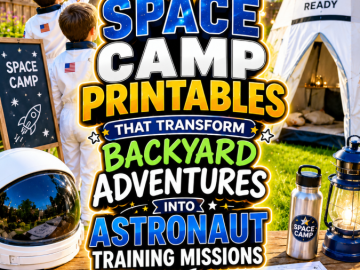
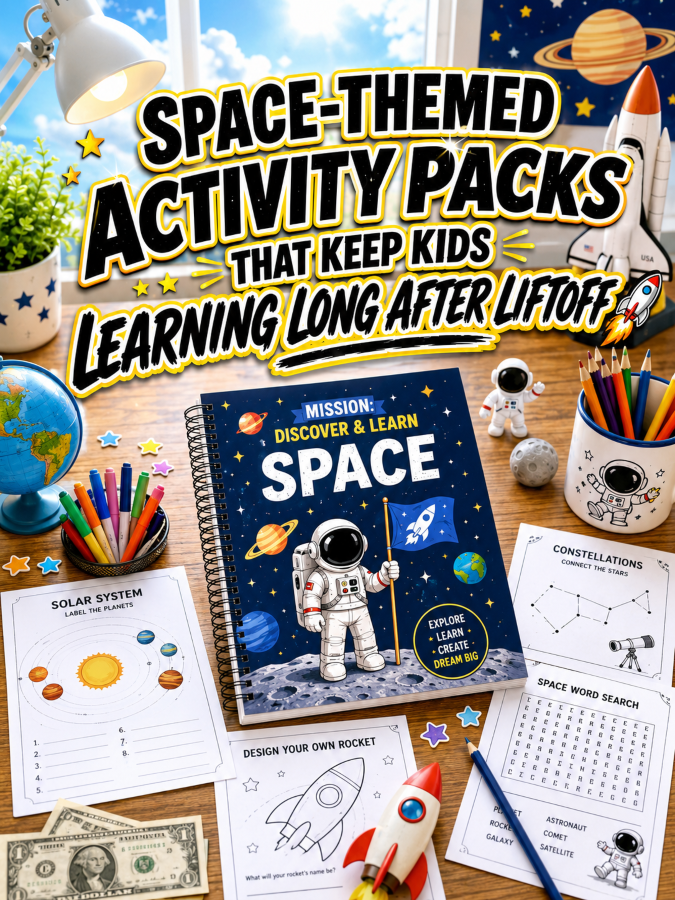
Space-Themed Activity Packs are downloadable printable collections featuring puzzles, games, coloring pages, STEM challenges, scavenger hunts, mazes, writing prompts, and educational activities inspired by astronomy and space exploration.
A starter pack can comfortably sell for around $7. Expand it into classroom editions, homeschool bundles, seasonal science kits, and premium STEM libraries, and you’ve built a natural product ladder reaching $27, $47, and even $77.
Parents and teachers aren’t simply buying activity sheets. They’re buying curiosity, learning, and hours of meaningful entertainment. That someone creating that solution could absolutely be you!
Why This Niche Works
Children rarely outgrow their fascination with space.
Rockets, astronauts, planets, stars, black holes, and distant galaxies continue inspiring new generations every single year.
Many families want educational resources that don’t feel like school assignments. That’s a bit like trying to convince children that broccoli is secretly birthday cake.
Once customers discover activity packs that genuinely entertain while teaching, they’ll often return for astronomy journals, STEM challenges, science printables, and countless related thingees.
Unlike cartoon characters that drift in and out of popularity, the planets appear remarkably committed to remaining in orbit.
Prior to pouncing upon this opportunity, you should first know all about the:
Tools You’ll Need
You don’t need a rocket launch facility or your own observatory. These dependable tools are more than enough.
- Canva for creating activity sheets, puzzles, and printable games.
- Google Docs for organizing lessons and activity instructions.
- AWeber for building your email list with educational ideas and printable updates.
- GetResponse for launches, newsletters, and customer follow-up.
- Gumroad for selling downloadable activity packs.
- Teachable if you’d eventually like to teach STEM activities or printable creation.
- Amazon Space Activity Research for discovering the activities children enjoy most.
Don’t spend four weeks deciding whether Saturn’s rings should be slightly thicker while your future customers are already searching for engaging science activities.
Next, move to:
Your 5-Step Action Plan
Follow these five steps unless you’d rather spend 22 hours rearranging planets while somebody else’s printable quietly launches into orbit with your potential customers.
Step 1. Research What Excites Young Explorers
Spend about 91 minutes exploring teacher communities, homeschool groups, parenting forums, STEM blogs, and customer reviews.
Create a master list containing 28 to 35 activity ideas. Include mazes, space bingo, astronaut missions, coding puzzles, planet matching games, coloring pages, word searches, and creative writing prompts.
Your research becomes an X-ray machine that reveals the activities children genuinely enjoy instead of those adults merely hope they’ll enjoy.
Step 2. Build Your Core Activity Pack
Create a collection containing 36 to 48 printable pages that balance learning with imagination.
Include puzzles, games, experiments, drawing challenges, quizzes, and reward certificates. Keep everything simple because simplicity is always a Good Thing.
Step 3. Create Specialty Editions
Build separate packs for preschoolers, elementary students, homeschool families, classrooms, libraries, birthday parties, and science camps.
Specific activity packs always feel more valuable than one giant workbook attempting to educate every child from preschool to university.
Your customers will appreciate having choices.
Step 4. Add High-Value Bonuses
This is where your activity pack starts standing out from the thundering herd.
Include achievement certificates, mission passports, observation journals, experiment logs, reward charts, and family challenge pages.
Those bonus thingees require very little additional effort yet dramatically increase the value of your bundle.
Parents and teachers love practical extras that extend learning well beyond the first activity.
Step 5. Build Your Product Ladder
Launch your starter activity pack for $7. Expand into STEM bundles around $27, then introduce premium educational libraries approaching $77.
Before long, your business won’t simply be selling printable activities. You’ll be helping inspire tomorrow’s scientists, engineers, astronauts, and curious lifelong learners.
Once you’ve figured out all of the above, the next step is implementing:
3 Ways to Stand Out From The Thundering Herd!
Let’s be honest. Many children’s activity books are simply the same puzzles wearing different costumes.
The Good Thing is that space naturally sparks curiosity, adventure, and imagination. Your activity pack can become an experience instead of just another stack of worksheets.
Way 1. Turn Everything Into a Mission
Children love having a purpose.
Instead of asking them to complete a maze, invite them to navigate a spaceship through an asteroid field. Instead of a word search, let them locate hidden supplies before the crew runs out of oxygen.
Those little storytelling thingees dramatically increase engagement while making learning feel like an exciting adventure.
Kids rarely complain about homework when they believe they’re saving a space station.
Way 2. Mix Learning With Creativity
Don’t fill your pack with puzzles alone.
Include drawing prompts, build-your-own-alien activities, rocket design pages, constellation art, comic strip templates, writing challenges, and simple STEM experiments.
The more ways children can interact with your printable, the longer it stays on the kitchen table instead of disappearing into the recycling bin.
Way 3. Design for Families, Not Just Children
Parents appreciate activities they can enjoy alongside their children.
Include family trivia games, scavenger hunts, cooperative challenges, and discussion cards that encourage conversations about space exploration.
Parents become enthusiastic buyers when your printable creates quality family time.
Next, here’s the thing. You’re probably NOT the only person offering this service. So you now require:
3 Nifty Ways to Find Customers
You don’t need a NASA-sized advertising budget because your ideal customers gather in remarkably predictable places.
Way 1. Homeschool Communities
Homeschool parents constantly search for engaging educational resources.
Share free science activities, printable samples, and simple learning ideas before introducing your complete activity packs. Helpful creators become trusted creators surprisingly quickly.
Way 2. Teachers and Libraries
Teachers love activities that reinforce science standards without requiring hours of preparation.
Create classroom licenses and library editions that make purchasing an easy decision.
Way 3. Parenting Blogs and Family Creators
Family bloggers, YouTubers, and parenting influencers are always searching for educational content to recommend.
Offer review copies and affiliate partnerships that place your products directly in front of thousands of interested parents.
Speaking of completed projects, now let’s move to:
3 Takeaways You Won’t Find Elsewhere!
These aren’t feel-good reminders. They’re practical lessons that quietly transform one activity pack into an entire educational printable business.
Takeaway 1. You’re Selling Curiosity
Parents aren’t simply purchasing mazes, coloring pages, and puzzles.
They’re investing in opportunities for children to ask questions, solve problems, and develop a genuine interest in science.
Takeaway 2. Kids Love Series
If children enjoy one mission, they’ll eagerly look for the next one.
That creates natural opportunities for monthly releases, seasonal editions, holiday themes, and companion products.
Takeaway 3. One Pack Can Launch an Entire STEM Brand
Your Space-Themed Activity Pack can naturally expand into astronomy journals, science experiment kits, planet study guides, classroom bundles, and educational games.
Those connected thingees make scaling dramatically easier because families already know and trust your teaching style.
Now that you know the above, it’s time for:
3 Common Mistakes to Avoid
Many creators overload children with text.
That’s Not a Good Thing. Young learners respond much better to visual, interactive, hands-on activities than pages filled with lengthy explanations.
Some sellers forget different age groups.
A six-year-old and a twelve-year-old learn very differently. Age-specific versions are always a Good Thing.
Others create one pack and stop there.
The biggest opportunities often appear when customers begin requesting additional science themes, seasonal editions, and advanced challenges.
What else should you know? How about:
Scaling Your Results
Expand into complete STEM learning collections.
Create Earth science packs, dinosaur adventures, ocean exploration activities, weather challenges, engineering projects, coding games, and science fair planners that naturally complement your space collection.
Create subscription bundles.
Offer one brand-new printable activity pack every month featuring exciting educational themes families can look forward to.
Build an email list parents genuinely appreciate.
Share free mini activities, science facts, seasonal learning ideas, and exclusive printable updates throughout the year. A collection containing 32 educational activity packs could realistically generate an additional $524 to $1,624 each month through memberships, bundles, repeat customers, and affiliate partnerships. Trust me, you’ll thank me later.
Let’s now wrap up everything via the:
Your Next Steps
Start by listing 35 educational activities children already love. Then imagine how each one could become more exciting with astronauts, rockets, planets, galaxies, or space missions.
Build your first printable pack in Canva using colorful layouts, simple instructions, and activities that encourage both learning and creativity. If children ask to play it again tomorrow, you’ve created something valuable.
Then share your activity pack with five homeschool communities, teachers, librarians, parenting bloggers, or educational Facebook groups. Remember, 5 good messages beats 50 generic ones every single time.
One thoughtfully designed activity pack can quietly become the beginning of an entire educational printable business.
Next, let’s finish with:
Final Thoughts
The best educational printables don’t simply keep children busy. They inspire questions, spark imagination, and encourage lifelong curiosity about the world-and the universe-around them.
Your Space-Themed Activity Packs can become part of those unforgettable learning moments. They help families spend meaningful time together while making science feel approachable, exciting, and fun.
Start with one activity pack that solves one meaningful challenge exceptionally well. Keep listening to parents and teachers. Keep improving your products. Keep building resources that make children excited to learn something new every day.
You don’t need bazillions of products to build meaningful income. You simply need one thoughtfully designed activity pack that turns an ordinary afternoon into an unforgettable mission through the stars.
That’s it. That’s your beginning!
If you were creating your first Space-Themed Activity Pack tomorrow morning, would you design it for preschoolers, elementary students, homeschool families, classrooms, or future little astronauts dreaming of Mars?
Enjoy!