
Introduction
Every parent knows the moment.
The tablets are out of battery, the television has somehow lost its magic, the weather refuses to cooperate, and someone in the house asks, “What can I do now?” approximately every 11 minutes until the walls begin considering early retirement.
The children aren’t the problem. Running out of ideas is.
Parents, grandparents, homeschool families, babysitters, and caregivers constantly search for activities that keep children engaged without relying entirely on screens.
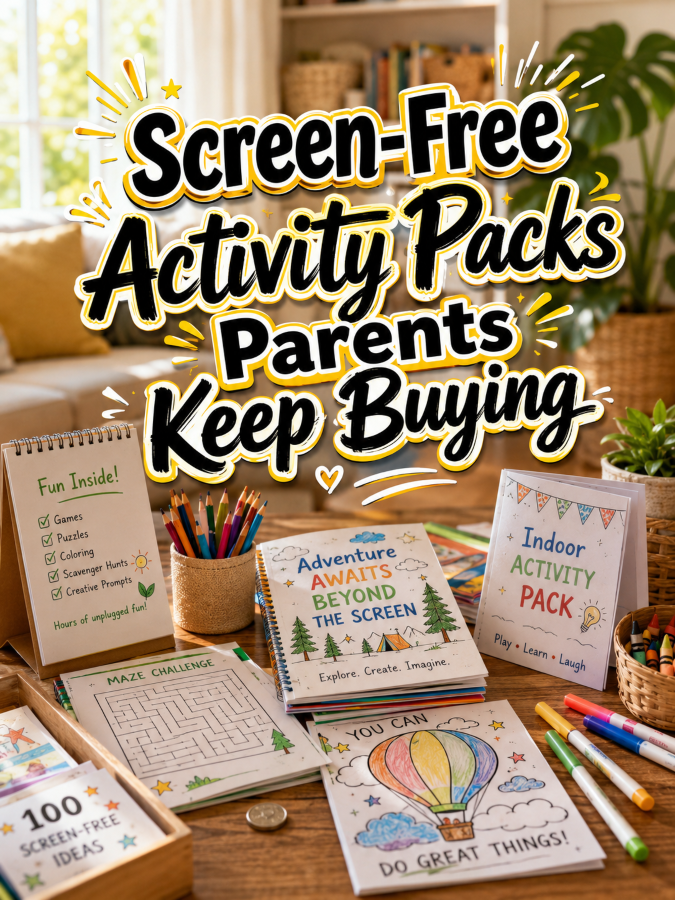
That’s exactly why Screen-Free Activity Packs continue selling year after year. They help families encourage creativity, problem-solving, and independent play while giving printable creators an evergreen digital product business filled with repeat customers.
One thoughtfully designed activity pack can rescue a rainy afternoon faster than a superhero arriving with snacks and fresh markers.
Quick Answer
Screen-Free Activity Packs are downloadable printable collections filled with puzzles, scavenger hunts, creative challenges, games, journals, drawing prompts, problem-solving activities, and hands-on projects designed to keep children entertained without screens.
A starter activity pack can comfortably sell for around $7. Expand it into seasonal collections, travel editions, age-specific bundles, and premium family activity libraries, and you’ve created a natural product ladder reaching $27, $47, and even $77.
Parents don’t simply want quieter afternoons. They want activities their children genuinely enjoy. That someone creating that solution could absolutely be you!
Why This Niche Works
Parents are actively searching for healthy alternatives to endless screen time. Whether it’s summer vacation, school holidays, road trips, rainy weekends, restaurant visits, or quiet afternoons at home, families regularly need fresh ideas.
Many activity books contain a handful of coloring pages and call it a complete solution. That’s a bit like opening a buffet that only serves crackers and expecting applause.
Once parents discover an activity pack that genuinely keeps children engaged, they’ll happily return for travel kits, holiday editions, educational challenges, family game nights, and countless related thingees.
Unlike trendy toys that disappear after one season, boredom keeps showing up with remarkable punctuality.
Prior to pouncing upon this opportunity, you should first know all about the:
Tools You’ll Need
You don’t need a classroom full of supplies to build this printable business. These dependable tools are more than enough to get started.
- Canva for designing activity pages, challenge cards, and printable games.
- Google Docs for organizing instructions, activity guides, and planning notes.
- AWeber for building your email list with family activity ideas and printable updates.
- GetResponse for automated launches, newsletters, and customer follow-up.
- Gumroad for selling downloadable activity bundles.
- Teachable if you’d eventually like to teach printable creation or family activity planning.
- Amazon Activity Book Research for studying layouts, reviews, and popular activity formats.
Don’t spend weeks collecting shiny software thingees. Spend that time creating activities families can use this weekend.
Next, move to:
Your 5-Step Action Plan
Follow these five steps unless you’d rather spend 22 hours inventing games on the spot while someone asks, “Are we there yet?” despite not being inside a vehicle.
Step 1. Discover What Parents Need Most
Spend about 92 minutes researching parenting groups, homeschool communities, family blogs, and customer reviews. Pay attention to the situations parents mention repeatedly.
Create a master list containing 28 to 35 printable pages. Include scavenger hunts, drawing prompts, boredom busters, observation games, indoor challenges, outdoor adventures, creative writing activities, puzzle pages, and family competitions.
Your research becomes an X-ray machine that reveals frustrations many families quietly accept as unavoidable.
Step 2. Design Your Core Activity Pack
Create a printable collection containing 36 to 48 pages that naturally guide children through a variety of activities without requiring constant adult supervision.
Include simple instructions, age recommendations, supply lists, challenge levels, and activity timers. Keep everything easy to understand because simplicity is always a Good Thing.
Step 3. Build Specialty Editions
Create separate packs for road trips, rainy days, camping weekends, restaurant visits, summer vacation, holidays, siblings, preschool children, and tweens.
Specific activity packs always feel more valuable than one giant collection trying to entertain everyone from toddlers to teenagers.
Your customers will appreciate having choices.
Step 4. Add High-Value Bonuses
This is where your activity pack begins standing out from the thundering herd.
Include reward certificates, progress trackers, family challenge cards, memory pages, printable badges, achievement charts, and bonus weekend activities.
Those bonus thingees don’t require much additional work, yet they dramatically increase the value of your bundle.
Parents love practical extras that make life easier.
Step 5. Build Your Product Ladder
Launch your starter activity pack for $7. Expand into seasonal bundles around $27, then introduce premium family activity libraries approaching $77.
Before long, your business won’t simply be selling printable games. You’ll be helping families create memories while reducing the phrase “I’m bored” by at least a statistically satisfying amount.
Once you’ve figured out all of the above, the next step is implementing:
3 Ways to Stand Out From The Thundering Herd!
Let’s be honest. There are plenty of children’s activity printables online already. That’s about as surprising as finding crayons without their original box.
The Good Thing is that many activity packs contain random pages that feel about as connected as socks in a laundry basket after a thunderstorm. Your pack can feel intentional, organized, and genuinely helpful.
Way 1. Build Around Real-Life Moments
Parents don’t wake up hoping to buy “activities.” They wake up needing solutions for rainy afternoons, restaurant waits, road trips, sick days, power outages, summer breaks, and long weekends.
Create activity packs designed for those exact situations. A “Rainy Saturday Rescue Pack” feels much more valuable than “Activity Collection Number Seven.”
Way 2. Include Activities Children Can Actually Do Alone
Many parents love helping with activities, but they also occasionally need 27 uninterrupted minutes to cook dinner, answer emails, or simply remember where they left their coffee.
Create activities with clear instructions, visual examples, and independent play options. Parents remember products that buy them a little breathing room.
Way 3. Mix Learning With Fun
Children rarely complain when learning sneaks in through the side door wearing a silly hat.
Include observation games, problem-solving challenges, creativity prompts, storytelling exercises, and memory activities that feel more like play than homework. Those extra thingees quietly increase the value of your pack.
Next, here’s the thing. You’re probably NOT the only person offering this service. So you now require:
3 Nifty Ways to Find Customers
You don’t need paid advertising because parents practically shine the Bat Signal every school holiday, every rainy weekend, and every time someone says, “There’s nothing to do,” while standing in a house containing 312 toys.
Way 1. Pinterest
Pinterest remains one of the largest search engines for family activities, educational games, and printable resources.
Create colorful pins showing activity pages, challenge cards, scavenger hunts, and completed projects. Helpful visuals continue attracting families for months after publishing.
Way 2. Parenting and Homeschool Facebook Groups
Parents regularly exchange activity ideas, recommendations, and boredom-busting solutions.
Become helpful before becoming promotional. Practical advice creates trust much faster than sales messages ever will.
Way 3. Parenting Blogs and Family Creators
Many bloggers and creators are constantly searching for fresh resources to share with their audiences.
Offer your activity pack for reviews, collaborations, guest articles, or affiliate partnerships that place your products in front of highly interested buyers.
Speaking of completed projects, now let’s move to:
3 Takeaways You Won’t Find Elsewhere!
These aren’t feel-good reminders. They’re practical lessons that quietly separate thriving printable businesses from forgotten folders named “New Project Final V3.”
Takeaway 1. You’re Selling Relief
Parents aren’t buying puzzles and coloring pages.
They’re buying quieter afternoons, fewer boredom complaints, more independent play, and the satisfaction of seeing their children genuinely engaged.
Takeaway 2. Boredom Is Surprisingly Reliable
Technology changes. Toys change. Cartoons change.
Children announcing they’re bored has remained impressively consistent for generations. That creates remarkably stable demand for thoughtful activity packs.
Takeaway 3. One Pack Can Become an Entire Product Family
Your screen-free activity pack can naturally expand into travel kits, restaurant packs, homeschool activities, holiday games, family challenge collections, camp activities, and educational adventures.
Those connected thingees make scaling much easier because you’re serving the same audience with related solutions.
Now that you know the above, it’s time for:
3 Common Mistakes to Avoid
Many creators include too many complicated activities.
That’s Not a Good Thing. Parents appreciate simple ideas that require minimal setup and supplies already hiding somewhere in the house.
Some sellers ignore age ranges completely.
An activity designed for a five-year-old often feels very different from one designed for a ten-year-old. Clear age recommendations are always a Good Thing.
Others create one activity pack and stop there.
The biggest opportunity usually comes from building collections that families return to throughout the year.
What else should you know? How about:
Scaling Your Results
Expand into seasonal collections.
Create activity packs for summer vacation, Christmas breaks, spring holidays, birthdays, camping weekends, road trips, and rainy seasons. One successful pack can inspire dozens of related products.
Create premium family bundles.
Bundle scavenger hunts, challenge cards, creative journals, memory books, family games, and educational activities into complete entertainment libraries that parents will happily purchase together.
Build an email list parents genuinely appreciate.
Share seasonal activity ideas, printable updates, educational resources, and family challenges throughout the year. A collection containing 33 family activity products could realistically generate an additional $514 to $1,448 each month through repeat customers, memberships, bundles, and seasonal promotions. Trust me, you’ll thank me later.
Let’s now wrap up everything via the:
Your Next Steps
Start by listing 35 activities that children would genuinely enjoy without needing constant supervision or expensive supplies. Don’t try to create the world’s largest activity book because that’s usually a Not a Good Thing.
Design your first pack in Canva using colorful layouts, clear instructions, and practical activities families can use immediately. If parents can print it tonight and use it tomorrow morning, you’ve created something valuable.
Then introduce your activity pack to five parenting groups, homeschool communities, Pinterest boards, or family bloggers. Remember, 5 good messages beats 50 generic ones every single time.
One thoughtful activity pack can quietly become the beginning of an entire family printable business.
Next, let’s finish with:
Final Thoughts
The best childhood memories rarely involve staring at a screen. They involve treasure hunts, silly games, creative projects, unexpected laughter, and afternoons that somehow passed much faster than anyone expected.
Your Screen-Free Activity Pack helps create those moments. It gives families simple ways to connect, play, learn, and enjoy time together without needing complicated preparation or expensive materials. That’s exactly why parents continue coming back for more.
Start with one activity pack that solves one real problem for one real family situation. Keep listening to your customers, continue improving your products, and keep building solutions that make family life easier and more enjoyable. You don’t need bazillions of products to build a thriving digital business. You simply need one thoughtful resource that helps parents hear “This was fun!” a little more often.
That’s it. That’s your beginning!
If you were creating your very first Screen-Free Activity Pack today, would you build it for rainy days, travel, camping weekends, restaurant visits, or something completely different?
Enjoy!