

Aviation experts, including NASA officials, show how advanced automation is being woven into real‑world aircraft, airspace, and airline operations.
SAN DIEGO – At AIAA AVIATION Forum, aviation leaders zeroed in on a practical question: how to introduce advanced analytics, automation, and autonomy into live operations, including airlines, new entrants, and future airspace, without breaking the complex system that already moves hundreds of thousands of people every day.
Rather than debating abstract definitions, panelists from United Airlines, Reliable Robotics, Collins Aerospace, NASA, and the standards community focused on where AI and autonomy are already changing decision-making in the field and what it will take to certify, integrate, and trust these tools at scale. Their discussion was entitled, AI, Autonomy, and Assurance: Operational Implications.
United Airlines: Scaling AI Without Losing the Human
For United Airlines, AI is already embedded in daily operations, noted Roberta Zimmerman, United’s director of Air Traffic Strategy, Data Analytics, and Strategic Vision. The Chicago-based airline will hit 5,359 daily departures and expects to see over 700,000 daily seats available in its network. Recently, United flew its highest number of passengers per day in company history: 630,500. I
Zimmerman explained that United is using AI where it can reduce friction for customers and crew without taking over safety‑critical decisions. Prompted by CEO Scott Kirby, Zimmerman’s team built tools that explain delays in plain language and help passengers make better connections.
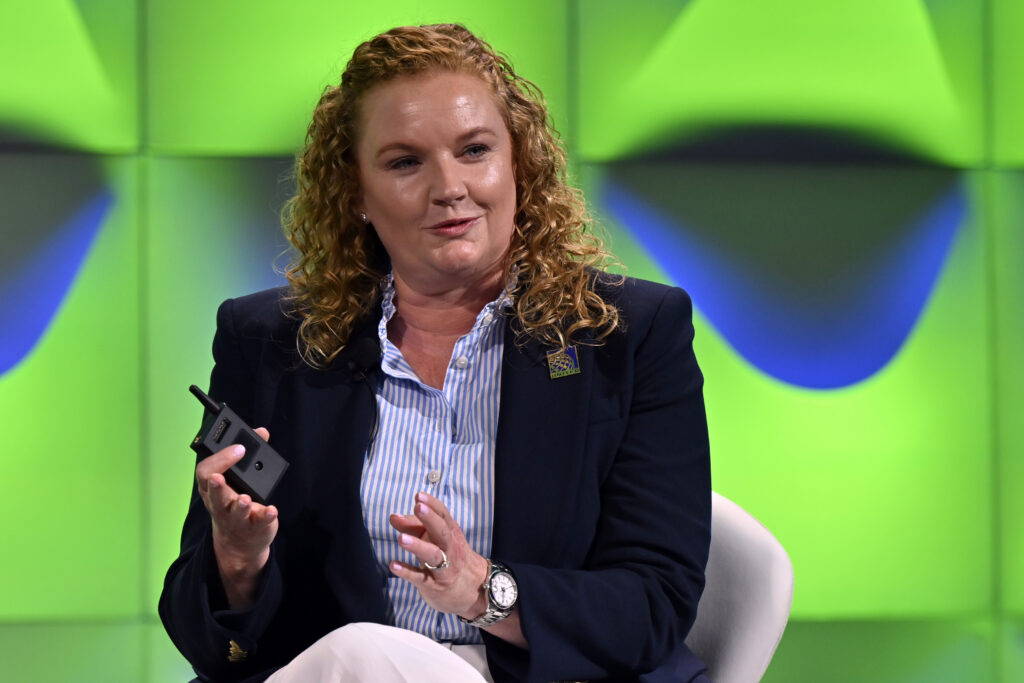
“We are using AI to communicate with our customers on a flight‑by‑flight basis,” she said. “If you have a connection and your first leg is delayed, we give you alternatives. You can rebook, you can… [see the] predicted time it takes you to walk from one gate to the next gate at your connecting airport.”
United is also applying AI to crew scheduling, a complex optimization problem shaped by increasingly intricate labor contracts. The pilot and flight attendant agreements contain a tremendous amount of detail, so “we’re using AI to help translate those contractual rules into scheduling logic that can support more effective crew planning,” Zimmerman said.
In the airline’s intense operational environment, even small disruptions cascade quickly. “The air traffic role is to mitigate those impacts without disrupting the network for the day. And then, what does recovery look like?” she said, emphasizing that humans will remain in the loop. Her team is looking at the best technology that can make employees’ life better and their work more efficient.
For Zimmerman, the real barrier is systems integration, not the maturity of AI algorithms. She pointed to a seemingly trivial change, one airport identifier switching Palm Beach International airport’s code from PBI to DJT, as a massive internal lift.
“We have such a vast display of capabilities in the NAS (national airspace), and we’re not going to change the infrastructure overnight,” she said. “We are a system of systems, and something very small, the integration of that is a huge impact to make sure that there’s no loss of continuity.”
Reliable Robotics Keeps AI Out of the Flight-Critical Stack
Where United is layering AI on top of existing networks, Reliable Robotics is embedding automation directly into the aircraft. The company’s autopilot platform, Reliable Autonomy System, can guide an aircraft through all phases of flight – “from gate to gate” – without a pilot on board.
Brandon Suarez, the company’s vice president of UAS Integration, described a program to automate the Cessna Caravan, an 8,000‑pound single‑engine turboprop widely used for cargo and passengers. In a 2023 demonstration at Hollister, Calif., the aircraft was controlled by a remote pilot sitting 50 miles away in the company’s Mountain View headquarters facility.
Reliable Robotics is testing a preproduction autonomous flight system that handles taxi, takeoff, and landing operations. Using a sensor suite of GPS, INS, and radar-altimeters, the system targets approximately 2,000 U.S. airports with LPV (Localizer Performance with Vertical Guidance) capability.
But Suarez is deliberately keeping AI out of the flight‑critical stack, at least for now. “AI as a… tool… that needs to go through a certification process [is] basically a non‑starter for a startup company, because there are no rules and procedures and standards to follow,” he explained. “So we’re working to do everything that we’re doing on the aircraft automation side with classic software coding languages and classic algorithms.”
Certification, he added, is ultimately about explainability. “What is certification? Just trying to convince a disinterested smart person that what I did was correct, and I can’t do that if I can’t even explain what’s happening in the software tool that I’m using.”
Reliable also operates Reliable Airlines, a Part 135 carrier based in Albuquerque that flies daily cargo routes for a major integrator. That airline will be the first operator of the automated system and a key design partner.
Bringing the pilots and the maintainers and the operator and the dispatchers into the design process “has been hugely fruitful for us,” he noted.
Suarez believes long-term autonomy must prove it can improve operations, not just safety metrics. “We all want to increase safety, but meanwhile, there’s billions of dollars of an ecosystem going, so we have to show the rest of the industry… that there’s actual operational benefit that can be derived by incorporating and integrating these technologies.”
Collins Aerospace: Increasing Automation and the Simulation Imperative
Travis Klopfenstein, Innovation program manager at Collins Aerospace, brought the avionics supplier view, covering cockpits, data services, and cabin systems from nose to tail.
He highlighted Collins’ experimental flight deck, where seasoned pilots trial technologies such as ATC speech‑to‑text conversion, a domain where probabilistic “best guesses” are unacceptable.
Collins is also experimenting with lower‑criticality applications like “Galley AI,” which uses optical sensing and data to track inventory, open latches, and passenger needs in the cabin. The company groups such efforts on a spectrum of complexity vs. criticality, intentionally clustering early AI deployments in low‑criticality zones while it works through certification questions.
“As a program manager, I’m never going to get to the funding stage if the entire leadership and approval chain doesn’t understand everything,” he said. “We started to use phrases less about autonomy and maybe increasing automation… We’re comfortable with increasing automation… really trying to optimize the human decision‑making.”
He noted that high‑fidelity modeling and simulation – potentially leveraging commercial game engines – is becoming essential both for operations and for eventual certification.
“I keep encouraging our company and others to really invest in building out these hyper‑fidelity models for demonstration and simulation… with an eye toward certifying those components,” Klopfenstein said.
The larger threat, he suggested, is cultural. “One of the biggest threats is this kind of closed‑mindedness… ‘This is kind of how we’ve always done things, and this is how it has to go.’… Now it’s a limiting factor.”
NASA and Standards: Designing for Density, Defining “Good Enough”
From the research side, Chester Dolph, engineer at NASA Langley Research Center, described a future where urban air mobility, multi‑rotor UAS, supersonic demonstrators, traditional jets, and space vehicles all share increasingly crowded skies.
In NASA’s air traffic management (ATM) and safety work, he said, three pillars dominate:
- Strategic ATM – extending today’s traffic management to support high‑density, diverse traffic with more complex trajectories.
- Safe, routine operations – integrating onboard and ground‑based sensors and autonomy, especially when Global Navigation Satellite System (GNSS) or data links fail.
- Safety and assurance – defining failure scenarios and requirements so AI and machine‑learning approaches can be validated.
Any AI‑driven system, he argued, must be generalizable, reproducible, and explainable. “Can you explain when it works and why it works, and when it fails, and why it fails?” Dolph asked.
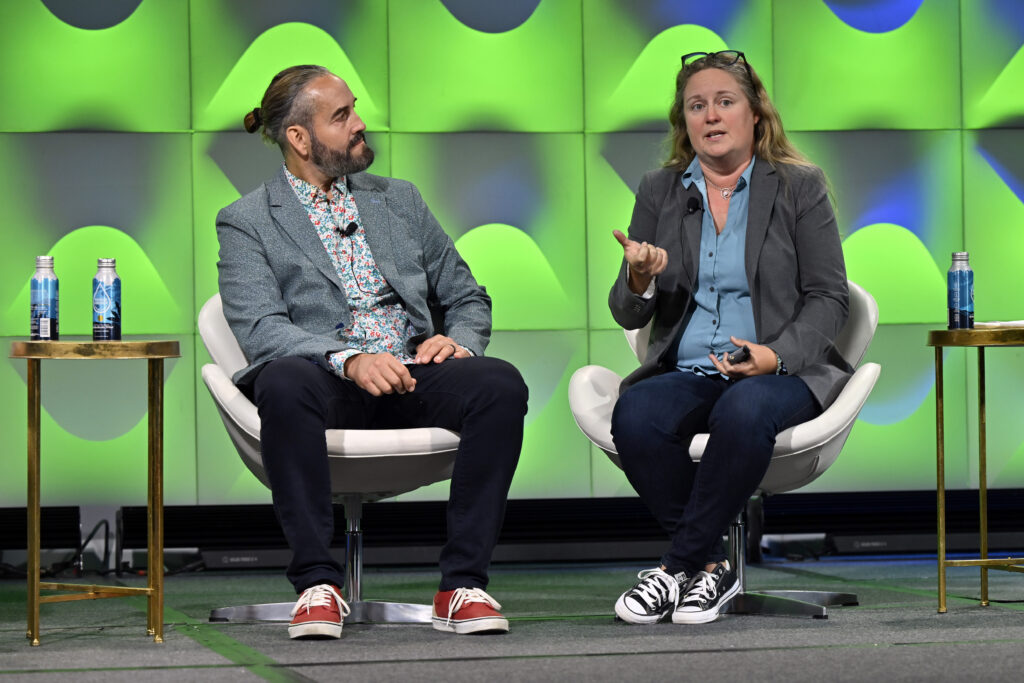
Standards expert Anna Dietrich, a consultant and former COO of Terrafugia, said one of the hardest open questions is deciding how good is good enough when machines take on functions normally handled by humans.
“We don’t have quantitative… consensus around… reliability that we want out of our humans that are in these systems,” she said. “We give people a lot of grace to screw up. We’re not giving the systems that same grace… setting the bar is proving to be the hardest part.”
Dietrich sees promise in techniques that bound adaptive systems, such as geofencing and “fail‑functional” architectures where a mature, simple core can safely bring an aircraft home if higher‑level autonomy fails. She also floated a provocative idea: applying pilot‑training‑style, experience‑based certification to autonomous flight managers, mirroring how the system already accepts non‑deterministic human visual flight rules (VFR) pilots in the NAS.
From Concept to Operations
By the close of the session, the panel had sketched a pragmatic picture where airlines are using AI to smooth operational friction and manage scale; startups are automating aircraft with deterministic tools regulators can certify; suppliers are threading intelligence into low‑criticality functions and simulation; and NASA and standards leaders are working to define safety frameworks that let more advanced autonomy emerge.
Across these efforts, AI and autonomy are being judged less by novelty and more by how well they fit into and improve the operations that keep aviation moving today.