

Your seat at the Additive Manufacturing Advantage awaits! Register free for AMA: Energy and AMA: Automotive & Mobility.
UK-based robotic AM systems developer Rapid Fusion has introduced an artificial intelligence (AI) assistant named Base of Build (Bob) to improve how its machines are operated and maintained.
Having been under development for the past eight months, the developer is now rolling out the platform for clients already using Rapid Fusion’s systems. Bob has been designed to enhance usability by giving operators more control while at the same time reducing downtime through preventative maintenance. It is compatible with the company’s Apollo and Zeus as well as Medusa, which is recognised as the first large-format hybrid gantry 3D printer built in the UK.
Rapid Fusion plans to introduce the assistant in two stages. A super user version will be released first to selected partners and universities, giving them the chance to contribute to further refinements. A wider rollout is scheduled for early 2026, when all owners of the company’s systems will gain access to a standard version.
“There is a lot of talk about how AI can transform the business world and numerous companies are jumping on the bandwagon,” explained Martin Jewell, Chief Technology Officer at Rapid Fusion. “It’s something we’ve been aware of from day one and all of our robotic additive manufacturing systems have been built so that we can use artificial intelligence to unleash the full potential of our technology.”
 Bob platform UI. Image via Rapid Fusion.
Introducing Rapid Fusion Bob
At the core of Bob is a pre-loaded knowledge base that draws on extensive additive manufacturing data. This can be accessed through cloud connections or used offline in air-gapped environments, making the platform suitable for industries where security and intellectual property protection are priorities. To support production tasks, the system incorporates more than 1,000 printing parameters which have been applied across over 100 components.
These parameters allow the assistant to carry out detailed monitoring and adjustments during printing. For instance, extrusion readiness is tracked across four heating zones, where temperatures are assessed in real time against stability windows and safety thresholds to deliver go or no-go decisions.
Beyond basic checks, the platform is also material-aware, adjusting configurations for applications involving composites and high-temperature polymers. In such cases, it evaluates factors like mould shrinkage, thermal expansion, and mechanical properties to determine the most suitable setup.
Development has also focused on how users interact with the platform. Bob is capable of recognising straightforward commands through pattern matching but can also interpret more complex requests by accessing its database and applying contextual understanding.
This allows the system to automate linked actions, such as choosing materials, adjusting heating profiles, and scheduling post-processing steps, all triggered by a single instruction. Complementing these functions is an integrated library that contains maintenance guidance, troubleshooting support, and established print workflows. With regular updates delivered over the air, Bob is expected to evolve continuously and extend its support for operators over time.
AI software expands industrial 3D printing capabilities
Rapid Fusion is the latest to introduce AI-powered software for enhancing 3D printing processes.
Two years ago, Materialise introduced its Process Control software for metal 3D printing together with a Build Processor Software Development Kit (BP SDK), both designed to give manufacturers greater control over production. The software uses AI to analyze layer data and powder bed images, enabling early detection of flaws, faster root cause analysis, and reduced reliance on costly post-processing.
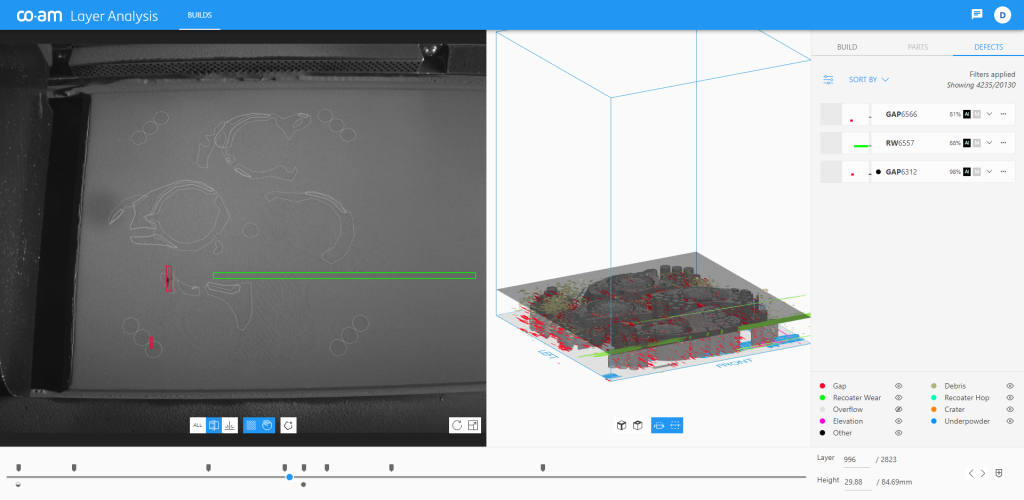 Materialise Process Control. Image via Materialise.
Through collaborations with Phase3D and Sigma Additive Solutions, the software also incorporates height mapping and melt pool data for a more complete picture of the build. Alongside this, the BP SDK allows users to customize build parameters that affect speed, density, and surface quality, creating tailored processors that balance cost and consistency while integrating with CO-AM and Magics.
Elsewhere, London-based 3D printing software developer Ai Build released Aibuild 2.0, the new version of its cloud-based AI software for industrial 3D printing, bringing together automation, an integrated AI assistant, and ISO 27001-certified data security. The platform combines slicing, optimization, live monitoring, and automated quality control through its Sensor Fusion technology, which evaluates real-time process data to boost consistency and minimize waste.
A new “Talk to AI” feature, powered by large language models, allows users to create toolpaths through simple text commands, streamlining preparation and simulation. Compatible with a range of additive manufacturing technologies, Aibuild 2.0 also incorporates digital twin support for WASP’s CAREBRO robotic-arm tool, enhancing pellet and ceramic extrusion capabilities.
Help choose the 2025 3D Printing Industry Awards winners – sign up for the Expert Committee now!
To stay up to date with the latest 3D printing news, don’t forget to subscribe to the 3D Printing Industry newsletter or follow us on LinkedIn.
While you’re here, why not subscribe to our Youtube channel? Featuring discussion, debriefs, video shorts, and webinar replays.
Featured image shows Bob platform UI. Image via Rapid Fusion.